Here's How: Add Openness With a High, Sloping Ceiling
Dear James: I like the openness of a high ceiling. Is it possible to remove some roof trusses to convert part of the ceiling to a high, sloped one or would it be too weak? -- Gail V.
Dear Gail: Changing a room's ceiling to a high, sloped one would totally change the appearance and ambiance of the room. It would require more than just removing some of the roof trusses from the attic and finishing the ceiling on an angle with drywall. You are correct in questioning the strength of the roof with the trusses removed. Without other structural changes, it would not be very strong and would not meet building codes.
This is definitely not a job for the typical do-it-yourselfer, but here are a few options that your remodeler will have. Consider using vented, structural foam core panels to build an entirely new sloped roof and ceiling. Installing a skylight or two at the same time is simple with these panels.
This is the most efficient and strongest construction method, but you will have to replace the roof shingles too. These panels have a strong plywood skin on each side of thick, rigid foam insulation with built-in ventilation channels. This will give you a sloped ceiling at the same pitch as the roof.
If your contractor is not familiar with these roofing panels, try contacting these manufacturers for detailed information: Johns Manville, www.jm.com; and Rmax, www.rmax.com.
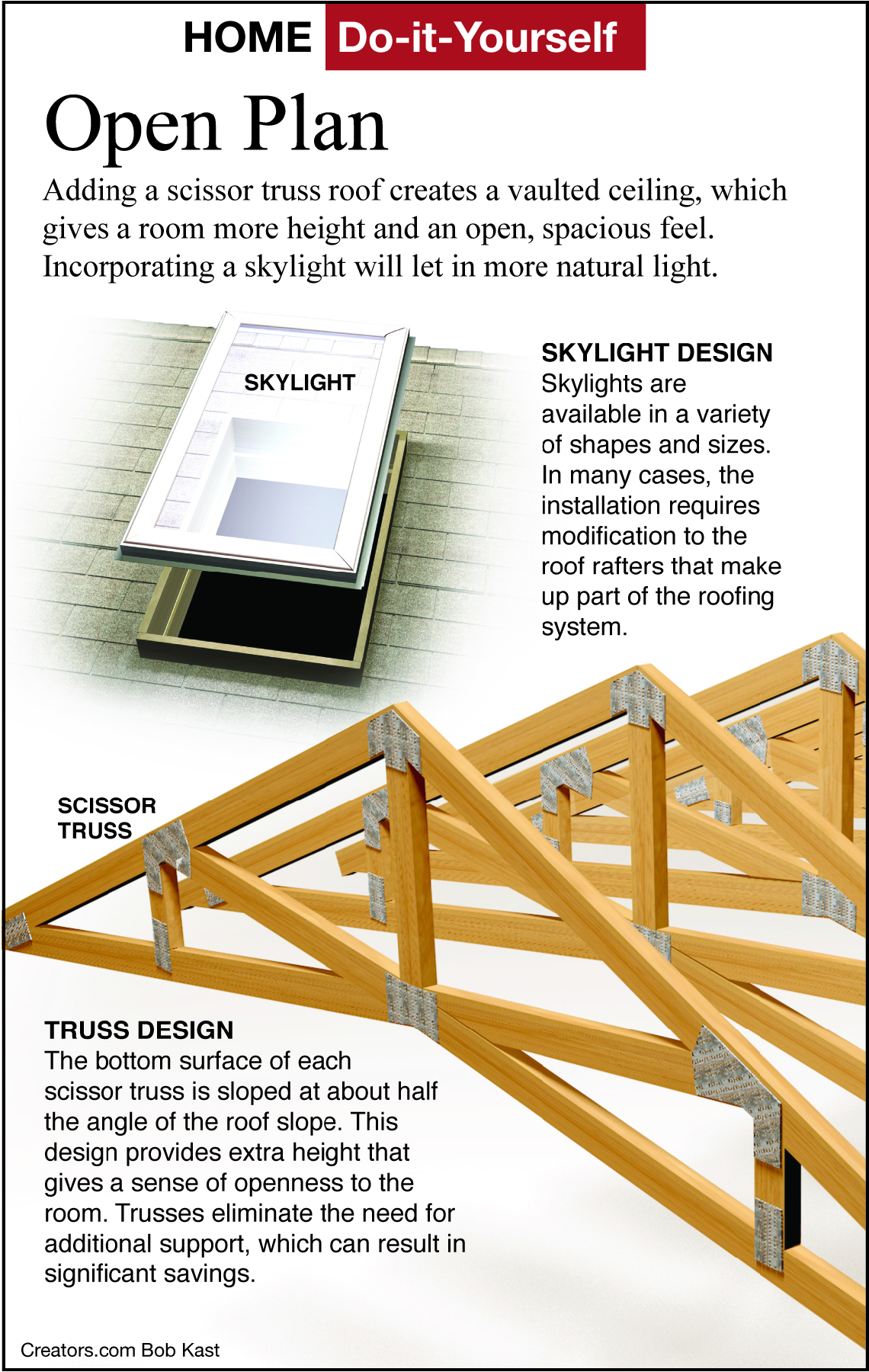
Another option is a scissor truss. These trusses are manufactured to the slope of your existing roof. The truss members below it are designed such that the bottom surface of the truss is sloped at about half the angle of the roof. This provides room for insulation and ventilation in the roof.
Scissors trusses work best in areas where high roof pitches are common. In many southern climates with a low-pitched roof to start with, the resultant slope of the living room ceiling would not be very great. Talk with truss designers to see what they might be able to design for you.
Installing a skylight is trickier when using scissor trusses. You must build a lightwell to connect the roof to the ceiling below. A flared lightwell, with a larger opening in the ceiling, will provide better light distribution and look better than a simple straight-sided lightwell.
A third option is stripping off the entire roof and existing truss system and building it again from scratch. This will allow you to support the roof properly and include adequate insulation for your climate. There are many different truss designs, beams, glulams (glued laminated beams), etc., that you can use to create any look you wish.
When selecting your skylight, consider a venting model you can open and close. With a sloped ceiling, hot air rises during the summer and will naturally vent out the skylight. Since the skylight is high, a remote, motorized model is most convenient.
If you use scissor trusses and a lightwell, either a flat or domed skylight will be effective. For skylights without a lightwell, a flat skylight looks better and provides a better view of the sky.
========
Send your questions to Here's How, 6906 Royalgreen Dr., Cincinnati, Ohio, 45244 or visit www.dulley.com. To find out more about James Dulley and read features by other Creators Syndicate writers and cartoonists, visit the Creators Syndicate website at www.creators.com.
Copyright 2025 Creators Syndicate Inc.
























Comments