NOAA's denial of endangered status for salmon sparks talk of legal challenge
Published in Science & Technology News
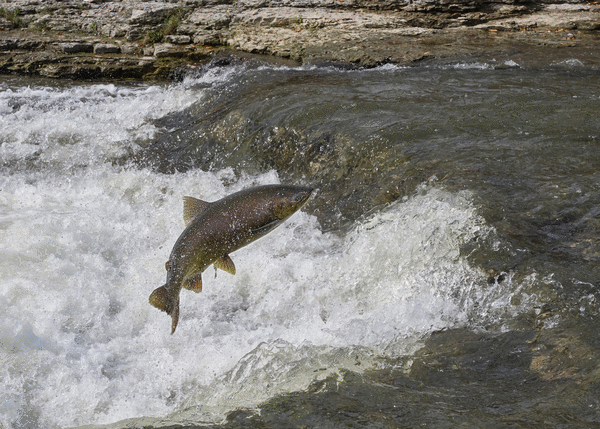
Federal fisheries officials on Monday rejected a bid to designate West Coast Chinook salmon as threatened or endangered under the Endangered Species Act.
In response, one of the conservation groups that petitioned for the listing, the Center for Biological Diversity, says it is considering a legal challenge.
“The major species protections could have benefited not just the salmon, but other wildlife that feeds on them,” Jeff Miller, a senior conservation advocate at the Center for Biological Diversity said, adding orcas, river otters, bald eagles, and bears as some of the examples.
“Unfortunately, the decision by the Fisheries Service really only benefits the logging industry and dam operators.”
In 2022, the Center for Biological Diversity and other partner groups filed their petition to the National Marine Fisheries Service and the National Oceanic and Atmospheric Administration to list southern Oregon and Northern California Chinook, along with Oregon Coast salmon, as threatened or endangered.
The groups cited concerns about the chronically low abundance of the few remaining spring-run populations, listing extensive habitat loss from logging and dams, warming stream temperatures, and inadequate regulatory protections to prevent further decline as some of their primary reasons for seeking federal protection.
But the federal regulators rejected the request, stating that the Chinook population is still large and widely distributed, and that the spring-run fish aren’t distinct enough to qualify for protection as a separate group.
“We’re looking at the Fisheries Service determination and seeing if we can challenge it,” Miller said, arguing that NOAA’s decision is inconsistent as the agency already lists spring-run Chinook as distinct endangered populations in places like California’s Central Valley and the upper Columbia River, and that recent science shows the Oregon and Northern California spring-run fish are similarly unique.
The listing of the fish would have meant stronger oversight of logging near rivers, new requirements for dams to allow salmon to pass and to release colder water, and an influx of restoration work that usually follows an endangered species designation, Miller said.
Ashley Overhouse, a water policy adviser at Defenders of Wildlife, expressed her disappointment by the decision, noting Endangered Species Act protections are critical for species at risk, including aquatic animals already in decline in California.
“Unfortunately, we’re seeing decisions made by this administration that are not based on the best available science,” she added. “It’s disappointing to see the opportunity to protect imperiled species like Chinook salmon be denied.”
____
©2025 The Sacramento Bee. Visit at sacbee.com. Distributed by Tribune Content Agency, LLC.






Comments