Tijuana wastewater pipe repairs completed in 3 days, ending river discharge
Published in Science & Technology News
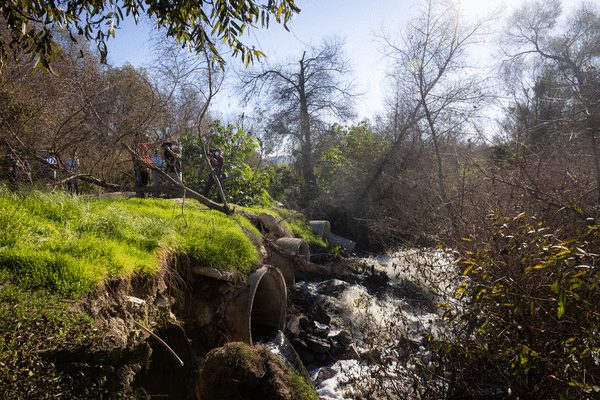
SAN DIEGO — Repairs to a collapsed wastewater pipe in Tijuana have been completed, with flows to the Tijuana River now stopped, the U.S. International Boundary and Water Commission announced Monday.
The Insurgentes Collector, part of the larger Tijuana Wastewater system, collapsed the night of Jan. 15, diverting about 11.5 million gallons per day of extra flow into the Tijuana River, according to the IBWC.
IBWC Commissioner Chad McIntosh was informed by Comisión Internacional de Límites y Aguas, or CILA, Commissioner Adriana Reséndez on Monday afternoon that repairs had been fully completed and flows to the Tijuana River had stopped, the IBWC said. CILA is monitoring the system to ensure proper operation.
The repairs took three days to complete, faster than the originally estimated 10 days, the IBWC said.
San Diego County Supervisor Paloma Aguirre said in an email that when infrastructure failures occur, those most affected are South Bay residents living near the river.
“Once a malfunction happens, thousands of gallons of raw sewage, and industrial waste, flow across the border, polluting the water and air in the South Bay,” Aguirre said. “Infrastructure failures like this underscore the need for the U.S. to continue pursuing solutions on our side of the border. Until we make a serious commitment to capture river flows on our side of the border, and treat the waste before it makes its way to the ocean, we are at the mercy of infrastructure problems that are out of our control.”
The South Bay International Wastewater Treatment Plant was not affected by the incident, the IBWC said.
McIntosh spoke with Reséndez on Friday morning, during which Reséndez “reaffirmed her commitment to take every possible action, as quickly as possible, to repair the collector,” according to the IBWC.
The IBWC met Friday afternoon with CILA and CESPT, the State Commission of Public Services of Tijuana. CESPT confirmed crews were onsite working around the clock to complete repairs, the IBWC said.
By Saturday, CESPT had reconstructed the well and manhole, with additional repairs continuing, according to the IBWC.
On Sunday, CILA advised that repair and reconstruction of the collapsed well and manhole had been successfully completed, with testing and inspection in progress to ensure the collector was operating properly, the IBWC said.
Data from the IBWC and San Diego County Air Pollution Control District (APCD) showed no significant increase in transboundary flow or hydrogen sulfide levels — a source of odorous air pollution.
The APCD showed hydrogen sulfide levels remained well below the recommended safety threshold of 29.9 parts per billion throughout the weekend, peaking at only 19.7 ppB in Nestor.
Transboundary flow reached 59.31 million gallons per day on Saturday at 7 p.m., matching the weekly high recorded Thursday night when the collapse occurred. The South Bay Wastewater Treatment Plant showed influent levels peaking at 23.26 MGD on Saturday — well below the permitted capacity of 35 MGD.
_____
©2026 The San Diego Union-Tribune. Visit sandiegouniontribune.com. Distributed by Tribune Content Agency, LLC.






Comments