The Sierra snowpack is dropping fast. Here's why experts say it's not as bad as it seems
Published in Science & Technology News
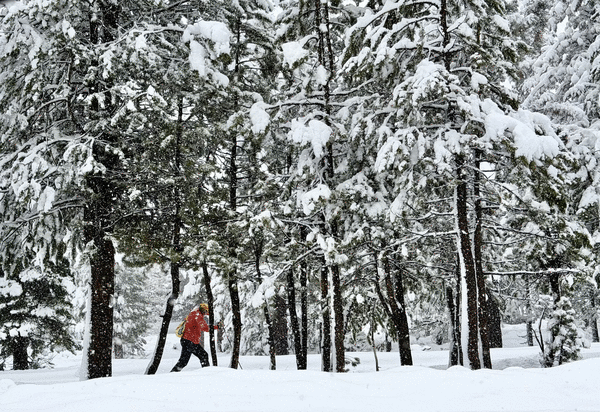
The Sierra Nevada snowpack, the source of nearly one-third of California’s water supply, is looking a little like a New Year’s resolution: full of hope and promise at the beginning of January, but now struggling with a bothersome reality check.
Starting on Christmas Eve, big storms dumped 7 to 8 feet of new snow across the Lake Tahoe area over a two-week period, ending a dry December and drenching the rest of the state with rain.
By Jan. 6, with umbrellas and snow shovels getting a workout, the statewide Sierra Nevada snowpack was a respectable 93% of its historical average. But in the three weeks since, the switch has flipped. Sunny and warm weather has been the norm throughout most of California. On Thursday, the Sierra snowpack had fallen to just 59% of its historical average.
“It’s been 23 days without a good storm,” said Jan Null, a meteorologist with Golden Gate Weather Services in Half Moon Bay. “And I don’t see anything of any significance in the forecast for the next week.”
That means the Sierra snowpack number will continue to fall in the coming days.
But it’s not as bad as it seems, experts said Thursday.
The past three winters in California have been at or above average precipitation for the first time in 25 years. Wet conditions ended the 2020-2022 drought and filled most of the state’s large reservoirs.
And even though their levels dropped last summer as cities and farms used the water, California’s reservoirs started this winter season fuller than normal. The big storms, which Tahoe-area ski operators have dubbed “the Christmas miracle” because they saved ski season, also sent reservoir levels rising fast. Very fast.
Between mid-December and early January, the state’s largest reservoir, Shasta — a massive 35-mile-long lake near Redding — rose by 36 feet. The second-largest, Oroville in Butte County, rose 69 feet over the same three weeks.
They have even more water in them now, and are still rising. On Thursday, Shasta was 80% full, or 125% of normal. Oroville was 82% full, or 138% of normal. San Luis, the nation’s largest off-stream reservoir, between Gilroy and Los Banos, was 77%, or 105% of normal. Diamond Valley, the largest reservoir in Southern California, was 95% full.
“It would be nice to have more snowpack,” Null said. “But it would be a different conversation if the reservoirs were below average.”
And, winter is only half over. California gets most of its precipitation in December, January, February and March.
“There’s a lot of winter left. It’s only the fourth inning,” said John Rice, president of Ski California, an industry association.
Rice noted that ski resorts, which typically open around Thanksgiving, were struggling until the Christmas storms. Now, he said, despite three weeks of dry weather, the storms built a big base, and ski resorts add to it daily with their snow machines, which freshen up the top layer.
“Mother Nature came late this year,” Rice said. “Then nearly 100 inches of snow fell in a few days. That snow is still around. It’s cold at night. That keeps it good and firm. And then snowmaking adds to it.”
Further, because of the three previous wet winters, the solid Christmas storms and the high reservoir levels, no part of California is in a drought, according to the U.S. Drought Monitor, a weekly report that comes out every Thursday from the federal government.
Most of the rest of the West, including eastern Nevada, Utah, Colorado, Wyoming and New Mexico, is in varying degrees of drought.
A persistent ridge of high pressure off the West Coast has blocked storms from coming in off the Pacific Ocean to California, pushing the jet stream north, Null said, like water going around a big boulder in a river.
The jet stream has looped up into the Pacific Northwest and Canada, picking up cold temperatures and dumping big amounts of snow on the East Coast in recent weeks.
“South Carolina is getting our snow,” Null said.
On Friday, followed by a gaggle of journalists with TV cameras and microphones, crews from the state Department of Water Resources are scheduled to conduct a monthly media snow survey at Phillips Station, a scenic meadow near the Sierra-at-Tahoe ski resort, located about 90 miles east of Sacramento off U.S. Highway 50 in El Dorado County.
The state operates a network of electronic sensors throughout the Sierra Nevada, however, which provide daily automated measurements at more than 100 locations across the iconic 400-mile mountain range.
Null noted that Northern California usually has dry spells every winter. Since 1950, the average of the longest one is 21 days, measured at San Francisco, he noted. San Francisco received .03 inches of rain on Tuesday, ending 20 days in a row without precipitation, he said.
To be sure, if very little rain or snow falls for the rest of the winter until April, that has negative consequences, even though the reservoirs are full. Less snow means higher chances of wildfires in the mountains earlier in the summer. It also means less water overall, because the snow acts like a giant frozen reservoir, and slowly melts in the spring and summer, topping up reservoirs as they are drawn down.
There is some hope for more snow in mid-February.
Bryan Allegretto, a forecaster with OpenSnow, a company that tracks weather patterns for ski resorts, said in a blog post Wednesday that long-range weather models are suggesting the high-pressure ridge off California could shift northwest toward Alaska after Feb. 8.
“It could open the door to wetter storms developing along the West Coast and dropping in,” he wrote. “Until then, likely another 10 days of dry weather, and then hopefully improvement in our pattern by mid-month.”
Rice, who has spent decades in the ski industry, takes it all in stride.
“Mother Nature can change on a dime,” he said. “One day you are out there in short sleeves, and the next day you are shoveling snow. The good news right now is that the roads are all clear. You don’t have to put chains on.”
©2026 MediaNews Group, Inc. Visit at mercurynews.com. Distributed by Tribune Content Agency, LLC.






Comments