What's Minnesota's largest raptor? Hint: it might not be the bald eagle
Published in Science & Technology News
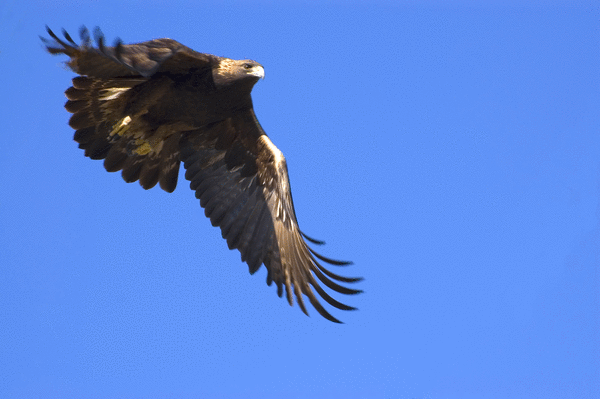
MINNEAPOLIS — Look at the armpits — or, technically, the “wingpits.”
That’s what Scott Mehus, education director at the National Eagle Center in Wabasha, Minn., told a group of bird watchers recently as they prepared to scan the winter skies for a majestic raptor that’s especially tricky to identify: the golden eagle.
It’s easy to confuse the giant birds with juvenile bald eagles, which don’t get their distinctive white head and tail until they’re at least four years old.
But looking up at the two birds as they soar, white feathers appear in different places on their wings, he said: “If the white is in the wingpits, we’re looking at a juvenile bald eagle. If the white is out at the wrists, the outer part of the wing, then we’re looking at a golden eagle.”
To remember, Mehus likes to think that the national bird and symbol of the United States “should probably wear deodorant.” While the golden eagle, which unlike the bald eagle is also found in Europe and across the Northern Hemisphere, takes a more continental approach and dabs cologne on its wrists.
Wrists and wingpits aside, which raptor is the biggest found in Minnesota? A young reader asked Curious Minnesota, the Strib’s audience-powered reporting project, this question during an event at the State Fair. The answer is a little tricky.
The largest raptor, or bird of prey, most commonly found in Minnesota is the bald eagle, according to experts at the University of Minnesota’s Raptor Center. (The last statewide bald eagle nest survey, in 2005, found that there were more than 1,300 pairs nesting in the state, and the population has been on the rise since.)
But though their numbers are much lower, golden eagles, too, are residents of the state – in the wintertime at least. And generally, the two species are about the same size.
Both have average wingspans that range from 6 to 7.5 feet, according to the National Eagle Center, and the average weight for bald and golden females is between 10 and 14 pounds. Males weigh about 25% less.
There’s one other factor though: Birds of the same species that hatch further north typically grow to be larger than those that hatch closer to the equator, Mehus said.
And while Minnesota’s bald eagles build their nests here, hatching eaglets each spring, the goldens wintering in the state actually nest about 2,000 miles to the north in Canada’s Northwest Territories.
That gives the golden eagles found in Minnesota a likely edge in size compared to the bald eagles found here, according to Mehus.
For many years, people thought that golden eagles weren’t found in Minnesota at all.
That’s partly because they can be so easily misidentified as juvenile bald eagles, Mehus said. But, he added, it’s also because goldens’ very nature makes them difficult to spot.
While bald eagles eat fish and seek out a perch with a clear view to see them in the water, goldens try to blend in and quickly strike their prey of squirrels, rabbits and even deer. They can reach speeds of more than 150 miles per hour as they dive.
Golden eagles’ midwestern winter hub is in the bluffs of western Wisconsin and southeast Minnesota near the National Eagle Center, as well as similar landscapes in northeast Iowa.
The center partnered with Audubon Minnesota and other agencies to put small transmitters on some of the golden eagles that winter in this area, learning about their migration routes and breeding areas in the northernmost reaches of Canada.
They’re also keeping track of how many spend winters here. Each January and February, the center runs guided golden eagle field trips (this season’s final one is on Feb. 19). And for 22 years, Mehus has been leading citizen scientist volunteers on an annual winter count of golden eagles.
On Jan. 17, groups of volunteers in five states went out to see how many golden eagles they could spot. Many of their routes included areas where the south slopes of otherwise forested bluffs give way to the small, open prairies where the birds often find their prey.
Conditions were cold and even snowy at times, but all told they tallied 111 golden eagles.
Researchers are wary about the ways climate change could impact golden eagles’ habitats and prey, especially way up north, but their numbers have been stable here, Mehus said.
“From my observations, for 30 years now, the population seems pretty consistent,” Mehus said. “You will often hear people say, ‘I’m hearing there’s more golden eagles in Minnesota and Wisconsin.’”
But that’s likely just the result of groups like his own getting the word out about this majestic bird.
During one of the center’s recent eagle field trips, Mehus pointed a scope into the bluff and urged everyone to come look before the elusive bird perched in its sights took flight.
The eagle turned, letting the sun briefly flash on the gold feathers at the back of its head, before lifting off.
------------
©2026 The Minnesota Star Tribune. Visit at startribune.com. Distributed by Tribune Content Agency, LLC.






Comments