China's new 5-year plan is crucial for world's climate fight
Published in Science & Technology News
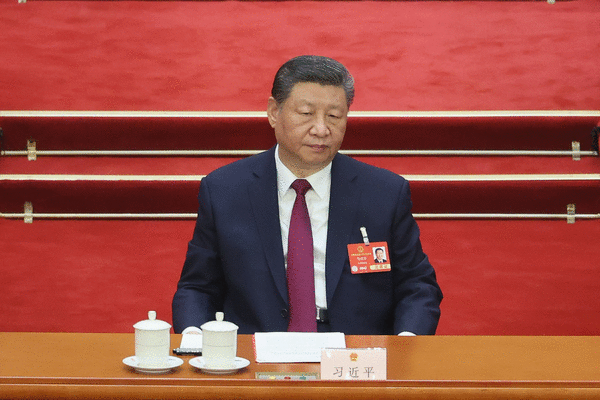
China’s next five-year plan set to be published this week will help dictate how fast the top polluter can cut greenhouse gas emissions and the extent of new support for clean technology sectors, policy settings that are critical to determining the world’s success in tackling climate change.
Policymakers gathering in Beijing from March 5 for the National People’s Congress, China’s flagship annual political meeting, will review progress on green goals and most importantly endorse economic and policy strategy through 2030 — President Xi Jinping’s deadline for the nation to peak its carbon pollution.
Though the relentless adoption of renewable energy and electric vehicles has begun to limit growth in China’s climate footprint — with one analysis concluding carbon dioxide emissions fell 0.3% in 2025 — there are concerns the nation’s new strategy will focus more on stimulating growth in green manufacturing than on accelerating efforts to minimize greenhouse gases.
As pressure mounts on the Chinese government to boost growth, create jobs and compete with the U.S., "focusing on green industries and technologies helps Xi to advance all three of these goals," said Neil Thomas, a fellow on Chinese politics at the Asia Society’s Center for China Analysis. However, "the trade-off is a plateauing in China's ambition when it comes to emissions reductions."
Data published Saturday indicated China has missed a flagship climate target set in its previous five-year plan, to lower carbon emissions intensity per unit of GDP by 18% through 2025. A 5% reduction last year would take the cumulative decline to about 13% based on past statements.
New 2035 climate goals outlined in September pledged a 7% to 10% cut in emissions, and are regarded by many observers as far too timid. Still, those targets for the first time addressed pollutants beyond carbon dioxide and are based on total volumes rather than intensity metrics.
The degree of ambition laid out in China’s new policy plans, and the speed at which the nation can begin to meaningfully reduce emissions, is critical to international climate efforts. China accounted for about 29% of greenhouse gas emissions in 2024, compared to the 11% contributed by the U.S. — the second-ranked polluter.
Here are some of the key climate policy issues in focus at China’s political gathering:
Counting emissions
Officials have signaled the 15th five-year plan will see China shift toward setting climate targets based on total volumes of emissions, alongside carbon intensity — a measure that’s faced criticism as it can obscure the true extent of progress in cutting pollution.
While experts don’t necessarily expect a clear pollution cap, the new policies could include language calling for emissions to decline from a peak during the 2026-2030 period, or potentially set out how much they should fall, said Hu Min, co-founder of the Beijing-based Institute for Global Decarbonization Progress.
Any new carbon intensity target would likely need to be higher than the 18% goal in the previous plan, according to the Centre for Research on Energy and Clean Air, or CREA. That’s to enable China to make up for lost ground and meet commitments made under the Paris Agreement.
This year’s policies could also set out specific directives to address a wider suite of pollution — including methane and nitrous oxide — after China’s latest Nationally Determined Contribution lodged with the United Nations pledged to tackle all greenhouse gas emissions.
Green growth
Clean energy sectors like solar, EVs and batteries contributed about 11% of China’s gross domestic product last year, and without that contribution the nation would’ve missed its 5% growth target, CREA said in a note last month.
China is likely to offer further backing to manufacturers and also support growth in other decarbonization technologies like energy storage, green hydrogen and nuclear fusion. Officials will probably show more tolerance for excess capacity in green technology sectors — unlike in mature industries like steel or cement — because China is focused on capturing future global demand, the Tony Blair Institute for Global Change said in a February report.
Officials in October called for the construction of 100 zero-carbon industrial parks to showcase emissions-reduction initiatives that are seen as having the potential to dramatically cut the climate impact of manufacturing and other sectors. Measures are also being introduced to stimulate green consumption, including the purchase of smart home appliances, EVs and organic food.
For Hu, “the key theme is still about green growth” and having “the green economy as the engine” for economic expansion. “It’s very important to have certain language, to keep emphasizing it, so people believe that it’s long term — we are not changing,” she said.
Fossil fuels peak
In 2021, Xi called for China to begin reducing its coal consumption in the 15th five-year plan period. However, he has recently used slightly more conservative language — instead calling for a peak in the next five years, without referencing any reduction. That same language has appeared in proposals for the 15th five-year plan.
An October policy paper included a call for both coal and oil usage to peak, and was “the first time such language has appeared in a top-level planning document,” BloombergNEF said in a report last year. A November article in state-owned Xinhua argued consumption of the two fuels could peak in 2027 and 2026 respectively.
Chinese officials have continued to favor the nation’s rich domestic deposits in its power system, putting forward a record number of proposals for new coal-fired power stations last year. And while emissions from transportation and power declined, they rose 12% in the chemical industry as China continued building a huge fleet of new coal-consuming plants to pump out plastics.
_____
(With assistance from Coco Liu.)
_____
©2026 Bloomberg L.P. Visit bloomberg.com. Distributed by Tribune Content Agency, LLC.






Comments