Could salad get you high? Wastewater irrigation raises contamination questions
Published in Science & Technology News
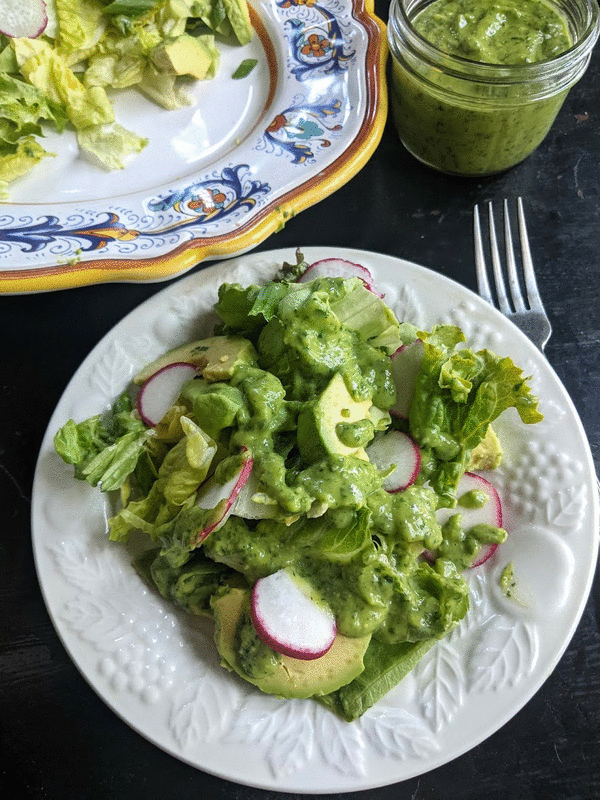
Drugs found in treated wastewater can be stored in the leaves of vegetables irrigated with that water, Johns Hopkins researchers found. But are drug-infused greens sitting on your grocer’s shelf, and how powerful is the dose?
“Farming practices place a high demand on freshwater resources. With limited rainfall and droughts threatening global water supplies, we’re looking at a future with shortages that may only be met by repurposing treated wastewater,” Daniella Sanchez, a doctoral student at Johns Hopkins University and study lead author, told ScienceDaily.com. “To continue to use wastewater safely, we need a more sophisticated understanding of where and how crop species metabolize, or break down, agents in the water.”
In their lab, Sanchez’s team grew lettuce, tomatoes and carrots in water infused with tiny amounts of psychoactive chemicals as often found in treated wastewater. They found that the leaves stored much more of the drugs than the edible fruits and roots. The findings are intended to help understand how crops process contaminants as farmers turn to new sources of water for irrigation, including processed wastewater.
They examined four psychoactive drugs frequently detected in treated wastewater: carbamazepine, lamotrigine, amitriptyline, and fluoxetine. These medicines frequently treat common psychiatric conditions such as depression, bipolar disorder, and seizures. They watered the plants with a solution of ultrapure water, salts, nutrients and one of the drugs for up to 45 days. Tomato leaves contained over 200 times the pharmaceuticals as the fruits, and the leafy tops of carrots contained seven times as much as the root.
“Plants don’t have a well-developed mechanism to excrete these drug compounds. They can’t easily get rid of waste by peeing, like humans do,” Sanchez said.
They published their work on March 12 in the journal Environmental Science & Technology. The U.S. Environmental Protection Agency supported their study through a National Priorities grant.
How are the drugs getting into wastewater?
Baltimore’s leaky sewer system delivers tens of thousands of human doses of pharmaceuticals to the Chesapeake Bay each year, according to research funded by the U.S. National Science Foundation in 2021. Drugs like methamphetamines harm algae growth and can stimulate bugs that start their lives underwater to emerge prematurely, they found, disrupting their natural cycle.
“These are common drugs,” Doug Levey, a program director in NSF’s Division of Environmental Biology wrote. “All are known to have significant effects on human health. The discovery that they pass through our bodies largely unchanged and commonly end up in our waterways is a wake-up call because they likely impact the health of fish and other animals in unknown ways.”
A recent study from the University of Massachusetts, Lowell, found that common street drugs can have devastating and strange impacts on the lives of oyster larvae or spat.
But could these drugs be in your salad? It depends on where they are grown.
About 3% of American croplands are irrigated using reclaimed human wastewater, the United States Department of Agriculture reports. Some states use more, including major lettuce producers in California and Florida, which supply grocery shelves around the country with a variety of greens during the winter months.
Maryland’s Department of the Environment encourages wastewater use for irrigation to reduce the strain on lakes and rivers and to filter out pollutants before they reach waterways. The law also limits application near streams, property lines, schools, roads and drinking water supplies.
The University of Maryland Extension reports that 29% of the state’s wastewater is diverted to farm fields, but primarily for non-food crops and seed crops like soybeans and corn destined for processing.
The United States also imported $371 million worth of lettuce from Mexico in 2025, according to the online data visualization platform, Observatory of Economic Complexity. These producers are legally required to meet FDA safety standards to export to America.
How strong is the dose?
“Just because these medications are commonly found in treated wastewater doesn’t mean they’ll have any meaningful impact on the plant or plant consumer,” co-author Carsten Prasse, a Johns Hopkins associate professor, told Science Daily.
“Hopefully, this research will help in identifying which compounds should be assessed in more detail in order to support potential future regulations,” he said.
_____
©2026 Baltimore Sun. Visit baltimoresun.com. Distributed by Tribune Content Agency, LLC.






Comments