State climate laws targeted around US as Iran war spikes gas prices
Published in Science & Technology News
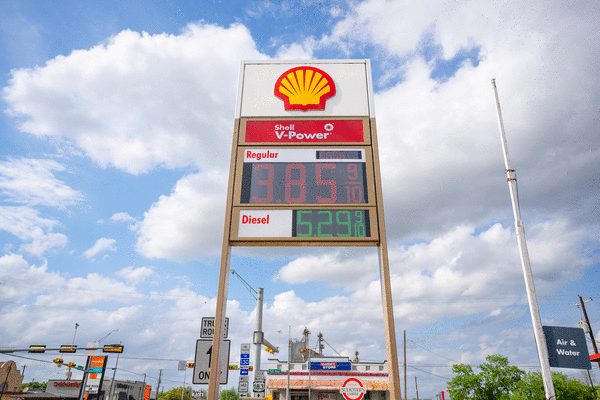
As countries and consumers embrace renewable energy in the wake of the Iran war, skyrocketing gasoline prices in the U.S. are fueling efforts to weaken state climate laws.
Renewable energy mandates to reduce greenhouse gas emissions generally have little impact on U.S. gas prices, according to experts. But the growing pain at the pump has charged debates in California, Massachusetts, Michigan and New York over whether climate action is affordable as households face rising costs for electricity, groceries and housing.
“The war in Iran is driving up gas prices at the pump to the breaking point for too many New Yorkers,” New York Gov. Kathy Hochul said in March as she proposed to delay regulations implementing the state’s 2019 climate law, calling its emission-reduction targets “costly and unattainable.”
As Michigan lawmakers debate how to respond to gas prices exceeding $4 a gallon, Republicans have introduced legislation to repeal a 2023 law that requires utilities to obtain 100% of power from emission-free sources by 2040, a goal they blame for rising electricity bills.
“Lowering the cost of daily life isn’t just an issue for Michigan families. It’s the issue,” Republican state Representative Pauline Wendzel said in an email.
“There’s this effort to jump on affordability as an issue that should dissuade states from pursuing climate policies,” said Michael Burger, executive director of the Sabin Center for Climate Change Law at Columbia University. “When my [utility] bill was two or three times higher this winter it didn’t make me happy but it’s not connected to the state’s climate goals.”
Climate policy experts note that high electricity rates are in large part due to increased demand from such things as data centers and artificial intelligence, and that non-polluting solar and wind energy are cheaper than fossil fuels.
“If anything, we want to be spurring the development of those resources,” said Ann Carlson, a professor of environmental law at the University of California at Los Angeles. “There are costs to fossil fuels that don’t show up directly in your electricity bill, such as dirtier air and increased greenhouse gases.”
California oil refiners, though, are warning that war-triggered $6 a gallon gas prices, the nation’s highest, could rise another $1 or more if the state implements proposed changes to its “cap-and-invest” carbon market. The revisions would tighten limits on industrial emissions to help California achieve its target of carbon neutrality by 2045.
“The proposed regulation will cripple the survivability of the state’s remaining refineries, which will result in California losing the entire industry to this misguided program,” wrote Chevron Corp. executive Andy Walz in a March letter to state officials. Chevron, whose refineries account for about 35% of California’s crude oil capacity, said the new emissions limits could cost it $500 million within five years.
Regulators dismiss those assertions. “That does not reflect market reality,” Lindsay Buckley, a spokesperson for the California Air Resources Board (CARB), which oversees the state carbon market, said in an email. “The ongoing war further underscores why it’s important to move away from fossil fuels and reduce our dependence on oil altogether.”
Still, 15 Democratic state lawmakers sent a letter to CARB Chair Lauren Sanchez in March asking the agency to reconsider changes that they said would “further destabilize California’s fuel supply, economy and working families.”
Pollster Mark Baldassare said affordability is a major concern of Californians, who pay some of the highest electricity rates in the U.S. But he said 25 years of data from annual surveys of residents’ attitudes toward environmental issues shows ongoing support for the state’s climate policies, particularly as disruptions from wildfires and extreme weather accelerate.
“We see that most Californians continue to believe that we’re on the right path in terms of our climate change policies and efforts to move towards renewable energies and away from gas and oil,” said Baldassare, survey director for the nonpartisan Public Policy Institute of California.
Two days before the U.S. and Israel attacked Iran on Feb. 28, the Massachusetts House of Representatives passed legislation that aimed to provide relief from escalating power costs by cutting $1 billion from an energy efficiency program funded by surcharges on utility bills. The state Senate now takes up the legislation amid soaring gas prices.
Caitlin Peale Sloan, vice president for climate and energy at Boston-based nonprofit Conservation Law Foundation, said she expects gas prices to become part of the debate. “People name the energy affordability crisis and spiking fossil fuel costs in the same breath,” she said. “It just doesn’t make any sense to change long-term climate targets and mandates to address a short-term crisis.”
©2026 Bloomberg News. Visit at bloomberg.com. Distributed by Tribune Content Agency, LLC.





Comments