In the Bay Area, the best place for birdwatching can be your own backyard
Published in Science & Technology News
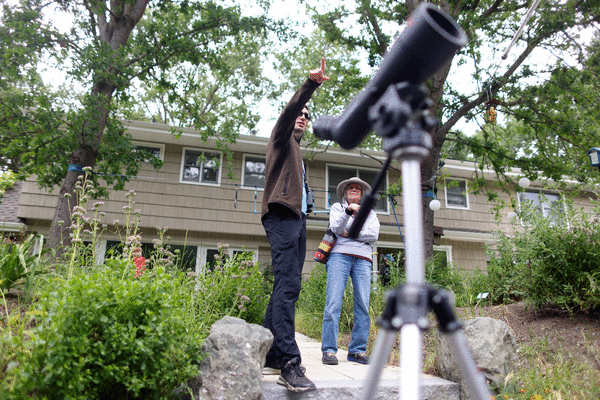
Nestled below a canopy of oak trees on the rolling hills and sunlit woodlands of Contra Costa County lies a hidden oasis for birdwatching enthusiasts.
With a vast array of natural habitats perfect for spotting a variety of diverse native and migratory birds, Orinda is widely considered one of the Bay Area’s premier birding destinations.
The city’s welcoming environment for species like warblers, swallows and chickadees is evidenced by the dozens of birdhouses attached to street signs peppered along the valley’s winding roads.
And for many lucky Orinda residents, the best birdwatching doesn’t even require a trip to the loping East Bay trails — it can be done right in their backyards.
Bob and Stephanie Sorenson’s backyard off Sundown Terrace, for instance, is a bustle of activity. On one recent visit, an Anna’s hummingbird hovered at a feeder, while a red-shouldered hawk drifted overhead and a chatty house finch and chestnut-backed chickadee crowed from the nearby woods — made up of more than 32,000 square-feet of restored native plants and habitat.
The Sorensons’ backyard and garden is a safe haven for dozens of bird species and other wildlife, with more than 150 species of local native plants tucked throughout the three-quarter-acre property. But it wasn’t always.
Previously used as grazing lands for cattle, the property was overrun with invasive grasses, Bob Sorenson said. He’s spent the last 30 years restoring and maintaining the property’s creekside and adjacent uplands to bring back the native habitat.
For budding birdwatchers looking to attract more birds to their backyards, Sorenson said the solution is simple: make your backyard a more enjoyable ecosystem for wildlife.
“If you want birds, they want native plants,” he said.
Sorenson pointed to research by entomologist Douglas Tallamy, which shows that native plants support significantly more insects than non-natives.
Tallamy’s research champions native “keystone” plants — essential native plant species that support the highest biodiversity in a habitat. Sometimes referred to as the “glue” of a local food web, keystone plants support the vast majority of food, pollen, nectar and shelter that insects, birds and pollinators need to survive and reproduce.
In fact, keystone plant species support more than 90% of the insects — especially caterpillars — that nesting birds rely on to feed their young.
Sorenson said native oak trees, for example, will support hundreds of insects, while invasive eucalyptus trees — which were introduced to the Bay Area from Australia in the 1850s — support far fewer.
“If you look at all the reports about declining bird populations, declining butterfly populations, it boils down to loss of habitat,” Sorenson said.
Because birds tend to be sensitive to habitat changes, their population trends serve as useful indicators of ecosystem health, according to the San Francisco Bay State of the Birds, a nonprofit which tracks bird population trends and guides restoration and management actions across San Francisco Bay.
The group found that California’s bird populations are declining at alarming rates, with some shorebird species dropping by 25% to 86% since 2006, according to a January report. Climate change, severe droughts and the loss of natural habitats are key drivers in bird population declines, the group says.
To combat that loss, and because habitat creation is the single most effective way to attract and sustain local bird populations, many birdwatchers often transition to native planting, including Sorenson’s son-in-law, Michael Strom.
A local bird expert, Strom has been an avid birdwatcher for more than 25 years. Strom said he was first introduced to birdwatching by his grandmother, who had a pair of binoculars and some bird feeders in her backyard.
“She wasn’t a hardcore birder…She was just trying to get me interested in nature,” he said. “But I had a great time in the yard and tried to identify species with the book she got me and then it built from there.”
Strom said he became more serious about birdwatching in college, going on to lead bird watching trips for his local Audubon society. Now, Strom said he’s getting into gardening and planting native plants — largely inspired by Sorenson.
“Before, it was just birds. And then I realized, oh, of course, the birds are using the plants,” Strom said. “So if I learn the plants, I’ll get better with what birds are going to be there and then I can draw them into my own backyard.”
For those new to birdwatching, or looking to improve their skills, Strom suggested starting small and local.
“If you’ve got it, your own yard is a great place to start because you can familiarize yourself with maybe 10 species or so that frequent your yard,” he said. “That’s how I learned too, you have this core set that you’re really familiar with and then build outward from there.”
Strom said understanding bird songs and calls is also crucial to getting into birdwatching.
“A lot of these birds, you’re probably going to hear them before you see them,” he said.
Strom said today, there are tons of apps that make it easy to identify a bird’s song — far quicker than using the books with mnemonics that he grew up using.
When coming across a bird you haven’t yet identified, Strom suggested trying to determine the bird’s general shape to narrow it down to a few species before moving on to identifying its color and call.
And for attracting birds to your own yard, Strom suggested bringing in bird feeders, nesting sites and water features, as well as planting native plants.
A small hummingbird or seed feeder is great for those with less space or who don’t have a backyard, Strom added. And native plants in container gardens are a great option for bird enthusiasts with small patios or balconies, he said.
Bird lovers who don’t have any outdoor space — or those ready to venture beyond their backyard — can join one of many local birdwatching groups or visit one of the Bay Area’s many parks and trails to improve their skills.
“We’re pretty spoiled in the Bay Area,” Strom said. “Just within a day’s drive, you could be at the bay looking at waterfowl and shorebirds, or you could be in the mountains looking at a totally different set of birds.”
The hiking trail is where Oakland-based couple Joe DeVries and Olga Bolotina connected. Both avid lovers of nature, the couple said their first few dates were hikes during the pandemic when there was little opportunity to leave the house to do much else.
Their love for hiking and nature eventually led them into birdwatching, DeVries said, and the couple frequently use an app to identify birds by their songs and calls on trips or hiking expeditions.
“I can identify a lot of birds now that I couldn’t before,” he said.
Bolotina said the couple is also actively restoring the native plants in their garden to support wildlife and their natural ecosystems.
“To me, environmental protection means understanding the diversity of a particular region and preserving that,” she said. “We cannot save the planet by just planting trees. Planting trees does nothing for supporting the habitat.”
She emphasized the importance of educating others about the benefits of natural backyards rather than typical American manicured lawns, which she argued consume staggering amounts of water and erode native habitats.
“My goal is actually to create a garden of all natives and show people that they’re absolutely spectacular,” Bolotina said.
The couple visited Sorenson’s garden for inspiration, as part of the “Bringing Back the Natives Garden Tour” — an annual East Bay event where residents open their private yards to the public to showcase beautiful, water-conserving pesticide-free gardens that are composed of at least 60% California native plants
Sorenson said he’s opened his home and backyard to the public for 15 years to try to encourage others to plant native plants in their yards and protect biodiversity.
He pointed to research by Tallamy that found that suburban landscapes must contain at least 70% of native plants to sustain bird populations and other wildlife.
Today, Sorenson’s property contains 95% of native plants.
“I like to show this off to encourage people to plant native plants in their yard,” he said. “I’m trying to change the world a little bit. One garden at a time.”
©2026 MediaNews Group, Inc. Visit at mercurynews.com. Distributed by Tribune Content Agency, LLC.






Comments