Commentary: Utah Gov. Spencer Cox makes a plea for American architects, not arsonists
Published in Op Eds
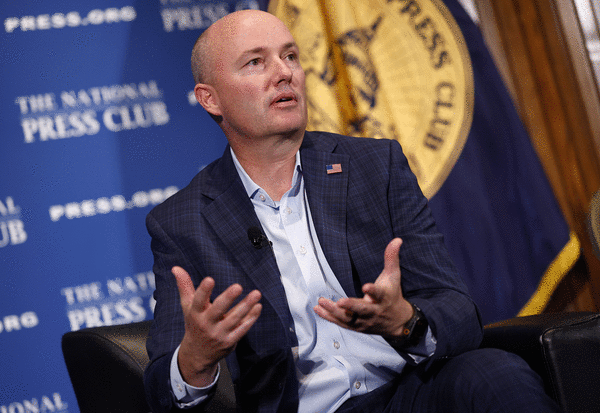
At first glance, Spencer Cox, the Republican governor of Utah, seems to be a throwback to 1950s America and the age of Dwight Eisenhower.
Slender, affable and earnest, Cox exudes polite deportment, controlled intensity and quiet competence. His message of civility and respect echoes from a distant, even quaint, time. However, Cox believes these traditional values can be combined with a building and growth agenda. America, he often says, should once again become a nation of architects, not of arsonists.
Cox is convinced that the central issue confronting statesmen and stateswomen is to restore a culture of civility to American life and promote passionate and respectful discourse.
“Disagreeing better isn’t just about being nicer to one another — it’s about finding a way to disagree that moves us toward solutions rather than deepening divides,” he said.
Cox has been in public service for most of his adult career. A sixth-generation Utahn, he has served as a city council member, mayor, county commissioner, state legislator, lieutenant governor and now governor.
In his 2020 gubernatorial campaign, he edged past Jon Huntsman, a popular former governor, in the Republican primary and then easily defeated his Democratic opponent, Christopher Peterson.
However, Cox catapulted into the national spotlight that year with a striking campaign innovation. Worried about America’s darkening political climate in the aftermath of the police murder of George Floyd, partisan recriminations related to the pandemic and ominous electoral warnings by President Donald Trump, Cox invited Peterson to join him in a campaign ad that modeled civility. In the midst of a competitive race, the two men jousted with good humor and grace. They acknowledged that they disagreed on many issues but respected each other and would honor the outcome of the election. They conveyed a message that has all but disappeared from American politics: that elections are contests between rivals, not enemies. The ad went viral and has been viewed nearly 300,000 times on YouTube.
This experience influenced Cox’s decision as the 2023-24 chair of the National Governors Association to establish “How to Disagree Better: Healthy Conflict for Better Policy” as his signature initiative.
He considered more obvious issues such as health care costs and energy but concluded that no major problem in the United States will be solved until Americans regain their ability to speak, and listen, to each other respectfully.
“This isn’t just another civility initiative; it’s not just about being nice to each other, although we desperately need more of that,” he said in describing the program. “It is relearning how to disagree the right way, how to have debate, how to stay true to your principles, your core values, without demeaning and tearing apart the other side and, in so doing, actually find out where there is common ground, where we can meet each other to solve problems.”
The Disagree Better initiative explored techniques to lower tension and reduce polarization. About 20 state governors recorded videos with leaders from the other party. Cox also consulted experts who study polarization and conflict resolution for policy guidance. Now an independent nonprofit, Disagree Better includes a free parenting toolkit to help families learn how to manage disagreements.
Cox believes that governors, whom he calls “doers and builders,” are in a unique position to model healthy debate and constructive disagreement. Members of Congress, he said, are more accustomed to fighting than coming together and finding solutions.
Cox is troubled by the coarsening of American political life that is partly fueled by endless conflict on cable TV and in social media. However, he is heartened by research that shows most Americans strongly disapprove of the current state of affairs. “They’re desperate for something different,” he told New York Times columnist Ezra Klein. “And neither party is offering them an opportunity for anything different.”
Cox’s willingness to criticize his own party and reach out to Democrats has triggered some GOP criticism and persuaded him that he could never win a Republican presidential nomination, although he insists he has never aspired for the presidency.
The governor continues to focus on solutions and practical advice for a weary and divided nation.
First, he calls for more face-to-face conversations with people from different walks of life and political perspectives. Conflict is easy and often venomous when it occurs online. Talking to real human beings, he believes, is elevating and good for the soul.
Second, he recommends that people join civic groups and volunteer for community projects, observing that service creates bonds and forges enduring relationships.
Third, the governor urges a return to a time when political affiliation was part of our identity but not the central way we defined ourselves and viewed others. “Politics is important, but it should not define us or destroy our relationships,” he said.
Fourth, he suggests we cultivate neglected virtues such as patience, moderation and humility. These qualities are not always rewarded in the marketplace but are important for honorable living.
Cox’s equanimity was challenged by the September assassination of conservative activist Charlie Kirk in Utah. Shaken and angry, Cox said at news conferences and in TV interviews that the nation needed to step back from the brink. “Politics feels like rage,” he said at a briefing with FBI officials. “We can choose a different path,” adding that “at some point, we have to find an off ramp or else it’s going to get much worse.”
As governor, Cox urges respect and tolerance as well as a commitment to building and growth, which he believes can begin at home. He recommends that adults challenge young people not to change the world but rather to revitalize their neighborhoods and communities. And treat others with dignity.
“We definitely need more kindness in our public interactions,” he told Klein. “We definitely need more peacemakers and bridge builders. We need more people with compassion and sympathy toward people we disagree with. We need more people breaking bread with one another and sitting down together.”
Cox’s plea for architects and builders is a compelling example of, and passionate cry for, statesmanship.
____
John T. Shaw is director of the Paul Simon Public Policy Institute. His most recent book is “The Education of a Statesman: How Global Leaders Can Repair a Fractured World.”
___
©2025 Chicago Tribune. Visit at chicagotribune.com. Distributed by Tribune Content Agency, LLC.




































Comments