Andreas Kluth: The duty to disobey unlawful orders was America's idea
Published in Op Eds
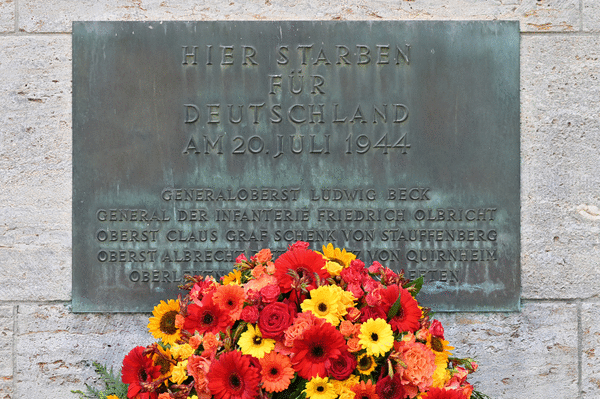
“Stauffenberg pointed the way: if your obedience requires you to do criminal, unhuman things, you are no longer bound by your oath. A soldier’s final benchmark must always, in the last instance, be his conscience, not his orders.” That’s what Jan Techau, a friend of mine with a special vantage on this matter (more about Stauffenberg in a minute), told me when I asked him what he thought about a controversy now raging in the United States.
It’s about six members of Congress who used to serve in the military or the CIA, and who made a video in which they remind active service members that “our laws are clear: You can refuse illegal orders. You must refuse illegal orders.”
The American president responded to their video by accusing the six of “SEDITIOUS BEHAVIOR, punishable by DEATH!” His department of defense — or of “war,” as he prefers — is already going after one of them: Mark Kelly, a retired naval aviator and former astronaut. The FBI has opened investigations into all six. They report receiving all manner of threats.
Many Americans, and especially those who have taken similar oaths, find this reaction “really disgusting, and frightening.” That’s what Rachel VanLandingham, a former military lawyer to top generals, told me. She thinks that Pete Hegseth, the secretary of war, “should be impeached for his abuse of power; threatening to court-martial a sitting senator for simply re-stating the law.” According to her, that “reminder to disobey unlawful orders needed to be said, given the current abuse of the military by this administration (ordering them to commit murder in the Caribbean with the boat strikes, for example).”
There’s another, and more historical, way to grasp how right the senators are, and how wrong Hegseth and President Donald Trump are. And for that I turned to Techau, who used to be a speechwriter in the German defense ministry (he’s now at the Eurasia Group). The speeches he wrote included addresses given by the German defense minister when she oversaw the swearing-in of German recruits in the Bendlerblock.
The Bendlerblock is a complex of buildings in Berlin. It was the headquarters of Adolf Hitler’s Wehrmacht during World War II, and the site where, on the second floor, Colonel Claus von Stauffenberg and his co-conspirators plotted to kill the Fuehrer. It is also where — in the courtyard, lit by the headlights of trucks — they were executed by firing squad when Operation Valkyrie failed on July 20, 1944.
Starting in the 1950s, the West Germans erected a plaque, memorial and museum in the Bendlerblock, which was by then in West Berlin, not far from the Wall. After reunification, the German defense ministry made the Bendlerblock its second headquarters (the other remains in Bonn). And on July 20 of most years, newly minted soldiers, sailors and airmen take their oath to the German constitution on the parade ground, right next to the memorial to Valkyrie.
Over the years, I’ve seen Angela Merkel and other grandees of German politics (including Annegret Kramp-Karrenberger, for whom Techau wrote) in attendance. This year the current defense minister, Boris Pistorius, addressed the troops and, like his predecessors, explicitly placed the modern German army in the tradition of the heroes commemorated behind him.
At a time when freedom, democracy and the rule of law are again threatened at home and abroad, Pistorius said, the plotters of July 20, 1944, exhort modern Germany’s “citizen soldiers” always to heed their conscience, always to think for themselves, and always to protect human dignity, enshrined in article 1 of the postwar constitution.
This embrace of the July 20 legacy was far from obvious in the early years after World War II. Turning Stauffenberg, Henning von Tresckow and the other plotters from traitors (a word Trump used for the six senators) to heroes required a huge rethink of war, morality and law, not just in Germany but in the world. This legal and ethical revolution, as it happens, was led by the Americans.
Its forum was the Palace of Justice in Nuremberg, and its mentor was Robert Jackson, an American supreme court justice whom Harry Truman appointed to lead the world’s first international tribunal for the purpose of prosecuting “crimes against humanity,” starting in 1945. The three other Allied Powers initially had different ideas about retribution against the Nazi leadership. But Jackson and Truman insisted on a demonstration of due process to lend credibility to new global norms, subsequently called the Nuremberg Principles.
In Principle IV, Jackson and others established that “the fact that a person acted pursuant to order of his Government or of a superior does not relieve him from responsibility.” This invalidated the “just following orders” defense that all the Nazi defendants attempted.
It also set the precedent for the Fourth Geneva Convention in 1949 and later its Additional Protocols, which emphasized individual responsibility in war and the duty to disobey unlawful orders. And it became the foundation for all subsequent tribunals against war crimes, such as those committed in the former Yugoslavia or Rwanda. It also led to the International Criminal Court in The Hague, which the United States midwifed in the 1990s but later turned its back on.
The norm also applied in domestic law, at least in liberal democracies. Germany most explicitly spells out the duty to disobey unlawful orders (nobody has ever questioned the duty to obey lawful ones, obviously), while France, Britain, Israel and other Western countries have analogs.
So does the U.S., where the Uniform Code of Military Justice stipulates that service members must obey lawful orders, while surrounding laws clarify what is unlawful. That definition includes any order “that directs the commission of a crime (for example, an order directing the murder of a civilian, a noncombatant, or a combatant who is hors de combat, or the abuse or torture of a prisoner).” In one famous case, for example, First Lieutenant William Calley testified that he was only following orders from his captain during the My Lai Massacre in Vietnam — and was nonetheless convicted of murdering 22 infants, children, women, and old men.
Nobody is suggesting that invoking the memory of Stauffenberg to inspire modern soldiers also equates their superiors to Nazis. The point of the exhortation is to take the most extreme situation imaginable and pose a simpler question, one that Kramp-Karrenberger (in words written by Techau) put to the recruits: In the midst of an inhumane dictatorship, a reign of terror, a war of aggression and genocide, “What would I have done?”
The situation in the U.S. today is completely different. And yet some American service members are asking themselves similar questions, not least about the U.S. strikes against boats of civilians who are suspected, on unclear evidence, of smuggling drugs. (In October, the admiral who was to oversee this campaign stepped down, less than a year into his three-year term.)
Elissa Slotkin, the senator who organized the video, also worries about troops deployed in American cities. In a committee hearing earlier this year, she grilled Hegseth about whether he would obey presidential orders to shoot at protesters (an order that Trump considered giving in his first term to one of Hegseth’s predecessors). The secretary made light of Slotkin’s questions and avoided answering.
“We know you are under tremendous stress and pressure right now,” the senators say in their video to service members. Which is why they found it necessary to restate the law of the land. Slotkin considers it “most telling” that the president believes this reminder should be “punishable by death.”
Fortunately, such threats from on high seem to be inspiring more courage than fear so far. “If this is meant to intimidate me and other members of Congress from doing our jobs and holding this administration accountable, it won’t work,” says Senator Kelly, who as an aviator had a missile blow up next to his jet and, with his wife, knows political violence all too well.
The obligations of warriors in a republic are clear. They are to be loyal not to any individual leader but to their country’s constitution, and to obey lawful orders while disobeying those that are manifestly unlawful. Reminders of this bounden duty are anything but “insurrection.” At times, they amount to acts of the highest patriotism — and even heroism.
_____
This column reflects the personal views of the author and does not necessarily reflect the opinion of the editorial board or Bloomberg LP and its owners.
Andreas Kluth is a Bloomberg Opinion columnist covering U.S. diplomacy, national security and geopolitics. Previously, he was editor-in-chief of Handelsblatt Global and a writer for the Economist.
_____
©2025 Bloomberg L.P. Visit bloomberg.com/opinion. Distributed by Tribune Content Agency, LLC.




















































Comments