Commentary: The US and the world need Poland as a full member of G20
Published in Op Eds
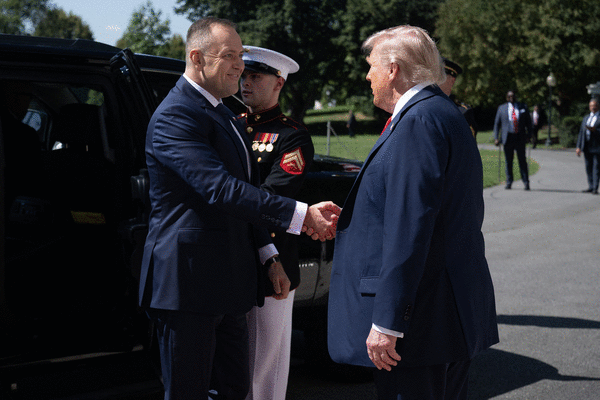
For the first time in the group’s 17-year history, the G20 summit in Johannesburg last month was marked by a complete absence of the United States at the negotiating table. The situation was made all the more striking by the fact that the meeting had been held just days before the U.S. government took over the G20’s rotating, yearlong presidency; it is preparing for next year’s summit at the Trump National Doral resort in Miami.
As President Donald Trump’s administration rethinks its own role in the G20, there is one easy step that it can take to make the group better, and more closely aligned with the U.S. interests: Invite Poland to participate as a full-fledged member. During President Karol Nawrocki’s visit to Washington in September, Trump extended an invitation to next year year’s summit. Yet, Poland ought to be there not simply as a guest and an observer but as an active participant, able to shape the agenda.
The G20 is an odd, largely informal and loosely structured entity, which started as an outgrowth of the earlier G7 and G8 meetings, currently encompassing the 19 largest economies in addition to the European Union and the African Union. The first summit took place in Washington in the wake of the global financial crisis of 2008, and the weight of the evidence suggests that bargains made at the meeting were critical in preventing the crisis from dragging the world back into another Great Depression.
Many criticisms can be mounted against the forum. Smaller countries have good reasons to fear the realpolitik that the new concert of great powers brought back into a supposedly multilateral, rules-based international system. The G20 tries to deflect the charge by “engaging,” through numerous talking shops, with civil society organizations, women’s rights groups, unions and other organizations. For Trump’s United States, the organization paying lip service to progressive issues du jour — climate, health care and equity — is naturally suspect. In addition to the president’s hostility to South Africa’s leadership, the meeting’s agenda is a main reason for the U.S. boycott this year.
Yet, it seems safe to assume that the G20 is here to stay, despite its current crisis. As a result, the United States would do well not to turn its back on the forum but shift its center of gravity toward friendly and like-minded countries. Facilitating Poland’s full membership is the easiest and most straightforward way to achieve that goal.
Poland is fully qualified for membership. This year, it became the world’s 20th largest economy, and Polish real incomes are on a par with Japan. Poland is the most important regional power in a part of the world that has recently seen the deepest challenge to world peace and the international order since 1945 — Russia’s war against Ukraine — and yet has no representation at the forum, unlike Russia. And, finally, Poland is America’s most reliable and consistent ally on the European continent.
To bring Poland to the table, in addition to France, Germany, the United Kingdom and Italy, is to rectify an age-long blind spot of U.S. and Western policymaking, which has reduced Central and Eastern Europe to an object, shaped by great powers — instead of a geopolitical force endowed with agency.
To give a voice to Poland is also to give a voice to Ukraine, whose survival — as Polish political elites understood already in the 1920s — is essential to Poland’s own nationhood. It is to give a voice to a host of smaller but important Nordic and Baltic nations, with whom Poland shares a basic strategic outlook. And given the G20’s focus on the economy, it is also to give a voice to the only major European economy with a recent track record of major structural reforms and consistently solid rates of growth.
Poland’s accession is unlikely to be opposed by China, as Warsaw’s relations with Beijing have been as cordial and constructive as possible given the realities of China’s support for the Russian war effort. Russia, of course, would throw a tantrum. Yet, it would be a perfectly tolerable outcome if Russia suddenly started boycotting the meetings because of Poland’s presence. The Kremlin has not been a good-faith participant in the G20 proceedings for some time, and to rely on Vladimir Putin’s Russia’s to manage, say, the next global financial crisis would require a heavy dose of naivete.
If the United States seeks a constructive reset of its relationship with the G20 following its absence from Johannesburg — a big “if,” perhaps — there are few better choices than using next year’s forum to elevate Washington’s most reliable European partner, friend and ally.
____
Dalibor Rohac is a senior fellow at the American Enterprise Institute in Washington, D.C.
___
©2025 Chicago Tribune. Visit at chicagotribune.com. Distributed by Tribune Content Agency, LLC.





























Comments