Abby McCloskey: What the GOP accomplished with all that power
Published in Op Eds
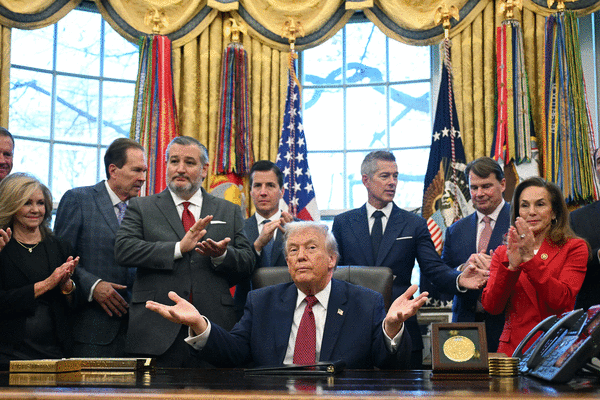
“What a decade this year has been.” That’s how a friend in Washington described 2025 to me. The last 12 months saw a flurry of activity as Republicans in the White House and Congress worked to enact President Donald Trump’s agenda before he reaches “lame duck” status. The result was a swirling mix of policy highs and lows that — without question — has rearranged the policy table heading into 2026.
First, the highs. The Southern border is secure: Border crossings have dropped to their lowest in recent memory, quite the change from the record highs of the Biden administration. Trump campaigned on sealing the border and, by all practical measures, he has done it. That’s good.
Another high: Within days of reaching the Oval Office, Trump signed an executive order to eliminate 10 regulations for each new rule added.
That’s again in sharp contrast to his predecessor. The Biden administration had run a freight train of regulation right through the heart of the economy. In 2024, the last year of Biden’s presidency, agencies added 3,248 new final regulations — the equivalent of a new regulation every two hours and 42 minutes, according to the Competitive Enterprise Institute. The 2024 Federal Register reached an all-time record of 107,261 pages. Good night.
Although regulation can be beneficial to protect consumers or the environment, too much is an economic chokehold. Even progressive pundits know this; regulatory restraint is a central tenet of the left’s new “abundance agenda.” We won’t have 2025’s numbers until the new year, but even if the Trump administration just holds the number of regulations constant, that would mark an improvement.
Then there’s the underreported financial relief given to working families as part of the Republican-led One Big Beautiful Bill Act passed this summer. That includes tax credits to companies that offer paid leave and child care, a 10% bump in the Child Tax Credit, $1,000 Trump Accounts for babies born between 2025-2028, and increased child-care vouchers to families in the form of the Child and Dependent Tax Credit.
To round out the highs and transition to the lows, we come to the shakeup of government. From the Department of Government Efficiency to Robert F. Kennedy Jr.’s focus on children’s health to historic peace deals, there’s been an appetite to try new things, to break up the staleness. One has to admire the energy; it’s reminiscent of big things in America’s past from the Homestead Act to the New Deal.
It’s too bad this energy was often erratically applied. DOGE was a wrecking ball through our civil service without much rhyme or reason (or savings). Health and Human Services raised very good inquiries into children’s health such as exposure to additives and chemicals and screen time, but also questioned age-old vaccines and oversaw a resurgence of childhood diseases like measles. The White House led a much-celebrated peace agreement in the Middle East, but failed to negotiate a deal between Russia and Ukraine and now faces scrutiny over US attacks on Venezuelan boats.
Some may argue that we can’t have big energy without crushing a few bystanders. I’m not sure that’s true.
Which brings us to the policy lows. People voted for Trump for many reasons, but mostly because they were sick and tired of Bidenomics and a weak economy. They thought they were voting “affordability” and limited government back into the White House.
Instead, the administration raised tariff levels to heights not seen in the better part of a century. Sure enough, costs of the tariffed goods rose — as any economist in their right mind could have predicted. This was an unforced error. Consumer sentiment keeps dropping and the labor market is slowing.
The federal debt remains a heavy Santa sack of unfunded goodies. We are borrowing on average $7 billion a day, according to the Committee for a Responsible Federal Budget. Much of this spending is driven by old-age entitlements, but the Trump tax package added a cool $4.1 trillion to the pile over 10 years by cutting tax revenue without an accompanying reduction in spending.
Yes, DOGE saved a few dollars and tariff revenue is surging. But that will barely even dent the debt trajectory. The US needs more fundamental reforms, like spending caps relative to GDP.
A stocking-stuffer assortment of other concerns: The heavy-handed federal raids on immigrants. The pressure on civil servants to be card-carrying members of MAGA; isn’t partisanship what the GOP was criticizing the alleged Deep State for? A coarseness in political talk at the highest levels. Trump insiders using their position to enrich themselves.
And so we head into the holidays with a feeling of underlying instability. It’s hard, sometimes, to tell which way the snow globe is shaking. But shaking it undoubtedly is.
This year has been a decade, all right.
____
This column reflects the personal views of the author and does not necessarily reflect the opinion of the editorial board or Bloomberg LP and its owners.
Abby McCloskey is a columnist, podcast host, and consultant. She directed domestic policy on two presidential campaigns and was director of economic policy at the American Enterprise Institute.
©2025 Bloomberg L.P. Visit bloomberg.com/opinion. Distributed by Tribune Content Agency, LLC.















































Comments