Robin Abcarian: Australia just banned kids from social media. Shouldn't we all?
Published in Op Eds
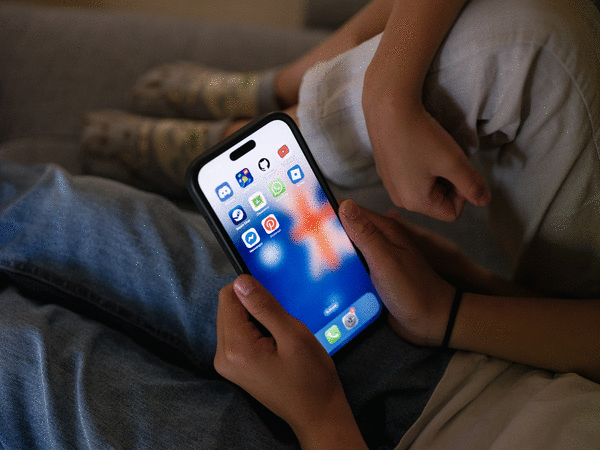
Last week, Australia became the first country in the world to enact a social media ban for kids under 16. As the children of Oz wept and gnashed their teeth (I presume), Prime Minister Anthony Albanese urged them to "start a new sport, learn a new instrument, or read that book that has been sitting there on your shelf for some time."
The ban is an incredibly bold, life-affirming move. You can only imagine how hard tech companies fought against it. (Reddit has already filed a legal challenge to the new law.)
"I've always referred to this as the first domino, which is why they pushed back," said Julie Inman Grant, the country's e-safety minister.
Indeed. Denmark is poised to ban social media for kids under 15. Norway, too. French officials have recommended banning the platforms for kids under 15, and instituting a curfew for those between ages of 15 and 18. In the U.S., many states are experimenting with bans, including California and New York targeting the "addictive" qualities of the platforms.
I can tell you from personal experience that all of these moves are long overdue.
Next month, my 15-year-old niece and I will celebrate the seventh anniversary of her arrival on my doorstep. I never expected to raise another child, especially not as a single mother during this stage of my life. We've managed — pretty spectacularly at times — to make a go of it.
But the biggest source of tension for us, bar none, has been her iPhone. We'd signed the pledge to "Wait Until 8th" for a smartphone. In 6th grade, while a lot of her friends had the latest smartphones, she used a Gabb, which looked like an iPhone but lacked Internet connectivity. She started eighth grade, got a smartphone, and that's when many of our troubles began.
There was the incessant scrolling. The real-time texting that allows no time for thoughtful response. The rage-baiting from "friends." The hysteria around breaking a Snapchat "streak" (a "gamified feature" designed to "encourage" daily engagement).
Her drop in situational awareness was equally alarming.
How many times have I asked her not to stare down at her phone when she is walking to and from the bus or crossing the street? How many times have I insisted she put the phone down when we are at the dinner table? That she leave it in her backpack during school hours? How many times have I just given up on hoping that the dopamine hit she gets from just opening her smartphone will ever be replaced by the joy of reading a book?
In September, after Charlie Kirk was murdered, I told her there was an awful video of the shooting. "Oh yeah," my niece said casually. "I saw it a bunch of times the day it happened. Everyone at school was watching it." (Her school, I might add, is part of the L.A. Unified School District, which banned cellphones this year. What a joke.)
This generation of children is unwittingly being used as lab rats for the effects of technology on the brain. We know from numerous studies that heavy social media use can lead to depression, anxiety, loneliness and suicidal ideation, and that the platforms depend on addicting kids with content tailored to their interests to keep them online. (Just as they do with adults.)
Please don't accuse me of succumbing to the same moral panic that has accompanied every technological innovation in history. (Violent video games cause mass shootings, rock music leads to oversexualization, etc.).
I am telling you, as someone who has stepchildren in their 50s, a daughter in her 30s and now a teenager at home, smartphones and social media have fundamentally altered childhood.
One day, we will look back at this period of unbridled social media use, free-for-all texting and never-ending screen time and wonder how we could have done this to our kids.
Despite protestations to the contrary, social media companies — Meta/Facebook, Instagram, Snapchat, Roblox, TikTok, X, Discord, YouTube and Reddit — are craven when it comes to the safety of minors. You've probably read stories about how Silicon Valley techies don't let their own children use their products. There's a reason for that. The tech companies care only about growing their user numbers and increasing their profits. You simply cannot read things any other way.
Even the most cursory search turns up many thousands of lawsuits filed against social media companies by parents alleging the platforms have harmed their children. Snapchat and TikTok have been linked in studies to teen fentanyl deaths. Instagram has been shown to funnel teens toward content that promotes eating disorders and self-harm. A handful of parents have filed wrongful death lawsuits alleging that AI chatbots encouraged their children to take their own lives.
Last month, a Los Angeles County mother filed a lawsuit against Roblox (a gaming platform marketed as safe for children) and Discord, alleging her 12-year-old daughter met a sexual predator who posed as a lonely 15-year-old. The predator then persuaded the girl to send sexually explicit photos over Discord. "Her innocence has been snatched from her," says the lawsuit, "and her life will never be the same."
Restricting teens is going to be a super messy process. I understand why kids think the new rules "suck." Critics have raised concerns about free speech and about how these rules could drive teens to darker corners of the Internet.
And yes, of course, while parents bear some of the responsibility for out-of-control social media use of their kids, they can only do so much.
When Mark Zuckerberg coined the Facebook motto, "Move fast and break things," I don't think any of us ever realized that our children would be among the things he would break.
_____
©2025 Los Angeles Times. Visit latimes.com. Distributed by Tribune Content Agency, LLC.
















































Comments