Commentary: Internet access is a human right
Published in Op Eds
Even for the casual observer, it’s probably apparent that modern warfare, both domestic and abroad, is dramatically changing. Scenes this summer of a synchronized fleet of Ukrainian drones descending on a field of Russian warplanes punctuate just how far we’ve pivoted from classic artillery and infantry-based operations. It’s not only the methods that are changing, but increasingly the targets. What will come next will be clandestine, remote hacking attacks supercharged by AI and targeted (or errant) munitions that sever broadband lines and incinerate internet infrastructure. And with data center development and the internet’s reach continuing to quickly accelerate worldwide, this shift should worry us all — because the primary victims of new age digital warfare will be vast civilian populations, and the toll will be catastrophic.
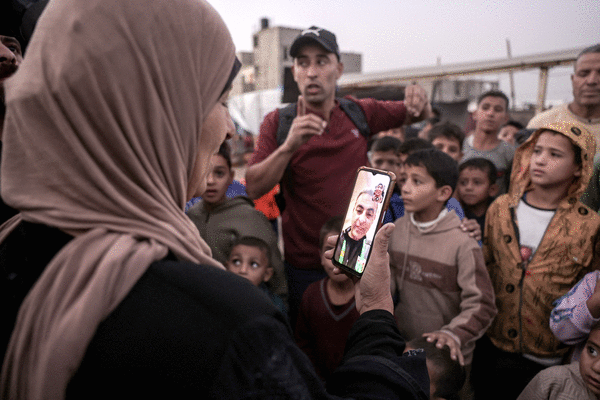
One need only look at Gaza to understand just how damaging these disruptions can be. According to a report from Access Now, Gaza experienced at least 27 complete or partial internet and telecommunications outages since Israel’s assault on the territory began in October 2023. The most recent shutdown, this past September, preceded an Israeli ground invasion with tanks and infantry.
Whether due to intentional sabotage or negligence, these actions have greatly hindered emergency responses and the coordination and delivery of services and resources, including food and water for besieged Gazans.
Concerns about attacks via or against the internet aren’t isolated to active conflict zones. Seventy-five percent of Americans are concerned about the safety of the country’s internet infrastructure, and it’s not hard to understand why. In the roughly two decades that the internet has been more or less ubiquitous in the U.S., the technology has evolved from being a novelty to being critical in how we perform our work, socialize, manage our finances and stay informed.
For most of us, the idea of an internet outage is mildly panic-inducing, plunging us into an experience that feels akin to temporarily losing one of our senses. But compare that with people in countries confronted by this new era of cyber- and internet infrastructure attacks, where internet disruptions are a recurrent reality. Civilian life, if not the target, is frequently among the collateral damage.
Somewhere around 5.5 billion people, roughly 68% of the world’s population, now use the internet. That’s more than double the number from just a decade ago, with the internet essential to how contemporary society and its institutions function. It’s used by hospitals and nonprofits to deliver healthcare and social services. It’s used by the government to make commercial travel and traffic safer. It helps coordinate the byzantine supply chains that fuel our economies. It even helps monitor and upkeep our communities’ water and energy infrastructure.
Because of how central the internet is to even these most basic functions, efforts to deliberately disrupt or terminate internet access reflect clear violations of human rights. And in a growing number of cases around the world, the violations are a clear matter of life and death. Yet there has been little international response to the increasing use of attacks on internet infrastructure in regions that are embroiled in explicit and covert war.
At multiple points over the last decade, undersea cables have been deliberately severed or otherwise sabotaged by antagonist actors. In 2024, two undersea cables in the Baltic Sea, one linking Germany and Finland, were ruptured, presumably by Russian saboteurs. And this past March, the Peace Submarine Cable, connecting Africa, Asia and Europe, was cut, causing widespread internet outages in East Africa. No cause has been officially determined.
In 2024, many Americans got a direct taste of just how much an internet blackout could affect our daily lives. A global internet outage in July 2024 caused by lapses from CrowdStrike, a cybersecurity firm, affected 26% of U.S. adults. The unintentional outage crippled financial services, delayed flights and led to disruptions of operations at hospitals and businesses across the world. So what happens when bad actors, including our own governments, intentionally, with even more precision and resources at their disposal, target our internet and threaten our ability to stay connected?
In October 2024, the Taliban instituted a broad internet shutdown in Afghanistan under the dubious pretext of addressing internet “misuse,” restoring it shortly after widespread condemnation. But this is far from the first instance of the internet being weaponized by internal forces. Following the example of Iran, Sudan, Bahrain, Egypt and Syria have cut off or suppressed internet access to stymie protesters, with varying degrees of success.
In a particularly troubling development that may signal broader trends, Russia has recently been testing a way to cut its territories off from the global internet as a way of building its own “sovereign” network — one that could allow the Kremlin to more directly surveil civilians and quash political dissent.
In 2016, the Human Rights Council of the United Nations formally declared access to the internet a human right. But like most of its pronouncements, enforceability and accountability aren’t guaranteed or widely expected. A handful of countries, each with deeply autocratic leanings — Russia, China, Saudi Arabia and India — have opposed UN amendments aimed at codifying the internet as a human right.
To earnestly make internet access a human right, it’s important that we define precisely what constitutes access, having a clear focus on an internet that is reliable and sufficiently fast. For example, although 5G was widely available in Israel in 2020, the Israeli government has long denied Palestinians access to 4G service, relenting to upgrades in 2021 that still have not fully come to fruition as they should have.
We also must recognize that human rights are often linked, with one essential to others. For example, internet access is increasingly connected to the quality of one’s education, a more globally recognized and embraced human right. According to one international survey, roughly 39% of internet users use it for education or study-related purposes. Internet access is also intimately connected to the ability to engage in free speech and to work, two other vital human rights.
While these kinds of infringements may seem unlikely to come to American shores, various forms of internet throttling and indirect censorship already broadly occur in the country. Owing to ongoing Republican politicking, the U.S. is behind on ensuring net neutrality, a principle that says all internet traffic should be treated equally and not subjected to the biases and financial spoils of tiered access. According to a CNET poll, 42% of U.S. adults said they experienced unreliable internet speeds or connectivity, and 63% saw their home internet prices increase.
With digital connectivity increasingly determining access to basic needs, the case for earnestly treating internet access as a human right has never been clearer. Like warfare, our understanding of human rights has to evolve with the times. This means understanding that in future warfare, victory won’t be measured just in terms of adversaries eliminated, but also by the depth of destruction of the internet infrastructure that sustains our societies.
____
Jerel Ezell directs the Berkeley Center for Cultural Humility and is a sociologist and assistant professor at University of Chicago Medicine. Sugy Choi is a health services researcher and assistant professor at the New York University School of Medicine.
©2026 Los Angeles Times. Visit at latimes.com. Distributed by Tribune Content Agency, LLC.





















































Comments