Editorial: Recording law enforcement officers is not a crime
Published in Op Eds
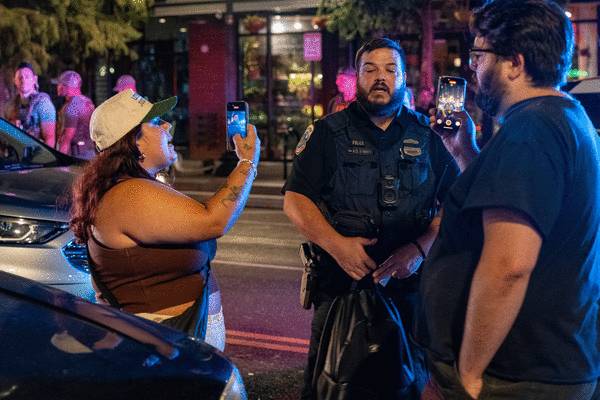
An official with the Department of Homeland Security recently suggested that following or recording federal law enforcement officers “sure sounds like obstruction of justice.” The statement was given to Reason magazine in response to a direct question, was confirmed in writing and followed by a warning that DHS will prosecute such conduct “to the fullest extent of the law.”
It’s also ridiculous and an affront to First Amendment case law.
As Reason’s C.J. Ciaramella observes, the issue is not whether officers deserve protection from real interference or danger. They do. The issue is that recording or observing officers in public is not — in an of itself — an act of interference. It is a protected form of gathering information about how the government exercises its authority.
Seven federal circuit courts have upheld the public’s right to record police or federal agents, as long as the person filming is not physically obstructing the officers. In one 2017 decision, the 5th U.S. Circuit Court of Appeals ruled that “a First Amendment right to record the police does exist,” subject to reasonable limits. The 10th Circuit echoed that view in 2022 when it allowed a First Amendment claim to proceed after a man was barred from filming a traffic stop. Courts have also protected the public’s right to alert others to police activity, recognizing it as part of public discourse and not a crime.
This principle is not new. In 1987, the Supreme Court struck down a Houston ordinance that made it a crime to interrupt or challenge an officer. Justice William Brennan wrote that the freedom to oppose police action without risking arrest helps distinguish a free country from a police state. Recording officers is simply a modern way of maintaining that freedom.
State attempts to limit filming have largely failed. Mr. Ciaramella points out that Arizona’s 2022 law restricting filming within 8 feet of police was blocked by a federal judge. Other states have passed distance requirements, but these measures face challenges because of vague language and concerns about arbitrary enforcement.
Simply recording officers is not an act of aggression. It is a method of ensuring transparency, reinforcing public trust and creating an independent record of government conduct. It is central to accountability in a democratic society. As Mr. Ciaramella points out, some of the most serious allegations against federal officers in recent years have surfaced only because bystanders had the courage to hit “record.”
DHS officials must be free to go about their business. But bystanders must also be free to document their activities as long as they do not willfully obstruct the administration of justice. The Constitution has already answered the question. The right to observe government power is not subject to the whims of those who carry badges.
©2026 Las Vegas Review-Journal. Visit reviewjournal.com.. Distributed by Tribune Content Agency, LLC.













































Comments