Allison Schrager: Americans are living in the worst of all tax worlds
Published in Op Eds
Taxes are a necessary fact of life. Although no one likes paying them, and they divert resources and cause waste, governments need revenue to provide essential (and some not-so-essential) services. And with its large debt, aging population and growing appetite for government benefits, the U.S. will have to increase taxes sooner rather than later.
Unfortunately, politicians in America — across all parties and levels of government — seem dead set on the absolute worst kinds of taxes.
From an economist’s point of view, there are good taxes and bad taxes. Good taxes are ones that raise money without changing people’s behavior very much. It may be controversial to say so, but the assumption should be that people make choices — how much they work, how they save and invest, what they buy — based on their preferences. The goal of tax policy, apart from sin taxes on such things as tobacco or alcohol, should be not to discourage people from doing what they would normally do. Otherwise, governments end up with more waste and a slower growing economy, which will decrease revenue even further. Generally, when it comes to efficiency considerations, consumption taxes (like a VAT) are better than an income tax, which is better than a wealth tax.
It may also make sense to have some progressive flavor to the tax regime, not so much to punish the wealthy or further some utopian egalitarian ideal, but because Elon Musk will not miss 20% of his annual income as much as someone who earns $20,000 a year. There are limits to how much you can tax high earners before running into efficiency issues — they may invest less or go to great lengths to avoid paying taxes — but a progressive tax rate has benefits.
Alas, none of the taxes currently in use or under consideration meets any of these objectives.
Consider the tariffs. Evidence suggests that in the past the cost of tariffs was mostly borne by the consumer. The latest round of tariffs has not increased prices as much as many expected, with some producers absorbing costs and lots of exemptions. Over time, however, this is probably not sustainable, and Americans will have to pay up.
Tariffs are in a sense a consumption tax, which is good. But they are bad because they distort economic behavior, taxing only foreign-made goods and services. Their supporters argue that tariffs give American producers a price advantage, but that very advantage reduces the incentive to be productive and more competitive. Tariffs also increase the cost of inputs, which can put U.S. producers at a disadvantage.
A more neutral consumption tax, especially on luxury goods, would be better. But the objective of the tariffs does not seem to be to raise revenue efficiently. Instead the arguments are about bringing back jobs to the U.S., protecting national security or raising revenue from foreign sources.
Another tax in vogue right now is a wealth tax. California is considering a “one-time” 5% tax on billionaires. Taxing wealth is appealing to politicians because by definition it affects so few of their constituents. But it is anathema to policymakers because it is so hard to implement. It is easy for rich people to move (themselves or their money), and it doesn’t take many of them to do so to reduce tax revenues. It also encourages rich people to invest in hard-to-value assets such as art or private funds instead of more productive areas such as the markets or their own companies.
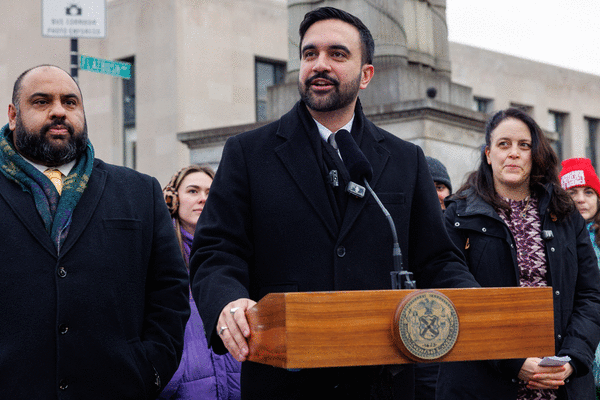
Then there is New York City Mayor Zohran Mamdani’s campaign promise to tax those earning more than a $1 million a year an extra 2%. This is neither a wealth tax nor a progressive marginal income tax, but rather a flat tax — and an exceptionally poorly designed one at that. Someone who earns $1,000,000.01 would owe $20,000 more than someone who earns $1 million. This sort of cliff would introduce all sorts of distortions. Progressive income tax rates are usually levied on each extra dollar of income; that million-dollars-and-one-cent earner would pay an extra 2% only on that penny that put him in the higher tax bracket.
Eventually, I suppose, politicians might rediscover the basic laws of economics and human incentives. They’d recognize their need for revenue and think seriously about how and what to pay for in a smart way. They’d get rid of as many distortions as possible, such as the carried-interest and stepped-up-in-basis loopholes. With a broader base, they’d be able to lower rates, collect more revenue and get more from richer Americans.
Even then, there still probably wouldn’t be enough to pay for the government services voters seem to want, so there’d need to be a consumption tax too. But tax policy these days is less about getting revenue and more about delivering punishment (to foreigners or the wealthy). And that’s how you end up with not only higher taxes, but higher taxes of the worst kind.
____
This column reflects the personal views of the author and does not necessarily reflect the opinion of the editorial board or Bloomberg LP and its owners.
Allison Schrager is a Bloomberg Opinion columnist covering economics. A senior fellow at the Manhattan Institute, she is author of “An Economist Walks Into a Brothel: And Other Unexpected Places to Understand Risk.”
©2026 Bloomberg L.P. Visit bloomberg.com/opinion. Distributed by Tribune Content Agency, LLC.



















































Comments