Ronald Brownstein: The Supreme Court could give the GOP a political lifeline
Published in Op Eds
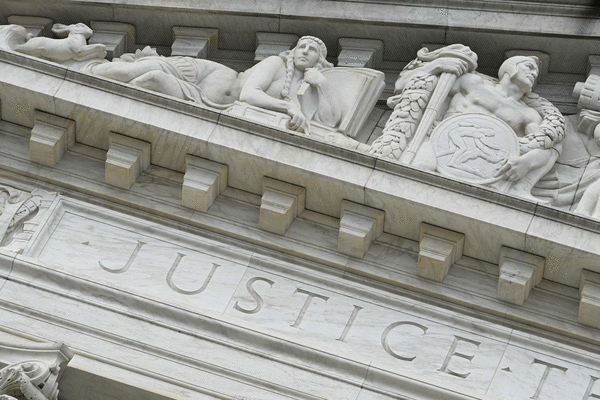
The GOP’s best chance of defending its narrow, five-seat majority in the House of Representatives in 2026 — and beyond — could come from an upcoming Supreme Court decision on the Voting Rights Act.
From any angle, Republicans face difficult odds in November. No party has successfully maintained unified control of the White House, the House and the Senate through a midterm election since 1978. Recent indicators, from President Donald Trump’s sagging approval ratings to the strong Democratic performance in the 2025 elections , offer Republicans little reason for optimism that they can break that streak.
Even Trump’s strategy of pressuring red states to redraw their congressional districts has largely fizzled. Though Texas and other Republican-controlled states have acted , the combination of GOP reluctance elsewhere (most prominently in Indiana) and offsetting Democratic responses (most notably in California) has reduced the GOP’s net advantage from this unusual mid-decade tit-for-tat to just a handful of seats—not enough to meaningfully improve their chances of maintaining control.
But the Republican-appointed Supreme Court majority could throw the House GOP a lifeline. In oral arguments last fall , the conservative justices appeared poised to significantly limit, if not completely overturn, the provision of the 1965 Voting Rights Act that bars changes in election laws that have the effect of discriminating against racial minorities.
If the court retrenches that section of the VRA, it would likely trigger another spasm of congressional redistricting, especially in Republican-controlled states across the South, to eliminate seats now held by Black and Latino Democrats. Depending on how many states act, that could tilt at least another seven or eight Congressional seats toward the GOP now , and likely many more over time — enough to reinforce their cushion in the near- and long-term battle for House control.
Typically, the court waits until the end of its session in June to issue decisions this important. But many legal and political analysts believe the majority may be tempted to influence the 2026 election by ruling more quickly.
If the court releases a decision unraveling the VRA’s protections within the next six to eight weeks, that would give states time to redraw their district lines before November. In that case, “you could still see some of these Southern states that are making threats pick up the pen” to eliminate Democratic-held seats, says John Bisognano, president of the National Democratic Redistricting Committee.
The timing of such a ruling may be uncertain, but the outcome appears anything but. Weakening the VRA sits at the crossroads of two of the court’s most consistent patterns under Chief Justice John Roberts: rolling back federal voting rules and unwinding civil rights law.
Down one road, the Roberts court has repeatedly limited Washington’s role in setting rules for elections — typically over unified opposition from the Democratic appointees. The court has eviscerated limits on independent campaign spending, invalidated a core VRA provision requiring federal “preclearance” of election laws in states with a history of racial discrimination, and barred federal courts from overturning redistricting maps as excessively partisan. The Republican-appointed justices may be ready to lengthen that list this session with decisions that could loosen limits on coordinated spending between political parties and candidates and stop states from counting absentee ballots received after Election Day.
Down the other path, the GOP majority has also prohibited race-conscious remedies for prior discrimination, most dramatically in rulings on college admissions and public school segregation.
The current VRA case, which involves a challenge to a second majority Black district created in Louisiana’s congressional map, may allow the conservative justices to advance both of those goals. Many analysts expect that the majority will rule that drawing legislative seats expressly designed to favor the election of racial minorities violates the Constitution, and either bar or severely restrict that practice.
Close observers consider Florida (which has apparently delayed reopening its congressional maps to wait for the ruling), Louisiana and Georgia the red states poised to most quickly redraw their congressional lines if the court greenlights undoing seats now held by minorities. Other possibilities include South Carolina, Tennessee and Alabama. Ironically, as the Equity Research Institute at the University of Southern California has calculated for me, non-White residents account for all or most of the recent population growth in those states.
And the ripple effect of a decision weakening the VRA would extend much further. Two civil rights advocacy groups have calculated that Southern states could eliminate as many as 140 state legislative seats held by Democrats of color — about 40% of the current total. Elections for local office, which account for about two-thirds of all legal challenges under the threatened VRA provision, would inevitably be upended too. Even Texas, Bisognano believes, might redraw its congressional lines yet again for 2028 if the current gerrymander doesn’t flip as many Democratic seats as state Republicans have promised Trump.
In Congress, the full effect of a sweeping ruling likely wouldn’t be felt until the redistricting that follows the 2030 Census. At that point, Republican-controlled Southern states would face little legal constraint on drawing maps that severely repress Black and Latino representation. “It’s becoming clear that elements of the GOP are seeking to match their nostalgia for a past America with a voter composition of that era,” Manuel Pastor, the institute’s executive director, told me in an email. Although the number of non-White Republicans has slightly increased over time, they still comprise only about 10% of all GOP House members; that suggests that if red states eliminate more House seats now designed to favor the election of minorities, those non-White Democrats are most likely to be replaced by more White Republicans.
A future in which people of color provide the growth that allows Southern states to add more congressional seats but are then denied a meaningful chance to represent those seats uncomfortably resembles the Constitution’s notorious three-fifths compromise — which counted slaves (as three-fifths of a free person) toward allocating House seats and electoral votes, but denied them the vote. Echoing that injustice would be a dubious but fitting capstone to Roberts’ long crusade against a federal role in both securing fair elections and safeguarding civil rights.
____
This column reflects the personal views of the author and does not necessarily reflect the opinion of the editorial board or Bloomberg LP and its owners.
Ronald Brownstein is a Bloomberg Opinion columnist covering politics and policy. He is a CNN analyst and the author or editor of seven books.
©2026 Bloomberg L.P. Visit bloomberg.com/opinion. Distributed by Tribune Content Agency, LLC.




















































Comments