Mary Ellen Klas: What my Trump-supporting friends won't say
Published in Op Eds
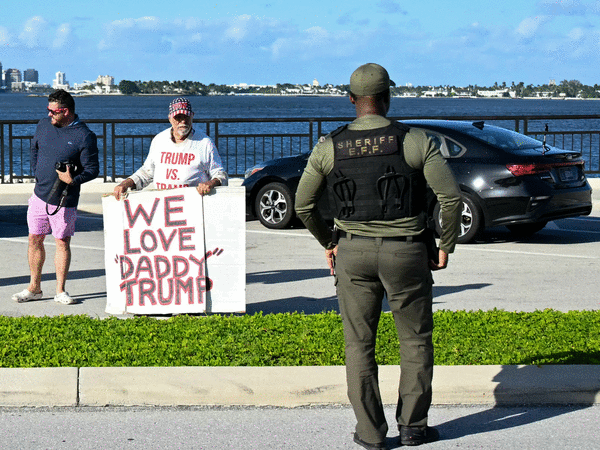
Let’s resolve to have the courage to speak up more in 2026. I realize this is easy for me to say; I’m a columnist. But I live in Florida, where I have many friends who have been Trump supporters and who are privately queasy about what they see as brazen corruption coming from President Donald Trump and his administration. While there is widespread support for the ouster of Venezuelan President Nicolás Maduro, many wanted more transparency about the threat to our national interest. Yet, they don’t feel right calling out Trump for this or his other transgressions, so they dance around it — often trying to find some equivalent outrage under a Democratic administration.
But there is no equivalence. We are a year into the president’s four-year term and we have seen a cascade of self-enriching deals, the firing of Justice Department watchdogs, the sweeping use of the president’s pardon power to free his allies — regardless of the seriousness of their crimes — and the frightening near-abandonment of the rule of law.
As Trump, Vice President JD Vance, Deputy Chief of Staff Stephen Miller, and Director of the Office of Management and Budget Russell Vought have pursued their wrecking-ball agenda, congressional Republicans have remained virtually dormant. The administration has systematically reengineered the president’s spending power; realigned federal policy to elevate the executive branch over the other branches of government; prosecuted the president’s perceived political opponents; fired public servants for simply doing their jobs; disappeared immigrants without due process; and snatched Venezuela’s president and laid claim to the country's oil.
Republican congressional leaders greeted these changes with silence.
In my experience, most Republican voters supported Trump and his promises in 2024 for defensible reasons. Many also now believe his behavior in office is wrong. So why isn’t there more public pushback? On a recent trip to Miami, the answer I got was a sobering one: We’re afraid.
“My parents fled an authoritarian regime and that’s the type of government that instills fear and puts people in jail and punishes them for their viewpoints,” said Marcos Daniel Jiménez, a former U.S. attorney under former President George W. Bush and the son of Cuban immigrants. “That’s exactly what this president is doing — maybe not to that level — but the retribution and the attacks by the president and his cronies have caused many people who own businesses and have families to be afraid.”
Of the several Cuban Americans I spoke with, most could see the parallels between the Castro regime and the Trump administration’s disregard for the rule of law and its assault on free speech. Others drew distinctions where there was little difference. But only Jiménez had the courage to go on the record. The others feared retaliation, which would have meant losing revenue, jobs — and access to power.
Those who have experience with life in an authoritarian regime know best what will happen if the Trump administration continues down its current path. But they don’t see it in their self-interest to speak out. Social scientists call this the “collective action problem,” when individuals acting in their own self-interest contribute to a worse outcome for the entire group.
For advice on how to handle this, we should look back more than a century ago. An essayist who fought the corrupt politics of Tammany Hall wisely warned that speaking out is a skill that must be practiced; otherwise, we forget how to do it. A man who waits to make himself heard soon finds that “he has nothing to say,” John Jay Chapman told the graduating class of Hobart College.
“Retain the power of speech no matter what other power you may lose,” Chapman advised. “… Do what you will. But speak out always. Be shunned, be hated, be ridiculed, be scared, be in doubt, but don’t be gagged.”
Chapman’s advice from so long ago seems meant for today. Each of us, in our own small way, should call attention to the political behavior we find morally objectionable or we may lose the chance to speak at all. We don’t need to go big or put out a social media blast — often it’s one-on-one conversations with friends and family that have the most persuasive power. It’s the practice of speaking up that’s important, the resilience it imbues — the idea that civilized criticism is normal. Maybe Congress would even start doing it, too.
Dakota Rudesill, associate professor of law at Ohio State University, has a simple template for how to speak up with integrity and courage. In an essay he wrote for his students (in which he credits Yale law professor and Bloomberg columnist Stephen Carter), he advises people to reflect on the values that are most important to them; refuse to lower their standards for those principles; and then communicate their reasoning.
When people encounter something that conflicts with their values, it’s natural to rationalize that it’s better to be pragmatic than to stand up for their beliefs and be subjected to risk, Rudesill told me. “But if everybody just looks to their immediate self-interest, then we are all just going to consent to transaction, submission, intimidation and threat — which undermines everything we believe in.”
Sometimes, a single voice can make a difference. For the first 11 months of Trump’s term, few Republicans in Washington were willing to call him out. Then, US Representative Marjorie Taylor Greene, one of the president’s most loyal acolytes, challenged him for reversing his position on a series of issues. Trump called her a traitor. Greene and her family received death threats. She announced that she would resign.
But within weeks, the U.S. House for the first time this year provided a critical check on the president: 13 Republicans joined with Democrats and voted to nullify a Trump executive order that had stripped collective bargaining rights from nearly 1 million federal employees.
The next day, the Republican-led state Senate of Indiana rejected the president’s intimidation tactics and voted down a plan for mid-decade redistricting. “We can’t be bullied,” said state Senator Sue Glick, a Republican.
A few days later, Greene told CNN that “the dam is breaking” on Trump’s influence over the Republican Party.
Polls show that only a third of Americans support Trump’s military intervention in Venezuela. His suggestion that the US take control of Greenland is opposed by even larger margins. He is under water on every domestic issue in the most recent YouGov/Economist polling.
When Congress does nothing in the face of such widespread disapproval, it’s time to speak up and hold them to account. Of course, it’s much easier to abide by moral principles and speak out against leaders when their favorability rating has declined, but it’s a start. Let’s remember Chapman’s sage advice, even if it means incurring some personal risk. Speak up because, as he said: “The time of trial is always.”
____
This column reflects the personal views of the author and does not necessarily reflect the opinion of the editorial board or Bloomberg LP and its owners.
Mary Ellen Klas is a politics and policy columnist for Bloomberg Opinion. A former capital bureau chief for the Miami Herald, she has covered politics and government for more than three decades.
©2026 Bloomberg L.P. Visit bloomberg.com/opinion. Distributed by Tribune Content Agency, LLC.






































Comments