David M. Drucker: The dubious art of explaining what Trump 'really means'
Published in Op Eds
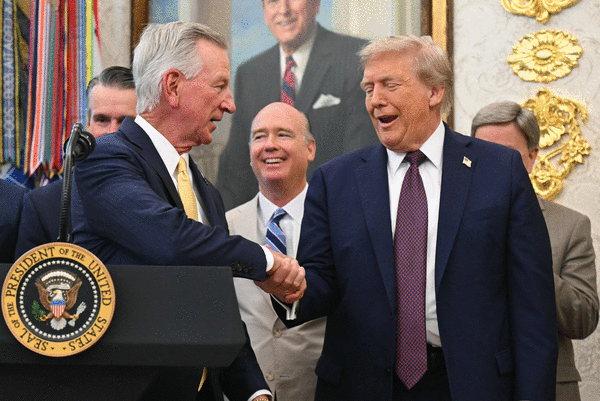
Prominent Republicans insist on treating President Donald Trump like a child or a clueless old man, telling Americans that he does not mean what he says — despite the commander in chief making quite clear he means exactly that.
Trump’s threat to use military force to seize Greenland from Denmark, a U.S. ally via the North Atlantic Treaty Organization, is a recent example. “I don’t think it’s a threat,” Senator Tommy Tuberville of Alabama told The Bulwark. “I think it’s a promise that we’ll offer some money for it.” Senator John Kennedy offered his own, colorful reimagining of the president’s saber rattling. “Even a modestly intelligent ninth grader knows that to invade Greenland would be weapons-grade stupid. Now, President Trump is not weapons-grade stupid,” the Louisiana Republican told CNN. Trump, Kennedy added, does “not plan to invade Greenland. That does not mean they’re not going to seek a legal, formal partnership with Greenland.”
Trump’s subsequent comments on the matter? All options are on the table, including a military invasion. “We are going to do something on Greenland whether they like it or not,” the president told reporters during a White House news conference last week. “If we don’t do it the easy way we’re going to do it the hard way.”
The phenomenon of redefining Trump’s rhetoric was somewhat understandable during his first presidency. He was new to elected office and still learning how the federal government operated. Although still somewhat infantilizing of a man who had reached high office, Republicans uncomfortable with the president’s rhetoric could theoretically make the case that Trump didn’t understand the implications of what he was saying, or of his policy proposals.
But as we head toward Year 2 of his second presidency, those excuses have worn thin. Trump has plenty of on-the-job experience and has demonstrated an understanding of executive power, so much so that he rejects most limits on it.
What gives? In my experience, it’s about political expediency. Republicans’ clumsy verbal cartwheels are obvious attempts to avoid publicly disagreeing with Trump while simultaneously attempting to avoid publicly agreeing with him.
It’s been more of the same regarding what’s next for Venezuela following an American military operation that led to the capture of dictator Nicolas Maduro and his wife and their arrest by federal law enforcement. During a Jan. 3 news conference, Trump, 79, said the U.S. is “going to run” the South American nation “until such time as we can do a safe, proper and judicious transition.”
The president elaborated under questioning by reporters, suggesting his declaration was hardly flippant. “It’s largely going to be, for a period of time, the people that are standing right behind me,” Trump said, when asked who inside the U.S. government would be running Venezuela. Flanking Trump on stage: Air Force General Dan Cain, chairman of the joint chiefs of staff; Defense Secretary Pete Hegseth and Secretary of State Marco Rubio, among others.
Yet the very next day, Rubio revised his boss’s remarks. “What we are running is the direction that this is going to move, going forward. And that is, we have leverage. This leverage we are using and we intend to use,” the secretary said Jan. 4 in an interview on the ABC News public affairs program This Week. To be fair, Rubio’s argument wasn’t wholly inaccurate.
But: Want to guess what Trump said later that day when asked, during a gaggle with reporters on Air Force One , if Washington was running the show in Caracas? “Don’t ask me who’s in charge because I’ll give you an answer and it will be very controversial,” Trump said. When asked what he meant, the president was blunt: “It means we’re in charge. We’re in charge.”
Naturally, Trump’s unequivocal comments didn’t discourage Senator Jim Risch, chairman of the Senate Foreign Relations Committee, from claiming the president’s rhetoric was equivocal. “I think that’s a matter of interpretation,” the Idaho Republican told NOTUS , when asked what the commander in chief meant by repeatedly saying the U.S. is “running” Venezuela.
Shawn J. Parry-Giles, a University of Maryland professor who studies political communication and rhetoric, explained the ongoing dilemma posed by Trump and his penchant for provocative rhetoric and proposals.
“ His messaging puts members of his party in difficult positions. They manage the rhetorical and political messiness by providing different interpretations that reshape the message into one they can support that appears more reasoned and grounded in legal [and] political principles,” said Parry-Giles, director of the Rosenker Center for Political Communication and Civic Leadership . “This is also happening with members of his cabinet. They are trying to reshape his messages into something that would be more acceptable politically.”
They’re hoping to “send” Trump “a subtle message of how the president would better express his views,” she added, while maintaining a sense of decorum that the commander in chief does not. “He routinely flouts such decorous practices,” Parry-Giles said.
All true and all understandable.
But after all this time, it should be crystal clear to Republicans — on Capitol Hill and everywhere else — that Trump knows what he’s saying and knows what he’s doing (or what he wants to do.) When he speaks and when he acts, it’s with deliberate intent. Congressional Republicans who oppose an American invasion of Greenland might want to ponder that rather than soothe themselves with fantasies that Trump’s tough talk is about “leverage.”
____
This column reflects the personal views of the author and does not necessarily reflect the opinion of the editorial board or Bloomberg LP and its owners.
David M. Drucker is a columnist covering politics and policy. He is also a senior writer for The Dispatch and the author of "In Trump's Shadow: The Battle for 2024 and the Future of the GOP."
©2026 Bloomberg L.P. Visit bloomberg.com/opinion. Distributed by Tribune Content Agency, LLC.









































Comments