Editorial: Remain wary even as feds resume review of research grant applications
Published in Op Eds
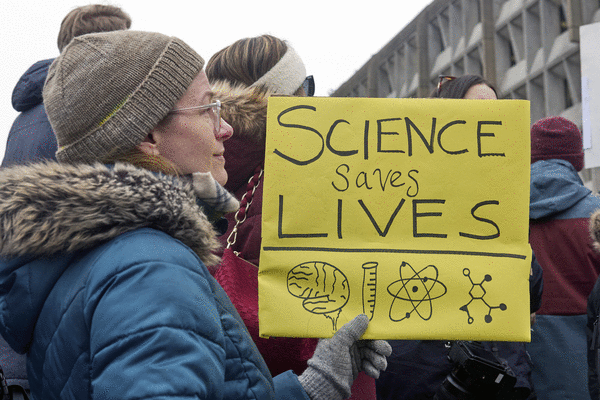
News that the Trump administration has agreed to reevaluate thousands of science and medical research grant applications held up because they supposedly had elements of diversity, equity and inclusion should be met with cautious optimism.
Some of the research grants by the National Institutes of Health, which is under the Department of Health and Human Services, and the National Science Foundation, could have offered advancements in HIV prevention and Alzheimer’s disease.
The University of Washington is among the dozens of universities affected by the government’s shortsightedness in freezing or terminating grant applications. That’s among the reasons why Washington’s Attorney General Nick Brown joined 16 other state attorneys general in a lawsuit against the government.
UW received $572 million from the NIH in 2024.
According to Inside Higher Ed, immediately after the agreement last month, NIH reviewed hundreds of applications and approved 499.
So why the skepticism?
Dating back to his first term, President Donald Trump attempted to cut $6.1 billion in NIH research funding, including $1 billion for cancer research, but bipartisan action in the House and Senate prevented it.
For much of 2025, Trump, through various means, tried to gain more control over and to reshape colleges and universities. First, in January, Trump ordered the pause on the federal grant applications. In February he cut funding for research grants, including research involving cancer treatments. Both actions brought a slew of lawsuits.
He also shook down colleges such as Cornell University ($30 million), Columbia University ($200 million), Brown University ($50 million) and even his alma mater, the University of Pennsylvania (withheld $175 million ), under the guise of protecting civil rights, and used the threat of withholding federal contracts and research funds. He also urged several universities to sign a higher education compact that would give colleges funding advantages if they aligned themselves with the administration’s views on, among other things, the use of gender and race in hiring and athletics.
The administration still has a backlog of applications to evaluate. This latest agreement with state attorneys general doesn’t require the NIH to fund any of the stalled applications, only to consider them. Movement in doing so is encouraging. But it took nearly a year and lawsuits to get to this point. In a country that for decades has prided itself on its medical and technological advances, it shouldn’t have been that way.
____
The Seattle Times editorial board: members are editorial page editor Kate Riley, Ryan Blethen, Melissa Davis, Josh Farley, Alex Fryer, Claudia Rowe, Carlton Winfrey, Frank A. Blethen (emeritus) and William K. Blethen (emeritus).
©2026 The Seattle Times. Visit seattletimes.com. Distributed by Tribune Content Agency, LLC.













































Comments