Editorial: Make America build again
Published in Op Eds
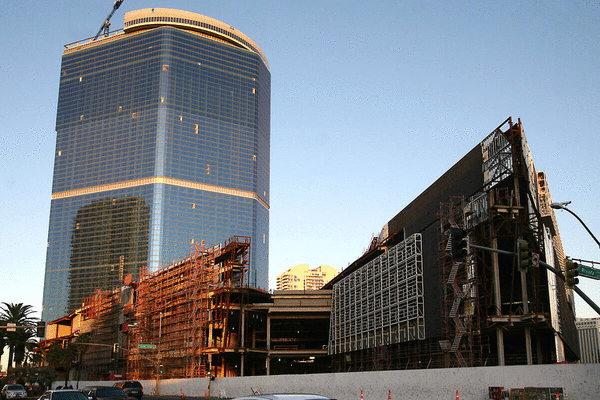
Some of the country’s most pressing problems have a simple solution — remove the regulatory obstacles that slow progress.
One obvious example is housing. The best way to reduce the cost of housing isn’t rent control. It’s to construct 10 million new houses. When supply dramatically increases, prices fall.
There’s an increasing demand for lithium and rare earth minerals. The United States currently imports many of these vital elements. But the nation has significant untapped mineral deposits. Yet thanks to red tape, it can take more than two decades for a new mining project to come online.
These delays and hurdles are typical in virtually every infrastructure endeavor. The Southwest needs more water. Nevada needs access to oil from Eastern states. New infrastructure projects would help alleviate both problems.
In 2022, former President Joe Biden signed the Inflation Reduction Act. It authorized hundreds of billions of dollars toward new green projects. Billions went to build a slew of charging stations for electric vehicles. By the end of 2024, only a few dozen had been built.
Southern Nevada will probably need a new airport in the coming years. Officials here have been planning for this reality since 2006. They hope it will open in 2037.
For most of human history, the biggest problem in accomplishing tasks such as these was practical. Societies didn’t have the technical know-how or tools. Today, it’s an overactive administrative state. Projects, ranging from major undertakings on the scale of Hoover Dam to minor ones such as building a casita, face bureaucratic barriers. Two of the biggest are permitting and environmental reviews.
Consider a chip factory being built near Phoenix. There’s broad agreement that domestically producing cutting-edge computer chips is a national security imperative. Amkor Technology selected a spot to build an advanced semiconductor packaging plant. The facility would put together chips from the nearby Taiwan Semiconductor Manufacturing Co. plant.
Local residents objected, and the company had to move locations. As The New York Times reported, TSMC faced challenges, too.
“Every step requires a permit, and after the permit is approved, it takes at least twice as long as in Taiwan,” TSMC’s chief executive and chairman, C.C. Wei, said last year. He added, “We ended up establishing 18,000 rules, which cost us $35 million.”
This is not an anomaly. Over the past four or five decades, the number of local, state and federal rules and procedural demands have exploded to the point that they undermine ingenuity and accomplishment and represent a very real barrier to getting done what needs to be done. Thirty years to build an airport? Two decades to get a new mine off the ground?
“How things are done has become far more important than what is done,” attorney Philip K. Howard wrote in his 1995 book “The Death of Common Sense.” Process “once existed to help humans make responsible decisions. Process now has become an end in itself.” And a means for activist groups to exploit the legal system to advance their own political agendas.
But is the tide finally turning? After their electoral losses in 2024, there has been a surge of interest among moderate Democrats — their “abundance” agenda — in reducing the obstacles that frequently stall out needed projects. Perhaps they’ve belatedly realized that not building housing in blue states leads people to move to red states. After the 2030 census, Democrats may find that their path to the presidency runs through lean-red states such as Arizona and Georgia.
Even if it’s politically motivated, a bipartisan push to cut red tape is vital to the nation moving forward and meeting future challenges. It’s time to make America build again.
_____
©2026 Las Vegas Review-Journal. Visit reviewjournal.com.. Distributed by Tribune Content Agency, LLC.




















































Comments