Editorial: The number of Americans who feel politically homeless is rising. Understandably so
Published in Op Eds
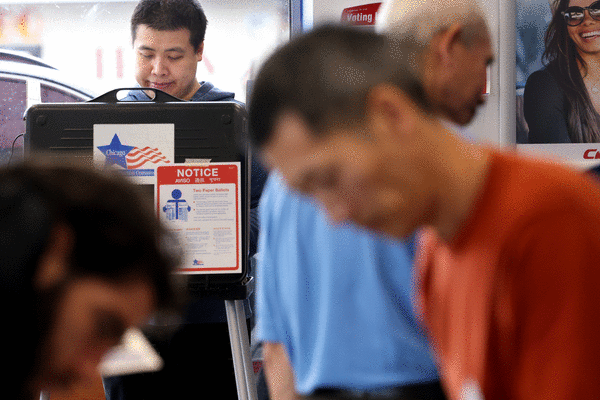
A record 45% of American adults now identify as political independents, according to new Gallup polling — up from 33% in 1990. That’s a big change.
As the ranks of the politically homeless grow, the share of Americans who call themselves Democrat or Republican continues to shrink. That’s hardly surprising.
Both parties increasingly reward the loudest, angriest voices within their coalitions, leaving many voters unwilling to claim a label that no longer reflects how they see themselves. Gallup found that many independents still lean toward one party; nonetheless, their reluctance to wear a partisan badge is telling.
It points to a broader problem: Our political leaders are mistaking a small but furious online minority for the country itself.
There’s a name for the system that thrives on that confusion: the rage economy.
It’s a concept increasingly used by voices such as TV journalist Chris Cuomo and state legislators such as Texas state Rep. James Talarico who discussed the term in a Jan. 13 conversation with Ezra Klein of The New York Times.
Talarico, a Texas Democrat, is in a high-stakes U.S. Senate primary against U.S. Rep. Jasmine Crockett. In his conversation with Klein, Talarico rails against billionaires who he describes as profiting off of news networks, social media platforms and algorithms that divide us instead of bringing us together.
“Because anger sells. Hate sells. Fear sells,” he said. “These billionaires and their platforms are engineering our emotions so they can profit off our pain. They are selling us conflict, and they’re calling it connection. It’s almost like feeding someone empty calories, and I think it has left people starving for actual community, for real relationships.”
Sounds about right, and we expect that such a raw expression of frustration and, yes, outrage, over a media universe hellbent on making us hate each other resonates with most people, especially that growing percentage of Americans identifying as independent.
The online outrage cycle has intensified a kind of pendulum politics, swinging sharply from one administration to the next — two nonconsecutive Trump presidencies sandwiching a Biden era shaped by COVID and cultural battles that often felt overamplified and out of touch with how regular, reasonable people feel.
As we approach the 2026 midterm elections, the signals should be clear: More voters appear to be searching for a return to moderation and common sense. Will politicians take heed? We’re hopeful, but skeptical at the same time.
Both parties are unpopular at the moment. Recent RealClearPolling averages say 52.5% of Americans regard the Republican Party unfavorably. That’s slightly better than the Democrats who stand at 56.2% when it comes to those unimpressed.
Perhaps what we should learn about partisanship during the second Trump era is that while Democrats and Republicans are engaged in mudslinging, a growing number of Americans — especially younger Americans — want no part in it. Most Gen Z voters — and roughly half of millennials — identified as independents in 2025, according to Gallup. We suspect they realize that attack ads and one-upmanship does nothing to benefit the American people.
As both parties worry about how to come out ahead in 2026, we’d encourage less power-grabbing and more soul searching. Winning at the ballot box is step one, and step two is delivering a country — or a state or a city — that works for the people who live there.
_____
©2026 Chicago Tribune. Visit chicagotribune.com. Distributed by Tribune Content Agency, LLC.






























Comments