David M. Drucker: Why congressional Republicans always chicken out
Published in Op Eds
Stop asking me if Republicans in Congress have finally reached their limit and are on the verge of breaking with President Donald Trump. They haven’t and they’re not.
Granted, it’s a fair question.
Trump is testing just how far he can push congressional Republicans without triggering a backlash. There are his threats to take Greenland through unprovoked military force — from North Atlantic Treaty Organization-ally Denmark no less. There are his threats to dissolve the independence of the Federal Reserve. There are his expansive use of tariffs and aggressive immigration enforcement tactics—both constitutionally questionable.
Republicans on Capitol Hill have responded with varying levels of squeamishness.
They’re noticeably uncomfortable with the president’s stubborn fixation on Greenland and the Fed but tend to muffle their discomfort with his trade and deportation policies. The handwringing is fueled by a mixture of ideological opposition, especially in the case of the former two issues, as well as political caution ahead of midterm elections.
On that front, Republicans in the House of Representatives and U.S. Senate, defending slim majorities, are right to worry. Trump’s job approval rating is 42.4% and trending south; Democrats lead the generic ballot, gauging voters’ preference for partisan control of Congress, 46.5% to 42.3%—a margin trending north.
But Republicans in Washington are standing by Trump for one simple (and pragmatic) reason: His relationship with GOP voters is durable and remains particularly strong.
For instance, in a YouGov poll for CBS News fielded Jan. 14–16, the president’s job approval was an abysmal 41% overall, driven by an anemic 31% from independent voters. Yet the same survey showed Trump at a stratospheric 90% among Republican voters.
A recent focus group for The New York Times, overseen by Republican pollster Kristin Soltis Anderson, offers more evidence of this. The “pro-Trump Republicans” who participated in the session conceded some doubts and questions about the president’s agenda. But by and large, their assessments of Year 1 of his second administration ranged from “hopeful” to “appreciative” to “awesome.”
With primary season right around the corner (it begins in March) and with Trump’s endorsement still capable of making or breaking a GOP nomination, it’s no wonder most Republicans in Congress aren’t breaking with the president, nor are they likely to anytime soon. Danny Diaz, a veteran Republican strategist in Washington, told me that not much has changed in this regard in 10-plus years.
“As someone who sees a fair amount of political and issue-based polling, both in on-years as well as off-years, two things have remained constant: No. 1, prognosticators predicting the base will leave President Trump and No. 2, the base sticking with President Trump,” he explained. “After a decade of forecasts that the base will walk away from the president, many of us will need to see in order to believe, as it has yet to manifest itself in the data or in practice.”
Case in point: This month’s Senate floor votes on a resolution to require Trump to come to Congress for authority to order further military action in Venezuela, whence the White House had plucked President Nicolas Maduro without the knowledge or approval of the legislative branch.
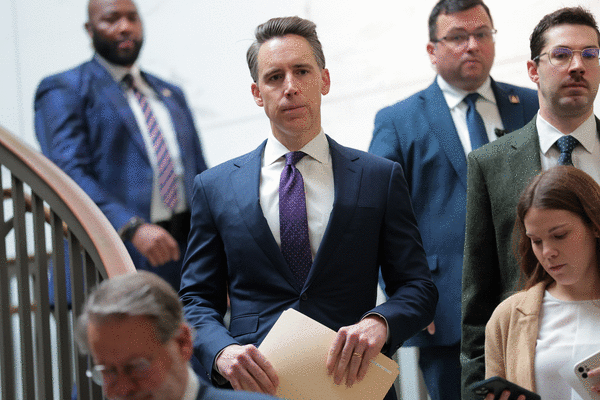
The proposal, offered by Senator Tim Kaine, a Virginia Democrat, initially picked up the support of five Republicans, putting it on the brink of passage. Three of them—Senators Susan Collins of Maine, Lisa Murkowski of Alaska and Rand Paul of Kentucky — were predictable. But the other two, Senators Josh Hawley of Missouri and Todd Young of Indiana, were not. Hawley is typically in lockstep with Trump and Young, although occasionally critical of the president, largely backs the administration’s agenda.
But Hawley and Young abandoned their support for Kaine’s resolution after Trump nuked them and their three Republican colleagues in a social media post, declaring the five “should never be elected to office again.” Hawley and Young did so even though neither is up for reelection this year. Without their votes, the initiative failed. The story arc on this war powers resolution should disabuse anyone paying attention that congressional Republicans are on the cusp of throwing Trump overboard. They probably won’t.
Major League Baseball’s spring training season is just weeks away. And like any committed fan who waits years for a World Series championship, hope seems eternal among certain political observers that "this year will finally be our year" — that prominent Republicans will finally stop whispering complaints about Trump in private and begin crossing him publicly. And like Cleveland Guardians fans, who last celebrated a title in 1948, odds are they’re likely to be disappointed once again.
Of course, the Chicago Cubs and Boston Red Sox ended World Series droughts of 108 years and 86 years, respectively. If the Republicans are blown out in November because voters have had their fill of Trump, perhaps the day will come. Maybe.
____
This column reflects the personal views of the author and does not necessarily reflect the opinion of the editorial board or Bloomberg LP and its owners.
David M. Drucker is a columnist covering politics and policy. He is also a senior writer for The Dispatch and the author of "In Trump's Shadow: The Battle for 2024 and the Future of the GOP."
_____
©2026 Bloomberg L.P. Visit bloomberg.com/opinion. Distributed by Tribune Content Agency, LLC.




















































Comments