Noah Feldman: The Supreme Court doesn't want to break the Fed
Published in Op Eds
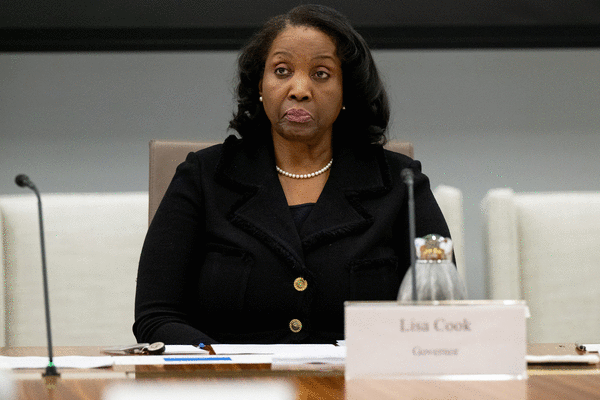
It seems very highly probable that the Supreme Court will allow Federal Reserve Governor Lisa Cook to remain in office despite President Donald Trump’s attempt to fire her. It’s less clear whether the justices will find a way to make the case go away altogether, or whether they will send it back to the lower courts for additional fact-finding or further discussion of the two difficult legal questions in the case: what the for-cause requirement protecting Fed governors from politically motivated removal actually means, and what process a president must follow to fire someone for cause.
Frequently, the justices try to lower the temperature in high-profile, headline-grabbing cases by smothering the lawyers — and by extension, the public — in opaque legal jargon. This time, the justices acknowledged the real-world facts right out of the box at Wednesday’s oral argument. Justice Amy Coney Barrett asked Solicitor General John Sauer about a friend-of-the-court brief filed by prominent economists suggesting that if the court were to overturn a lower court’s stay and allow Cook to be fired forthwith, “we could trigger a recession.”
When Sauer began to answer by saying that there was no reason to worry because the market had already undergone a “natural experiment” when Trump purported to fire Cook in the first place, Barrett interrupted him, saying, “I don't want to be in the business of predicting exactly what the market’s going to do.” For Barrett, the takeaway from that market uncertainty was that although she is “a judge, not an economist,” the existence of the risk would seem to “counsel caution on our part” in a case like this one, where the lower court had issued a stay and, under the law, the justices are supposed to balance the equities.
Barrett is effectively the swing vote on the Roberts Court, so her clearly stated concern about not disturbing the markets was a signal for the markets themselves to relax. What’s more, Barrett ordinarily thinks that the justices should follow the law, not calculate political or economic consequences, which makes her willingness to refer to market effects particularly noteworthy.
The other justice who emphasized the real-world consequences of the court’s decision was Brett Kavanaugh, who has taken the lead in reassuring markets that the conservative constitutional theory of the unitary executive won’t undermine the Fed’s independence. First, Kavanaugh tried to force Sauer to explain why Fed independence was important. Once Sauer reluctantly got there, Kavanaugh lowered the boom, telling him that the Trump administration’s “position that there’s no judicial review [of Cook’s firing], no process required [to fire her], no remedy available [to her], a very low bar for cause that the president alone determines … would weaken, if not shatter, the independence of the Federal Reserve.”
The justices’ concern about how Cook’s firing might affect the agency’s independence, however, doesn’t resolve the tricky legal issues the case raises. Much of the oral argument was spent with the justices pressing Cook’s lawyer, Paul Clement — the brilliant Supreme Court advocate who served as solicitor general under President George W. Bush — on how those issues might be resolved.
Clement put on a veritable oral-argument clinic, offering the justices numerous pathways for resolving the case in Cook’s favor. Chief Justice John Roberts seemed especially interested in finding a way to hold that Trump’s allegations against Cook (which she denies) couldn’t count as grounds for dismissal even if they were accurate.
But getting a consensus among the justices on the legal issues won’t be easy. The reason is that those issues are genuinely subject to reasonable debate. Clement argued, extremely convincingly as it happens, that the words “for cause” in the statute must mean that removal requires inefficiency, negligence or malfeasance. Yet while other statutes define “for cause” in precisely this way, the Federal Reserve statute leaves the term undefined. Ruling that the lack of a definition makes no difference is a tough pill to swallow for justices who claim to be textualists, relying on statutory language rather than legislative intent.
As for the procedure required for a president to fire someone for cause, the court would effectively have to invent one. During his presidency, William Howard Taft fired two members of the federal Board of General Appraisers for cause after appointing a special committee of inquiry at the suggestion of the young jurist Felix Frankfurter, who served on the committee (and later the Supreme Court). Requiring such a committee would seem excessive by today’s standards. Yet the court would doubtless prefer to avoid designing a special procedure to cover such firings — particularly given that, except for the Fed, the same justices have now held that presidents generally can’t be barred from making for-cause firings of Senate-confirmed officers.
The upshot is that, while Cook and the markets should sleep easier now, it’s conceivable that the case will continue to limp along if the chief justice can’t craft a majority to resolve it once and for all. There’s an old adage that hard cases make bad law. This is an easy case on the facts — but the law is hard, and so the justices have their work cut out for them.
____
This column reflects the personal views of the author and does not necessarily reflect the opinion of the editorial board or Bloomberg LP and its owners.
Noah Feldman is a Bloomberg Opinion columnist. A professor of law at Harvard University, he is author, most recently, of “To Be a Jew Today: A New Guide to God, Israel, and the Jewish People."
©2026 Bloomberg L.P. Visit bloomberg.com/opinion. Distributed by Tribune Content Agency, LLC.





































Comments