Editorial: EPA shouldn't try to hide the benefits of clean air
Published in Op Eds
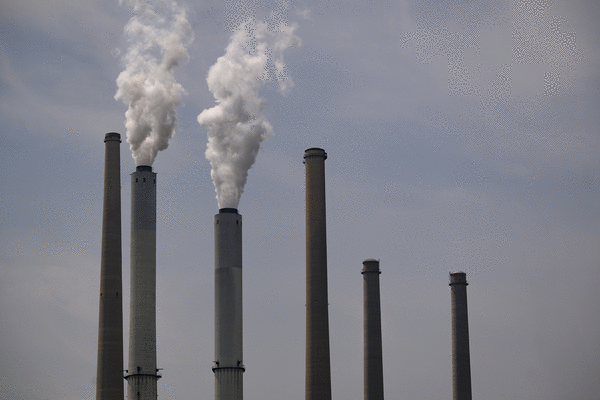
The Environmental Protection Agency’s decision to stop quantifying the health benefits of regulating soot and ozone is a victory for polluters and a loss for the public. Masking the benefits will make it easier for the EPA to defend lax regulations on toxic emissions but harder to make America healthy again. More people will get sick and die, and the EPA will bear some of the blame.
For decades, under both Democratic and Republican administrations, the EPA has conducted cost-benefit analyses of its air-pollution regulations. Fewer asthma attacks, for instance, produce lower medical costs, less missed work and higher productivity rates. Those economic benefits are given a dollar value that can be placed beside the costs that businesses incur complying with the regulations.
Such analysis is routine among government agencies, yet the EPA claims that past calculations have “often provided the public with false precision and confidence” regarding the monetary value of the health benefits. It’s true that determining their dollar value is an inexact science, and it’s fair to debate what variables belong in the formulas, how calculations should be drawn up, and what caveats or ranges should accompany the findings. But it’s foolish to walk away from the exercise entirely.
Exposure to PM2.5, fine particulate matter more commonly known as soot, is associated with asthma, heart disease, lung cancer and other serious illnesses, as well as dementia in seniors and low birth weight in babies — all of which carry economic costs. As the State Department’s website currently notes, “The World Bank found that air pollution costs the U.S. economy over $790 billion per year or approximately 5% of our GDP in economic welfare losses.”
The EPA maintains that it will continue to consider the health benefits of soot and ozone regulations, just not monetarily. But dropping the dollar value of the benefits will have the effect of highlighting only the dollar value of the costs. Not only does the public deserve to see the two side by side, but policymakers ought to be considering both sides of the balance sheet in determining the proper scope of regulations.
The EPA’s decision is part of a broader effort to pretend that air pollution isn’t a serious problem. Recently, the agency announced that it will attempt to keep all coal plants running, even when cleaner, cheaper power sources exist. Earlier this year, it forced a Michigan company to keep operating a coal plant against its wishes, with ratepayers across the Midwest picking up the tab — about $1 million a day. Now, the Energy Department is allocating up to $525 million in subsidies to build or upgrade coal plants.
Meanwhile, nearly half of Americans live in places with unhealthy levels of air pollution, a problem that climate change can worsen. Just days after the EPA announced its decision, it also urged communities in certain parts of California, Georgia, Nevada and Oregon to remain indoors because of “unhealthy” levels of soot.
The administration is taking the wrong tack on pollution because it mistakenly thinks that improving air quality and strengthening the economy are at odds. In fact, they’re consistent and complementary goals. As many mayors can attest, people want to live in places where the air won’t make them sick. And where people want to live, businesses want to invest. Cleaner air is a means, not a hindrance, to economic development.
The EPA’s attempt to hide the true costs of air pollution is a dereliction of its duty that will be harmful not only to health, but also to the economy. Americans deserve to know more about just how harmful it will be.
_____
The Editorial Board publishes the views of the editors across a range of national and global affairs.
_____
©2026 Bloomberg L.P. Visit bloomberg.com/opinion. Distributed by Tribune Content Agency, LLC.











































Comments