COUNTERPOINT: Higher education may be beyond saving, unless...
Published in Op Eds
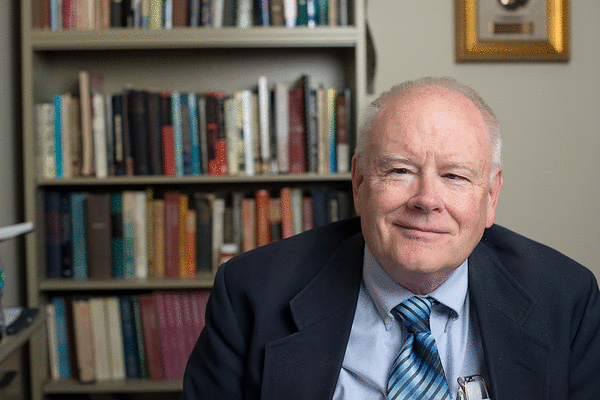
I’ve spent more than two-thirds of a century (since 1958) at American universities. Never in all those years has their earned and deserved reputation as the best in the world suffered bigger threats than today.
U.S. colleges and universities not only have behaved abysmally, but they’re now paying a high price for showing contempt for the prevailing values of the public that sustains them.
College is too expensive; graduates seem to be increasingly ill-equipped for the workplace; new technologies may be reducing a degree’s value to employers; the federal government is cutting financial support and making new demands; other nations are challenging our research preeminence, and, arguably the worst of all, falling fertility rates are reducing the size of the potential future student pool.
Getting trained as a plumber, welder or home healthcare aide increasingly looks more attractive than getting a degree in gender studies, sociology or even computer science.
Can and will universities be saved, overcoming this crisis? Not without some serious behavioral modification.
Our nation needs highly educated people with leadership qualities and integrity. Second, college also provides our generally affluent population with an enjoyable and often useful transition between adolescence and adulthood. It is a pleasant gap period between childhood and adult living. In the lingo of economists, universities are “consumption” and “investment” goods.
As I argue in my book “Let Colleges Fail,” the very real threat of “creative destruction” propels the competitive, market-driven private sector into often-painful changes. Failure to innovate and cut costs can be extremely costly or even fatal — look what happened to the once spectacularly successful Blockbuster, Eastman Kodak, and Toys “R” Us, to name a few. This threat of corporate death is largely responsible for our nation going from a poor farm-based economy to humankind’s most prosperous society during its 250 years.
Subsidies from governments (including federal student loan subsidies and unjustified loan forgiveness) and private philanthropists (often in the form of large endowments) have substantially cushioned universities from the consequences of their inadequate responses to needed change.
They have similarly encouraged the growth of campus communities contemptuous of the values that have made America affluent and a global leader. The universities have sneered at the people who are feeding them.
To be sure, there are some hopeful new developments. Some major private donors are withdrawing contributions in disgust, and the federal and some state governments, as well as the courts, have attacked higher education’s administrative bloat and anti-merit DEI policies.
Under political and donor duress, some schools have adopted statements promising institutional neutrality on issues of the day — even those about which administrators, faculty and students may be most vocal. University governing boards are also appropriately imposing rules governing behavior and becoming less rubber stamps for administrative wishes.
Still, inefficiencies and insufficient academic diversity remain big problems.
Let’s pose five embarrassing questions: Why does it take three years to earn a bachelor’s degree at Oxford University and at European universities generally, but at least four years in the United States? Why are American universities, using honest accounting procedures, losing billions of dollars annually on collegiate ball-throwing contests (football and basketball), unknown in the rest of the world? Why do typical college students spend fewer hours on academics than eighth graders, with few adverse consequences for their laziness? Why are plagiarism and data manipulation leading to a serious decline in the perceived integrity and utility of research findings? Why does it take more people to educate a college student today than in, say, 1960, while in other economic areas U.S. workers “are now roughly 250 percent more productive than their 1960 counterparts”?
With college closings increasing (“creative destruction”), market realities are starting to take hold, especially among adults in critical roles, such as university governing boards. They are asking more questions and demanding non-platitudinous answers.
However, the woke supremacy dominating many schools will not give up easily, and achieving greater intellectual diversity takes time and money, both in short supply.
Americans are usually good in times of adversity. Whether that will hold true for American higher education, still the most respected in the world, remains to be seen.
_____
ABOUT THE WRITER
Richard K. Vedder is a senior fellow with the Independent Institute and the Committee to Unleash Prosperity, and a distinguished emeritus professor of economics at Ohio University. He wrote this for InsideSources.com.
_____
©2026 Tribune Content Agency, LLC


















































Comments