Commentary: What we teach AI about our fellow animals -- and what it says about us
Published in Op Eds
As Super Bowl Sunday approaches—the second biggest food consumption day of the year—tons of people will ask AI for party recipes. Ask any AI for pork tacos, and it will quickly spit out several versions. But ask for cat tacos, and it will offer a lecture on morality instead of a shopping list. The contrast isn’t an error in code—it’s a mirror. And it reflects something hard to see: our own biases toward fellow animals. It’s up to us to change our hearts, and AI will then follow our lead.
As philosopher Peter Singer and researcher Tse Yip Fai recently observed, large language models “inherit the biases of their creators and their training data.” And in a society steeped in speciesism, AI learns a simple rule: Some animals are cherished companions; others are dinner. In other words, the algorithm is fluent in our moral contradictions.
Speciesism is the belief that one species matters more than another. Many of us learn this bias in childhood. We’re taught that puppies and kittens are “friends,” while cows and chickens are “food.” This arbitrary hierarchy shapes how we think, speak and shop. It’s why otherwise kind folks can cry over an abused dog yet give little to no thought when eating a chicken wing that was hacked off a bird.
We can overcome a culture of speciesism. We’ve done it before. As a society, we’ve challenged other prejudices once seen as normal, from racism to sexism. Speciesism is simply the next frontier of compassion, and many of us are already working to dismantle it.
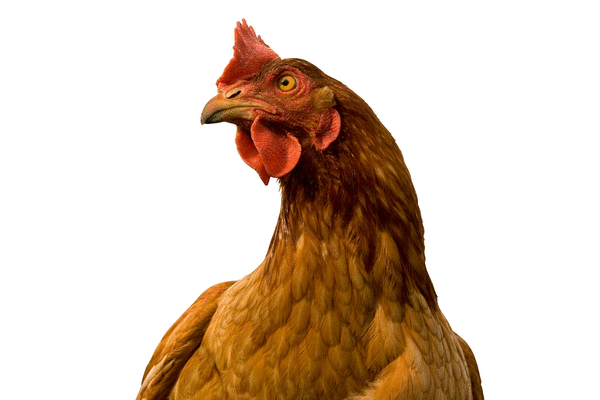
So let’s start by remembering that every animal is a someone—not a something. Chickens form friendships and mourn the loss of flock mates. Mother cows bond deeply with their calves. Scientific consensus now recognizes fish as sentient beings capable of experiencing suffering. Meanwhile, billions of animals are killed globally every year for food on land. That number is over a trillion when we add in fish.
The harm doesn’t stop with animals. Animal agriculture is also a leading driver of climate catastrophe, deforestation, water pollution and biodiversity loss. The United Nations has identified animal agriculture as one of the most significant contributors to greenhouse gas emissions, and researchers at Oxford University found that shifting to a vegan food system could reduce global food-related emissions by up to 70%. When we talk about compassion for animals, we’re also talking about the livability of the planet itself—our shared home.
Change starts with us—including how we use language in our own lives every day. Let’s stop calling an animal “it.” And let’s buy products not tested on animals and choose animal‑free clothing. And please, let’s leave animal flesh, eggs and dairy off our plates.
We’re living at a moment when AI is rapidly being threaded into daily life. It’s moving into our kitchens, grocery carts and meal‑planning apps. So it’s more important than ever not to let machines automate our cruel biases. It can start with the simplest act of all: asking better questions.
Ask AI for vegan Super Bowl recipes—crispy vegan wings, smoky jackfruit sliders, dairy-free queso that disappears before halftime, chili thick with beans and spices and nachos piled high without cheese from the milk of a grieving mother. Every search teaches the machine what matters. And every meal cooked without animal-derived ingredients helps our fellow earthlings.
AI may be a mirror, but we decide what it reflects. Let’s make sure it reflects kindness.
_____
Rebecca Libauskas is a climate research specialist for the PETA Foundation, 501 Front St., Norfolk, VA 23510; www.PETA.org.
_____
©2026 Tribune Content Agency, LLC.





















































Comments