Commentary: State violence can dehumanize us all. But you aren't powerless
Published in Op Eds
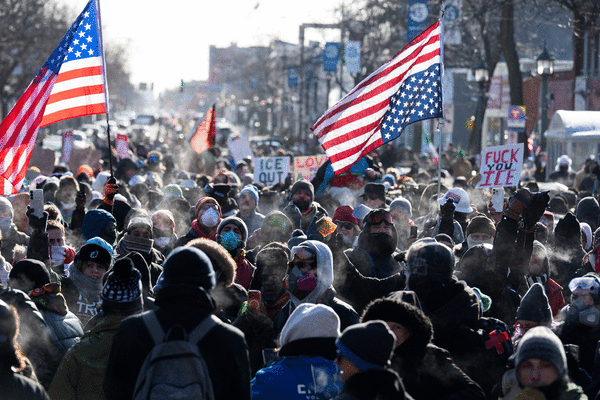
Millions of us saw what the killers did to Renee Good and Alex Pretti on the icy streets of Minneapolis. Millions of us are witnesses to the violence.
Like it or not, this forces us to make a decision. We know what happened — what are we going to do about it?
For many thousands, the answer is to keep showing up and speaking out. The good people of Minneapolis are carrying on the work of Good and Pretti. They are bearing nonviolent witness to a campaign of dehumanized violence against immigrants and people of color. In the face of terrifying armed aggression, they are fighting back, armed only with their humanity.
As disaster rages around them, they have decided to be the helpers. And in working to save immigrants, they are also saving themselves.
Today I’m asking everyone, all of us, all across the country — to do the same. I’m not asking you to step into any line of fire. We don’t want more martyrs. I’m just trying to persuade you to take some action wherever you are, now, today, this week — to stop yourselves from being dehumanized.
At this moment, in this terrible time, we should all be deeply worried about state violence. Worried about the death of our democracy. Worried about the violations of human rights that always go hand in hand with dehumanization. But although we all talk of President Trump dehumanizing his many enemies and victims, too few of us are identifying the dehumanization of the rest of the population, of those not in the deportation crosshairs.
I am speaking, respectfully, of you — you who are watching the news, sharing the videos, reading op-eds and wondering what to do.
People can bring dehumanization upon themselves when they commit cruelty and violence. When they brutalize the weak and innocent. But they can also shed their humanity when they tolerate such abuse by others, or ignore it, or allow themselves to grow numb to it.
Facing up to horrors is difficult. But we damage our souls by tuning out. The rabbi Abraham Joshua Heschel, a refugee and survivor of Nazi genocide, warned of the danger when he said that the opposite of good was not evil but indifference. “There is an evil which most of us condone and are even guilty of: indifference to evil,” he wrote. “We remain neutral, impartial, and not easily moved by the wrongs done to other people.”
This is one reason the second Trump administration has been a humanitarian catastrophe — not just for immigrants who live face to face with terror every day, but also for Americans who are going on with their lives, looking in the other direction.
This dehumanization doesn’t happen immediately. Of course we are moved by tragedy and sickened by state-sanctioned brutality. We feel anger and anguish. We want to do something. But over time we feel helpless. And when the next video circulates, we might not click the link. We close our eyes. We distract ourselves with something less grim.
I’ve been defending immigrant workers ever since I immigrated here myself from El Salvador in the 1990s. All of our efforts at the National Day Laborer Organizing Network have been to build immigrant power from the bottom up — often in the face of dehumanizing language and harassment. Where there are large groups of day laborers, mostly men, seeking work in public, we have worked, joyfully, to defend their rights, ease neighborhood tensions and help them make their communities more prosperous.
We immigrants have faced xenophobic headwinds for decades, but things got precipitously worse after 2015. Trump went down his golden escalator and said he was running for president to stop the flow of rapists and criminals from Mexico. Everything since then — the border wall, the Muslim bans, the workplace raids, the deportation quotas, the vigilante gangs, the slurs and lies about “shithole countries” and immigrants eating cats and dogs, the executions in the street — has been built on and flowed from the attempted dehumanization of brown and Black immigrants.
Two innocent white allies of immigrants were slaughtered in Minneapolis this month, by armed men enforcing Trump’s dehumanizing lies. But innocent Latino shoppers were also slaughtered at a Walmart in El Paso in 2019 by a man who believed Trump’s dehumanizing lies. Last September, a Mexican immigrant, Silverio Villegas González, was shot dead by federal agents near Chicago. These shootings are steadily increasing and all are horrifying, though not all of them have resonated equally.
Then there are the deaths in immigration detention and the deaths from causes other than gunfire. If you know about the tragic toll and turn the page, if you see and look away, then you, too, have been dehumanized. If you have no more time or patience to read the stories about the violence and terror, if you are numb to the point of indifference about deportations, torturous detention conditions, the suffering of little children separated from their mothers and fathers— then I would suggest that maybe it’s your humanity in peril.
We cannot succumb to indifference. We cannot give in to helplessness — that’s where dehumanization happens.
Think of the shameful acts of the men with masks and guns. The ICE agent who puts on his boots and armor and mask, and makes himself into a faceless instrument of terror. No wonder he hides his face! There is no pride in his work, only shame. Whatever tokens of humanity he might possess — kindness, understanding, mercy — he sheds for his shift. He is failing the test.
Is there any escape from this dehumanization trap? The Brazilian philosopher Paulo Freire says yes. “As the oppressors dehumanize others and violate their rights, they themselves also become dehumanized,” he writes. But when the victim stands up and resists, something shifts: “As the oppressed, fighting to be human, take away the oppressors’ power to dominate and suppress, they restore to the oppressors the humanity they had lost in the exercise of oppression.”
In the first Trump term, people often remarked that “the cruelty is the point.” This time it’s the numbness.
What can we do to free ourselves and our country? Something. Anything. Just don’t remain silent. Don’t go on about your day. Do something in your community. Do something good for someone this president hates and targets. Visit someone stuck at home. Patronize an immigrant small business. Adopt a day-labor corner. Join an ICE watch patrol. Give to a GoFundMe campaign. Go to a food bank. Share this op-ed. Post something on social media.
You don’t have to fail. There’s a lot you can do. Be good. Be yourself. Be human.
____
Pablo Alvarado is co-executive director of the National Day Laborer Organizing Network, which advocates for immigrant- and low-wage workers.
©2026 Los Angeles Times. Visit at latimes.com. Distributed by Tribune Content Agency, LLC.














































Comments