Lisa Jarvis: Even tech skeptics can cheer AI's promise in decoding the 'dark genome'
Published in Op Eds
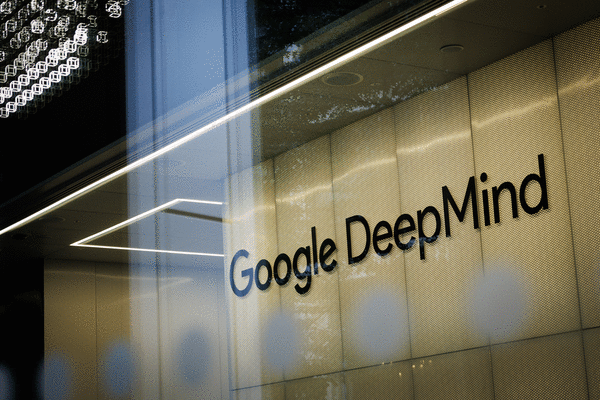
Google DeepMind, the artificial intelligence subsidiary of Alphabet, has made another leap in its efforts to illuminate human biology: progress toward using AI to interpret the many still-mysterious chapters in the text of life.
DNA sequencing, once a gargantuan feat, is by now cheap and easy. Deciphering the billions of letters in that code, however, is another story — particularly when it comes to understanding which of the many naturally occurring typos in the text are harmless, and which are implicated in disease.
Enter DeepMind’s AlphaGenome, a platform that, as is outlined in a Nature paper published last week, seeks to connect those typos to a particular function. This could potentially have lots of real-life applications: speeding up efforts to predict the impact of a rare genetic disease; determining which of the many mutations cropping up in a patient’s tumor is driving their cancer; and accelerating the development of genetic medicine, to name a few.
It will take a lot more work for those ambitions to be realized. Yet the rapid advances in using AI to imbue meaning in the 3 billion letters in our DNA should still be celebrated.
DeepMind has made incredible inroads in using machine learning to translate the text of the genome into biological insights. By far its most prominent advance — one that in 2024 earned its researchers a Nobel Prize — has been the development of AlphaFold, a program that predicted the 3-D structure of virtually all known proteins in nature from their genetic sequence. As I’ve written before, that tremendous feat instantly became a bedrock of drug development.
AlphaGenome is tackling a far more complicated problem. Each one of our cells carries the same set of genetic instructions, yet different types — a heart cell, for example, as opposed to a liver cell — behave in wildly different ways. This complex orchestration is conducted by the “dark genome,” the huge stretches of our DNA that control the genes that determine when, where and by how much various proteins are made.
So much of that orchestration remains a mystery — one with real-world consequences. Every day, oncologists sequence patients’ tumors to try to pinpoint the drivers of their cancer, tailor treatment, and predict the course of their disease. Yet doctors “get information we don’t know what to do with all the time,” says Omar Abdel-Wahab, a physician-researcher at Memorial Sloan Kettering Cancer Center. When they spot a new typo in someone’s DNA, they want to know if its function is important or not.
That’s where AlphaGenome comes in. It can predict nearly a dozen types of tasks from a sequence, such as whether it tunes the volume on a gene or where a gene is snipped apart. Some of those functions are already addressed by existing tools used by researchers, and in the Nature paper, DeepMind scientists showed that AlphaGenome performed as well as or better than all of them. (Abdel-Wahab, for example, is already using a tool called Splice AI to predict whether a patient’s mutations are relevant, and told me he is impressed that AlphaGenome appears to outperform it.)
The work comes with plenty of caveats. For starters, DeepMind’s platform works well for predicting some gene functions, but not all of them. Scientists tell me that for now, it might best be considered a filter rather than a finder — that is, it can efficiently narrow down the possible disease drivers, rather than confidently pinpoint the culprit.
And right now, AlphaGenome can only make predictions about certain types of cells, a limitation that has less to do with the power of the algorithm than the lack of experimental data for it to train on. That’s a problem that can’t be solved by ingenious engineering alone, says Peter Koo, a professor at Cold Spring Harbor Laboratory who develops deep learning methods for connecting genes to their function. “They’re pushing us towards the plateau of what we can achieve with existing data,” Koo says.
Progress, ironically, depends on humans in the lab — biologists who can catalog the most critical data AlphaGenome needs to advance. That work should be done thoughtfully, with an eye toward prioritizing experiments that will help improve the models, Koo says.
As the scientific community learns about where the DeepMind tool can be most useful and builds out the data needed to make it even better, Although DeepMind has made the tool freely available for non-commercial use, it’s easy to imagine those lines blurring as academic labs make discoveries based in part on its use—even as their own data might have contributed to improving its accuracy.
Much like AlphaFold, AlphaGenome would not be possible without access to large, publicly available, publicly funded datasets. At a moment when funding for government-sponsored research is tenuous, the advance should be a reminder of the value in the bread-and-butter work performed by scientists in the U.S. The impact can stretch far beyond one project or one patient — it could one day be the foundation for the next game-changing technology.
_____
This column reflects the personal views of the author and does not necessarily reflect the opinion of the editorial board or Bloomberg LP and its owners.
Lisa Jarvis is a Bloomberg Opinion columnist covering biotech, health care and the pharmaceutical industry. Previously, she was executive editor of Chemical & Engineering News.
©2026 Bloomberg L.P. Visit bloomberg.com/opinion. Distributed by Tribune Content Agency, LLC.



















































Comments