Commentary: Sociology is taking it on the chin. Here's how we can preserve this critical field of study
Published in Op Eds
After the dreadful year 2025, I’ve decided to parse my anger. It’s a good time to specialize so as not to wear out one’s psyche.
There are so many reasons to be mad; the mostly baseless and endless attacks on higher education, the dismantling of life-saving research, ICE, the subverting of policy that redresses shameful social harms. But the main focus of my anger, at least right now, is because my discipline is taking it on the chin. And I’ve decided to take it personally.
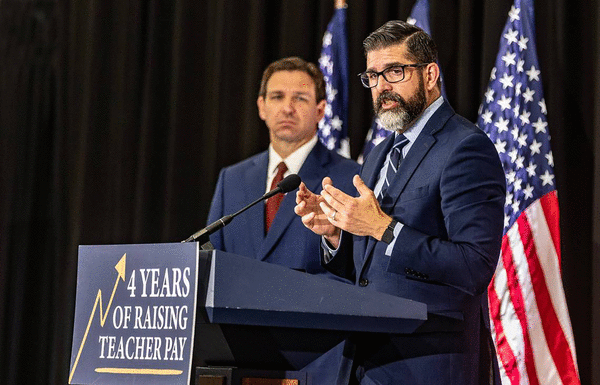
My field is being portrayed as one of the more “woke” — read ideological — disciplines. We sociologists infamously inculcate our innocent students with communist ideals. As Florida Gov. Ron DeSantis’ commissioner of higher education, Manny Díaz, posted in 2023, sociology “has been hijacked by left-wing activists and no longer serves its intended purpose as a general knowledge course for students.”
This, to justify excluding sociology classes as meeting core requirements, now the status quo for all state universities in Florida. For now, Oklahoma’s efforts to impose new standards on social science curriculum in K-12 courses to make it more Donald Trump-friendly has been stopped by its Supreme Court.
Sociology is often framed as disposable in ways that history or English never would be, even as the future of the humanities is being endlessly debated. Sociology departments are among the first to go when budgets are cut, “consolidations” occur, or when faculty are too political, too fractious, or too whatever.
Administrators report that many students are now afraid of having sociology classes on their transcripts, as this may put off potential employers. The reasons sociology is under threat may be due to the distinctive contributions it makes to higher education and more broadly, to society: It teaches better thinking; there is a fundamental focus on inequality; it synthesizes findings from multiple disciplines; and it interrogates values, ideas and power within systems.
I’ve spent nearly 40 years teaching sociology at three radically different universities: at Arizona State University, a giant, state school known for its first-gen students and parties; at the University of Chicago, a proudly self-selecting “nerd” school where rigor is sardonically celebrated (a popular T-shirt — “Hell does freeze over”); and at Northwestern University, a private, formerly Methodist, research university that is being extorted, my word, by the Trump administration into paying $75 million for the privilege of continuing to do pioneering, federally funded research.
Some regard sociology as a gut major that caters to lackadaisical students. (But for anyone who took the required, “Mind, Self and Society” aka “Self, Torture and Anxiety” at the University of Chicago, this would be a baffling image). Our majors are told they are unemployable, that what they have learned is irrelevant to good jobs and that if a field isn’t STEM adjacent it’s a waste of time. Yes, the job market is tough, and many parents have asked the timeless question: “What do you do with a degree in sociology?” One answer: Make better sense of your life and times. Shorter answer: Think better.
Like most stereotypes there is a glimmer of something truthful in the depiction of sociology as “woke.” Yes, most sociologists trend liberal. Inequality, in all its iterations, is fundamental to the field and if you study it long enough it’s challenging not to want to intervene. We are home to many activist scholars or policy experts who do not see a contradiction in that term. (Do we consider climate scientists activists when they try to educate the broader public or shape policy? And, if so, is this a bad thing?)
Another contested feature is its breadth. The specialization that cedes politics, economics or communication to separate disciplines is, in sociology, an invitation to synthesize and to consider how these broad social processes engage, reinforce or conflict with one another.
Another feature is the importance of thinking across levels of analysis: that is, how do global structures affect nations, organizations, groups and individuals and vice versa? Say, for example, did COVID, a global pandemic, change the delivery of health care, parenting strategies, long-term career goals, how much time teens spend in their bedrooms, or decisions about having children?
One criticism of sociology, that it has no single defined methodology, is also a strength. Sociologists routinely use computational methods, statistical analysis, interviews, archives and ethnography in their search for useful data. This methodological eclecticism leads to innovative insights. Moreover, sociology is one of the best empirical fields for interrogating the consequences of different values, for how ideas get built into institutions, for how social networks operate across domains. It is no surprise that it is the field that invented network analysis, an insight and a method that helps us understand how people get jobs, how gang violence spreads and why some teen girls are queen bees while others are fodder.
What to do about the crisis that sociology confronts? If you are a student, go take a sociology class, even if you don’t get core credit. Read some sociology. Chances are, what you learn won’t align with what the demagogues are saying. And if you don’t like our findings, argue with us. With data and logic. More importantly, show up for midterm elections. For most people, action, cultivating a sense of agency, beats seething. This, too, is a fundamental sociological insight. So, stay mad but get going.
____
Wendy Nelson Espeland is professor emerita of sociology at Northwestern University. She is the co-author, with Michael Sauder, of “Engines of Anxiety: Academic Rankings, Reputations and Accountability.”
_____
©2026 Chicago Tribune. Visit at chicagotribune.com. Distributed by Tribune Content Agency, LLC.


















Comments