Editorial: The Rev. Jesse Jackson was a formidable Chicago activist and achiever
Published in Op Eds
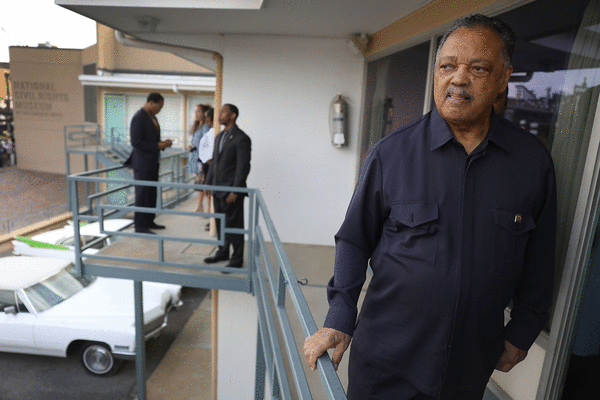
In 1988, the power brokers of the Democratic Party watched a Chicago civil rights leader, a maverick with a movement he called a “Rainbow Coalition,” start to threaten the presidential candidacy of Massachusetts Gov. Michael Dukakis. They’d expected him to do well with Black voters, but not to win easily the state of Michigan or make major inroads within Americans of all stripes.
As CNN’s Abby Phillip noted in her recently published book, “A Dream Deferred,” the rise of Jesse Louis Jackson was viewed with considerable alarm by party pundits and consultants. They feared having no choice but to nominate Jackson for president if he secured the most convention votes (by not doing so, they certainly would alienate the Black voters the party needed). Defeat, they thought, would surely follow his nomination.
It is easy to forget, of course, that Jackson was only the second Black candidate to seek a major political party’s presidential nomination following Shirley Chisholm in 1972. But Jackson had figured out better than most white candidates how to secure small donations from supporters or, more broadly speaking, how to get buy-in from ordinary Americans. And when the subsequently disappointing primary results in Wisconsin put an end to Jackson securing that nomination, he knew how to pivot and use his newfound national power to successfully push for an overhaul of Democratic Party rules. They were changes that Phillip argues probably made it possible for another outsider from Chicago, Barack Obama, to become president of the United States.
In later years, Jackson never stopped fighting for causes large and small. The small stuff rarely made national news.
In 2019, this editorial board wrote about his efforts to bring natural gas to Pembroke Township, population about 1,800, in Kankakee County. Jackson did not want the residents there, who had seen one broken promise after another, to have to continue to rely on space heaters. This quest was hardly akin to negotiations in the Middle East or the kind of civil rights efforts that made him famous, but it made a big difference if you happened to live in Pembroke Township.
The year before, Jackson had been involved in a demonstration that closed part of the Dan Ryan Expressway, a mass expression of frustration over gun violence. Shortly thereafter, Jackson visited this editorial board.
“I saw the broadest cross section of people,” he said of the march, organized by the Rev. Michael Pfleger. “It was nonviolent. It was disciplined. People stood in the hot sun and waited. There was an unusual spirit at that march Saturday.”
Wherever Jackson went, an unusual spirit usually was not so far away.
He’d risen to prominence as one of the Rev. Martin Luther King Jr.’s inner circle (he’d met King in Selma after Bloody Sunday in 1965) and as a member of the Southern Christian Leadership Conference, but in the end, he was the head of not just one but several movements, from Operation Breadbasket and Operation PUSH (People United to Save Humanity) to his National Rainbow Coalition, established in the mid-1980s to campaign for human rights.
Chicago, where he first arrived in 1964 to attend the Chicago Theological Seminary and died Tuesday at age 84, was always at the center of his life and work.
When the SCLC first came to Chicago in 1965, after wanting to expand its work to a Northern city, Jackson was already organizing on the city’s South Side and volunteering at the West Side Christian Parish. Jackson’s local standing, especially with Black clergy, helped Jackson become a pivotal part of the Chicago Freedom Movement, which was focused on housing discrimination with the aim of putting an end to the city’s slum housing. Only after the the Freedom Movement threatened to march into Cicero was an agreement reached with Mayor Richard J. Daley and City Hall that resulted in the demolition of hundreds of abandoned buildings, with many hundred others brought up to city code.
King and the SCLC moved on, but Jackson remained based in Chicago. In 1966, King chose Jackson as the head of the Chicago chapter of its Operation Breadbasket, an activist group that set about organizing Black purchasing power to pressure white businesses to hire Black people and buy goods and services from Black contractors. By 1971, Ralph Abernathy was running the SCLC and was at odds with Jackson, whom he had accused of “administrative improprieties.” That conflict led Jackson to establish his own Chicago beachheads, including Operation PUSH, which eventually became the Rainbow PUSH Coalition, carving out a much broader vision than Operation Breadbasket, working in the arenas of social justice and civil rights.
Jackson, of course, got up in people’s faces, and there were some who did not appreciate his work. He had an uneasy relationship with the Black Panthers, not least because Jackson’s aims were reformist first and (contrary to the stereotype) radicalist second. He mounted an anti-abortion rights campaign after Roe v. Wade, which proved controversial. And he was often a thorn in the side of the white establishment, which sometimes labeled him as an opportunist, or someone whose machinations led to cronyism at best and corruption at worst.
Those criticisms waned over time. For there can be no doubt that Jackson improved life immeasurably, and in concrete ways, for Black Americans and for Black Chicagoans in particular.
Jackson and his allies hit the airwaves, handed out awards and persuaded big business to hire more Black managers and buy more of the things they needed from Black-owned companies. Many of their boycotts won results, especially the 1982 boycott of Anheuser-Busch. Jackson won his own show on CNN. He even hosted an episode of “Saturday Night Live!”
Jackson raised his children on Chicago’s South Side in a large Tudor-style home in Jackson Park Highlands, a home frequently filled with activists, diplomats and other international guests, often coming to Chicago specifically to see Jackson and sticking around to learn more about the city, valuable in itself. His children — Jesse Jr., Yusef, Jonathan, Ashley, Jacqueline and Santita — clearly felt the pressure of their father’s fame. (Branden Jacobs-Jenkins’ hit play “Purpose,” first staged in Chicago and then on Broadway, was a thinly veiled version of the challenges of life in the intense and famously competitive Jackson family.) “You must get children in the environment of achievers,” Jackson told Chicago magazine in 2012. “The environment of achievers can be contagious.” And difficult, he might have added.
Indeed, Jackson himself was contagious. Across decades.
Few Chicagoans can claim they were a famous civil rights activist, a human rights activist and a presidential candidate who came close to winning the nomination of the Democratic Party, and then got a lot of people across the world out of jail.
“Everything that I’ve done has been in some context,” Jackson said on his 65th birthday in 2007 when asked to weigh his achievements and failings, “and I’m convinced that we look back like the true judge and ultimately you judge yourself by your cumulative box score. It’s not the home run you hit one inning; it’s not the strikeout the next inning. It is the box score. And our box score — my batting average — has been one I can accept.”
We should all agree with that, given that we are unlikely to see his like anytime soon.
___
©2026 Chicago Tribune. Visit at chicagotribune.com. Distributed by Tribune Content Agency, LLC.



















Comments