Commentary: Leave sheep off the catwalk
Published in Op Eds
Fashion week isn’t just a parade of clothes. It’s the cultural weather report, telling us what’s fresh, what’s fading and what the industry is finally ready to leave behind.
As designers debut the looks meant to define what we’ll wear next fall and winter in London, Milan, New York and Paris, they are proudly ditching fur, feathers and wildlife skins in favor of cutting-edge, animal-free materials that look luxurious without costing lives. Yet even though wool is equally outdated and cruel, some still stubbornly cling to it.
A new survey of over 2,000 U.S. adults commissioned by PETA and conducted by The Harris Poll reveals just how out of step the wool industry is. The issue isn’t that consumers are willingly choosing cruelty—it’s that they’ve been sold a fantasy, a sweater-weather fairy tale.
But the truth? It’s far from cozy.
The wool industry has spent decades selling softness while hiding the violence behind it. The poll found that 64% of Americans were unaware that sheep in the wool industry are sent to slaughter once their wool production declines. Sheep raised for wool are treated as production units, bred to grow excessive fleece and subjected to painful procedures—including holes being punched in their ears and large parts of their tails being cut off—from the time they’re babies.
The poll also found that 73% of Americans would likely reconsider buying wool if they learned that sheep are mistreated even on farms that claim to treat them “ethically” or “responsibly.” That hesitation makes sense. PETA entity investigations around the world—including on certified farms—have documented that shearers punch, kick and stomp on sheep, leaving them bloodied and injured. When sheep are no longer profitable, they’re shipped to slaughterhouses, where their throats are slit. No amount of rebranding can make that “humane.”
Perhaps the most telling statistic is this: If given a choice between a wool item and a non-wool option with comparable warmth, comfort, durability and style, 70% of Americans would choose the non-wool one.
Fashion doesn’t have to be a choice between style and compassion. The fabric revolution is already here.
Designers now work with next-generation materials that rival wool in warmth, durability and style—without harming animals. Those made from seaweed, mushrooms, bamboo, recycled fibers and agricultural waste are transforming sweaters, coats and accessories. These materials aren’t a compromise—they’re an upgrade. They’re breathable, soft, climate-smart and increasingly favored by brands that understand where fashion is headed next.
Fashion isn’t moving backward—and neither should our closets.
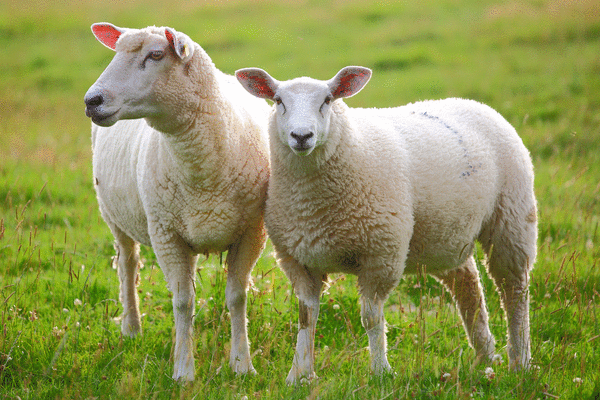
That matters because wool doesn’t come from an abstract “material”—it comes from sheep, who are gentle, social individuals. Studies show they recognize dozens of faces, remember them for years and experience fear, stress and isolation in ways strikingly similar to humans. Yet the wool industry reduces them to commodities, ignoring the individuals beneath the fleece.
From luxury houses to mall brands, major companies have already proved that creativity thrives when cruelty is cut out of the equation. Vegan fashion isn’t a niche trend—it’s where the industry is headed.
Wool, by contrast, is a relic—ethically indefensible and increasingly out of sync with climate realities. Sheep are among the largest contributors to methane emissions, and wool production degrades land, pollutes waterways and accelerates desertification. Fabrics made without animals don’t belch methane, require vast grazing land or generate manure runoff.
Fashion has always been about reinvention. This season, amid the buzz of fashion week, it’s worth asking a deeper question: What kind of future do our clothes support?
The poll makes one thing clear: Informed consumers would choose alternative options to wool if given the choice. Fashion week is the perfect moment to reflect that reality. Sheep don’t belong on the runway, and they certainly don’t belong in our closets.
Compassion is in style—and it’s here to stay.
____
Scott Miller is a staff writer for the PETA Foundation, 501 Front St., Norfolk, VA 23510; www.PETA.org.
_____
©2026 Tribune Content Agency, LLC.




















































Comments