COUNTERPOINT: Americans know Trump is wrong
Published in Op Eds

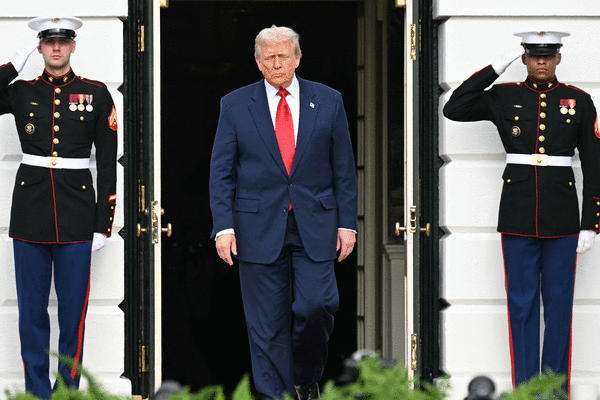

President Donald Trump is the consummate salesman, and his State of the Union address will certainly seek to convince Americans that our republic is in a better place. Despite some improvements, the American people, at our core, know that things still aren’t as rosy as our president would like us to believe.
News that consumer confidence has collapsed to the lowest level in more than a decade surprises no one. Despite promises to immediately reduce prices, the American people are still paying through the nose for food and energy. The cheapest ground beef at my local grocery store is at least 50% more expensive than it was just a few years ago.
Far from shrinking the government and reducing its role in the lives of the American people, Trump’s second term has entrenched it further, with trillion-dollar deficits, wildly perpetrated taxes of dubious utility, government interference in financial markets, expensive housing regulations and immigration policies that substitute one form of coercion for another.
Nobel Prize-winning economist Milton Friedman astutely noted that inflation “is made in Washington,” a product of excessive government spending, regulation, and, particularly, money creation. Yet, nowhere on Trump’s agenda is a serious effort to radically reduce government spending.
Remember how spending exploded during COVID? The shamdemic ended, but government spending never does. There is nothing more permanent than a temporary government program, except perhaps a government budget.
This month, the Joint Economic Committee found that in January, the government ran a deficit of nearly $95 billion. For every dollar it takes from your paycheck and mine, Trump and Congress spend $1.39. U.S. government debt now approaches 125% of GDP.
Trump’s tax cuts, however welcome in isolation, were never paired with commensurate spending restraint. As much as I hate taxes, we need spending cuts more than we need tax cuts. Frighteningly, entitlements have ballooned, military budgets have swelled and “border security” has become another trillion-dollar sinkhole.
As a result, the deficit has exploded.
Tariffs imposed helter-skelter on allies and adversaries have accentuated our economic pain. They function as a hidden tax on every American consumer and producer, regardless of how much of the cost might be borne by foreign manufacturers. Estimates peg the 2025 burden at $1,000 per American household; by next year, it will reach $1,300.
When the government imposes these taxes, it means that Washington, not individuals, decides which goods Americans may buy and at what price. That probably doesn’t sound like the freedom you voted for, and the American people are certainly paying the price as the cost of everyday goods keeps rising.
Government interference with human movement has exacerbated the situation. Trump boasts of negative net migration, millions of deportations and a “ secure” border achieved through ICE raids, self-deportations and expanded enforcement. Certain studies hold that immigration has noticeable economic benefits, generating as much as $14 trillion in fiscal savings over time.
Without immigrants, our debt might balloon to 200% of gross national product, potentially causing economic collapse. It would be great to save the republic without destroying it. With multitudes of immigrants being shown the door and policies generally orchestrated to hurt American wallets, the long-term economic consequences could be dire.
Unable to boost incomes, the president has embraced policy gimmicks, as politicians tend to do.
For example, he has urged Congress to cap interest rates at 10% while decrying “abusive” lenders.
Yet studies by Trump’s former senior economic advisers show that a 10% ceiling will shrink credit availability for underprivileged borrowers, young families and small businesses, as banks ration loans to the safest customers and hike fees elsewhere. Government interference in markets never goes well.
Equally destructive is Trump’s recent ban on private investors in the single-family housing industry. It sounds great … except that economic history shows these investors are single-handedly responsible for increasing the supply of affordable housing. Banning them will reduce the number of cheap units available, creating bidding wars over limited housing inventory that will only worsen the problem for America's low-income families. Somehow, Trump actually believes cheaper housing is a bad thing.
The bottom line is that, on most issues, Trump has not turned America around, and his policies leave much to be desired for Americans who love freedom and affordable prices.
There was a time when America knew that government governs best which governs least; we cannot thrive until we make this the core of our policies.
Trump doesn’t yet understand this, and his State of the Union speech will reflect that. Let’s pray he comes around before the end of his second term. Our financial future depends on it.
____
ABOUT THE WRITER
Elijah Henry is a public policy analyst and columnist. He wrote this for InsideSources.com.
___
©2026 Tribune Content Agency, LLC













































Comments