Commentary: Hegseth's war on diversity is eroding America's military edge
Published in Op Eds
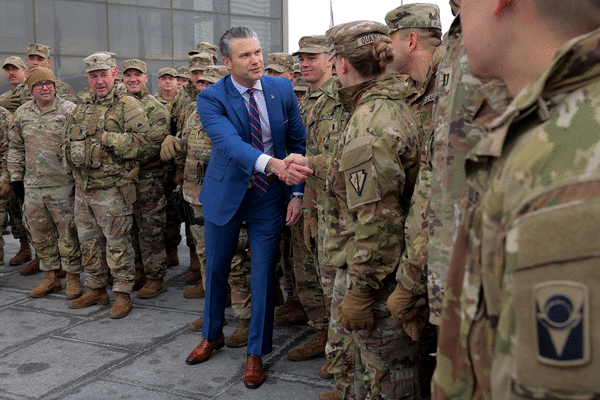
Secretary of Defense Pete Hegseth has returned again and again to a familiar target: the military’s long-standing refrain that “our diversity is our strength.” Last week, at Bath Iron Works in Maine, he dismissed it as “the dumbest phrase in military history” and mocked the generals who had repeated it “with a straight face.” Some of those lines drew applause in the shipyard crowd. They also revealed a dangerously thin understanding of how modern militaries generate combat advantage.
When the secretary mocks generals for saying “our diversity is our strength” and doing so “with a straight face,” he suggests they were engaged in political theater rather than expressing professional judgment. Most senior officers do not reach those ranks by echoing the talking points of whichever administration is in power. They rise through years of operational command, strategic study and decisions that carry real-world consequences. The more likely explanation is that they were articulating a lesson learned from war — a lesson now being dismissed.
The United States has entered a strategic environment in which overwhelming military superiority can no longer be assumed. A conflict with China would not resemble Iraq in 2003 or Venezuela just last month. It would be a hard fight against a larger rival, fought far from home in a battlespace dense with missiles, cyberattacks and constant surveillance. We have never faced an adversary with that kind of integrated technological reach, and we have not fought a comparably matched power since World War II.
In that kind of war, victory will not come from platitudes about “lethality.” It will come from making better decisions — spotting weaknesses in our own analysis, challenging assumptions and adapting faster than an adversary that is studying us closely.
Organizations that draw from a broader range of experiences are more likely to stress-test weaknesses in their analysis before their conclusions become doctrine. Research in organizational behavior and complexity science — including work by McKinsey & Co. and Stanford University— consistently shows that diverse teams make better decisions when problems are complex. And University of Michigan social and complexity scientist Scott Page has demonstrated that diversity of perspective reduces blind spots and improves judgment under pressure, rather than assembling teams “trained to see the world in the same way.” Predictable thinking, by contrast, produces predictable behavior. In modern conflict, predictable behavior makes for easy targets.
The U.S. possesses an unusual structural advantage: an all-volunteer military drawn from one of the most diverse societies on Earth. That breadth — regional, cultural, socioeconomic — expands the range of judgment available when decisions must be made quickly and with incomplete information. Many of our adversaries operate within far narrower political and social environments. That difference matters, but only if we take advantage of it.
Military planning sessions where everyone in the room shares similar career paths, backgrounds and assumptions are often smooth and orderly. That efficiency may give a sense of certainty. It can even feel reassuring. But it often conceals shared blind spots. In a high-end conflict, those blind spots will be unforgiving and deadly.
Hegseth’s campaign isn’t limited to rhetoric. Framed as a return to warfighting priorities, the Pentagon has moved to separate transgender service members, reexamine women in combat roles and reinterpret standards in ways that disproportionately affect otherwise qualified service members — all while arguing that the department had become distracted by culture-war priorities.
Policies should be evaluated honestly. If a rule harms readiness, change it. If an initiative overreached and lessened our ability to fight, we should absolutely correct it. But the only serious question is whether a policy makes the force more capable of fighting and winning. Personnel standards tied directly to mission performance are essential. They should be rigorous. But gender identity is not a performance metric. Standards untethered from combat effectiveness do not increase lethality. Excluding qualified personnel does not expand readiness. It does the opposite.
Arguments like this have been made before. When President Truman ordered the desegregation of the armed forces in 1948, opponents warned it would damage cohesion and combat effectiveness. American political and military leadership initially resisted the order, insisting the military was not an instrument for social change. Under the pressure of the Korean War, integration accelerated — and the dire predictions proved unfounded. History is instructive here. Claims that inclusion undermines readiness have repeatedly aged poorly.
Policies and rhetoric that narrow who serves don’t simply settle political or cultural debates. They shape who will raise a hand to join, who will choose to stay and who competes for advancement. They form the pool of talent that becomes tomorrow’s chiefs, commanding officers and senior planners. Exclude people long enough and you shrink the pipeline of experience and judgment that reaches the rooms where strategy is made.
At a moment of rising global tension, Hegseth’s department is spending real time and money on boards and processes designed to remove already serving, qualified personnel under a theory of “readiness” that treats identity as disqualifying. Retired Gen. Stanley McChrystal recently put it plainly: “God forbid, if we had a major war … I would hope that we would not suddenly say we are only going to draft people of a certain type.”
America’s competitive edge does not come from cultural posturing or applause lines. It comes from widening the scope of judgment inside the force — not narrowing it for political comfort. Shrinking the pool of Americans who can serve while signaling that only certain types of people truly belong limits whose judgment shapes strategy. Over time, that narrowing shows up in missed warnings, flawed assumptions and operational miscalculations. In the next serious war, the cost will be paid by those sent into harm’s way.
____
Jon Duffy is a retired naval officer. He writes about leadership and democracy.
©2026 Los Angeles Times. Visit at latimes.com. Distributed by Tribune Content Agency, LLC.






























Comments