Clive Crook: Bad economics isn't necessarily unconstitutional
Published in Op Eds
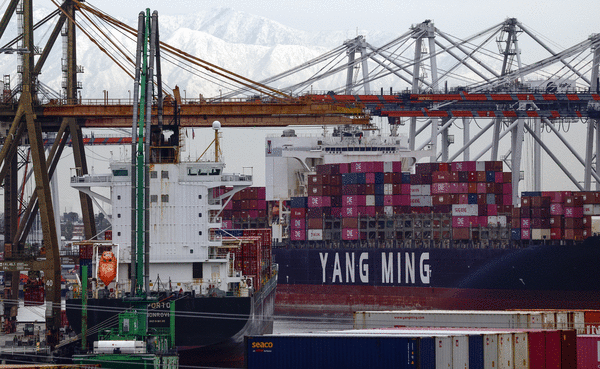
U.S. politics is apt to conflate disagreements about whether a policy is good or bad with disputes about whether it is constitutional. Reactions to the Supreme Court’s ruling on President Donald Trump’s tariffs are a good example.
Most commentators seem drawn to one of two positions: The tariffs are either bad policy and an abuse of presidential power, or good policy and constitutionally proper. Yet the criteria in question have little to do with each other.
I think Trump’s tariffs are foolish — a reckless repudiation of tried-and tested economics that jeopardizes America’s stunning economic strengths. But set that aside. Why exactly is this policy, smart or stupid as the case may be, illegal?
The court has ruled against the bulk of Trump’s tariffs on what seems a narrow technicality. According to the majority’s ruling, the statute purportedly authorizing the administration’s signature policy — the International Emergency Economic Powers Act — lets the White House “regulate” trade under certain circumstances but precludes tariffs as a way to carry out that regulatory function.
Notice that the word “tariffs” never appears in the statute, says the majority. Flyspecking the history of IEEPA and related laws (as always, Justice Neil Gorsuch is an excellent read on such matters) raises doubts about whether Congress intended “regulate” to include tariffs — and as a matter of constitutional law, this connection needs to be clear for the policy to comply.
My problem with the pivotal finding that “regulate” doesn’t encompass tariffs is its apparent absurdity (rarely something that concerns the best legal minds). Whatever Congress might or might not have meant, to deny that tariffs are a way to regulate trade is absurd. Regulating trade is what tariffs are for. Would the majority deny that carbon taxes regulate emissions of carbon, or that highway tolls regulate flows of traffic? Like tariffs, they are taxes whose purpose is to regulate.
Justice Brett Kavanaugh, dissenting along with Justices Samuel Alito and Clarence Thomas, underlines the point. Does the majority think the administration can respond to a qualifying emergency with straightforward tools of regulation — such as import quotas, or punitive local-content requirements, or “voluntary” export restraints, or any such barrier however ill-conceived or self-defeating, so long as it isn’t also a tax? A total ban on imports could be lawful in a qualifying emergency under IEEPA, but a 5% tariff is executive overreach? It’s a tad paradoxical.
Though the majority organized itself around the finding that tariffs don’t regulate, 170 pages of splintered opinions and dissents touch on many other constitutional ambiguities and uncertainties — few of which this ruling settles, and many of which will resurface as litigation over Trump’s ever-shifting trade policies advances.
For a start, there’s the question of refunds. The ruling offers no guidance on whether importers who’ve paid unlawful tariffs should expect restitution, or how any such scheme would be administered. Regardless of how the administration decides to proceed, there’ll be new legal challenges and protracted confusion.
The president immediately proposed a new universal tariff — so much for “reciprocity” — under a different statutory authority, plus investigations that might lead to country-by-country tariffs under yet others. Unlike IEEPA, these laws cover tariffs, but other questions arise. Will Trump’s new measures be deemed so radical or unprecedented that they implicate the court’s “major questions” doctrine, which demands more explicit congressional authorization? How far, statute by statute, has Congress already delegated its tariff-setting power — and what limits does the Constitution impose on such delegations?
Last week’s ruling ignores what strikes this non-lawyer as the most important separation-of-powers question of all, so far as trade policy is concerned: When Congress delegates the setting of tariffs to the executive because of an emergency, what exactly does “emergency” mean, who decides, and subject to what checks and balances? If declaring an emergency, even for a limited time, is deemed to be exclusively the president’s call (because trade policy is foreign policy or according to some other rationale), then what’s to stop the White House continuously declaring emergency after emergency for any reason it chooses? Some “emergencies” from the 1970s are still in effect.
Asked to rule on these and other trade-policy matters, the court will doubtless tell us more about what the Constitution means. My own preference, if I were drafting a new charter, would be a distribution of powers that puts the White House firmly in the lead on tariffs, merely because they require complex international negotiations that put legislatures, so to speak, at a comparative disadvantage. But here’s the main thing: My preferred distribution of powers has nothing whatever to do with my preferred policy.
Sum it up this way. Worry about whether Trump’s policies are wise as well as whether they’re constitutional — two separate questions. Don’t ask the Constitution to tame a reckless president supported by a cravenly acquiescent Congress. The only remedy for that is elections.
____
This column reflects the personal views of the author and does not necessarily reflect the opinion of the editorial board or Bloomberg LP and its owners.
Clive Crook is a Bloomberg Opinion columnist and member of the editorial board covering economics. Previously, he was deputy editor of the Economist and chief Washington commentator for the Financial Times.
©2026 Bloomberg L.P. Visit bloomberg.com/opinion. Distributed by Tribune Content Agency, LLC.


















































Comments