Editorial: Economic worries mount, while financial markets churn and companies keep spending. Can it last?
Published in Op Eds
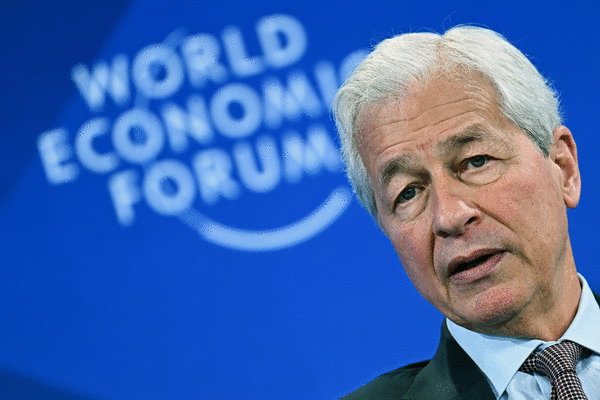
Jamie Dimon, once a resident of Chicago’s Gold Coast and a leader of the city’s business community, has gone on to become the nation’s most influential banker as boss of JPMorgan Chase in New York. Last week, he explained why, like so many leaders of big companies, he is spending today like there’s no tomorrow.
The $2 billion a week in capital investment his bank is making is needed to cement the company’s future, he told investors last week, assuring them it will mostly pay off.
That includes huge bets on artificial intelligence.
Like many other big-spending CEOs, Dimon has got the money: For months now, his bank has been making more than $1 billion a week in profits.
Excess capital, as it’s known, is a problem companies rarely complain about, but it’s real. One of the big risks of the AI boom that underpins U.S. economic growth today is that it won’t pay off. CEOs don’t last if they get a poor return on their investments and need to write down the value of their misbegotten bets. Limitations exist for other ways of investing excess capital, such as boosting dividends and stock buybacks or amassing a war chest for acquisitions.
Yet the money keeps coming: By the end of 2025, the earnings of blue-chip companies had soared a phenomenal 12% year-on-year, according to Bloomberg. The so-called “Big Beautiful Bill” provides huge tax cuts for big businesses (and their top executives) that take effect this spring. The recent U.S. Supreme Court decision overturning tariffs should by all rights result in enormous refunds for businesses that paid those illegal taxes on trade.
Ka-ching, ka-ching, ka-ching: The ingredients are in place for a free-spending party in boardrooms across America. So, what could go wrong? Just listen to Dimon.
At the same investment conference where he confidently touted his bank’s strong position, Dimon also expressed doubts about everybody else. Today’s financial world reminds him of the wild years preceding the global financial crisis of 2008-09.
“Unfortunately, we did see this in ’05, ’06, ’07, almost the same thing,” Dimon said. “The rising tide lifting all boats, everyone was making a lot of money, people leveraging to the hilt. The sky was the limit.” The sky was indeed the limit until it abruptly started falling, leaving everyday Americans to pick up the pieces.
A close look at the financial markets shows that Dimon isn’t alone in his concerns. Individual U.S. equities are making extreme moves. In the first weeks of the new year, an unusually large chunk of the 500 biggest stocks lost or gained more than 20% apiece. That volatility is a warning.
So is the return of the “AI scare trade.” Last week, investors got a reminder of what could go badly wrong with the rush into AI. A speculative blog post imagined a world where AI replaced human workers to such an extent that the economy collapsed. The stock market got spooked, a sign of its fragility. The bad news continued to mount on Friday.
This page has been keeping faith in the personal touch, believing that even as AI makes many workplace tasks more efficient, the smart bot will never fully replace the smart human. What’s scaring us even more than the “scare trade,” however, is unsustainable federal spending.
The federal debt is now bigger than America’s gross domestic product, a historic anomaly that is poised to get worse. Deficit spending is projected to approach $2 trillion this year. Annual debt service costs $1 trillion. Congress and the White House are digging a deep, deep hole for our children.
Yet just like in the private sector, the favored parts of the public sector are awash in money. The Pentagon is reportedly struggling to allocate an extra half-trillion dollars that the administration wants to throw at it. And while Department of Homeland Security funding is currently halted by a partial government shutdown, the Big Beautiful Bill has teed up tens of billions for building ICE detention centers and hiring immigration officers.
The tension is rising between spending, debt and monetary policy. The U.S. Federal Reserve is preaching restraint, as inflation remains above its 2% annual target. Ignoring the hypersensitive economy, the administration is demanding interest-rate cuts and raising doubts about the Fed’s future independence.
Add to those concerns the possibility that bad news about the economy is being censored. A recent New York Fed report concluding that American consumers and companies pay 90% of tariff costs provoked a threatening response from President Donald Trump’s administration, which said its authors should be “disciplined.” Wall Street firms, including JPMorgan, have admitted to toning down or censoring the research reports they sell to clients for fear of angering the White House.
Add to that uncertainty a rise in geopolitical risks, as the administration aims an air-and-sea armada at Iran, and what’s an investor to do?
Brace for a volatile stretch in the months ahead and organize portfolios accordingly. As anyone who has experienced a car wreck knows, the time to buckle up is before the collision.
___
©2026 Chicago Tribune. Visit at chicagotribune.com. Distributed by Tribune Content Agency, LLC.
















































Comments