Commentary: Inside Iran, my family and other citizens are caught between celebration and fear
Published in Op Eds
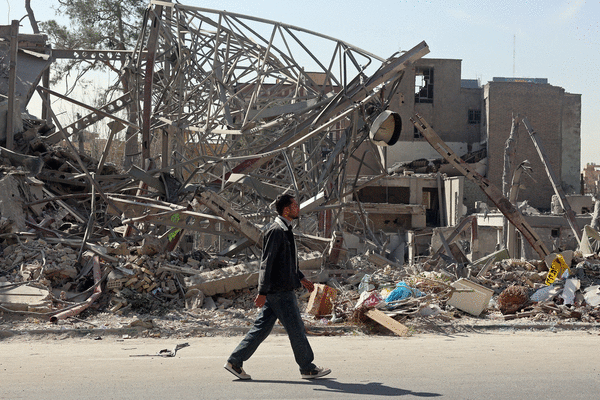
Early Saturday in Tehran, my father called me with his warm, steady voice to tell me that the attack had begun. As he always does, controlling his emotions carefully, he spoke calmly: “The war has started. They hit several places. But don’t worry — I’m fine.”
From that brief phone call, a moment filled with contradiction began. How are we not supposed to worry? How can anyone be fine?
Within an hour of that call, the internet was cut off. Only a small number of people retained access. News from Iran arrived in fragments. Then, astonishingly, the first reports of Ayatollah Ali Khamenei’s death began to circulate. Many Iranians were suspended between fear and an almost unbelievable sense of relief. Until outlets close to the regime confirmed it, the news felt unreal.
War had begun. Yet in the midst of the attacks, people in some areas took to the streets and began to dance. From inside homes came the first shouts: “Khamenei has fallen! Khamenei is dead!” Small groups gathered, lighting fires and dancing around them. One of the most striking images came not from Tehran but from London, in the Finchley neighborhood, home to large Iranian and Jewish communities. There, late into the night, Iranian and Israeli flags were raised together in celebration.
For 37 years, Khamenei presided over a transformation of Iran’s political system from what was once called a republic into a system of concentrated clerical authority — what many critics describe as absolute guardianship. By empowering the Islamic Revolutionary Guard Corps and allowing it to embed itself deeply in Iran’s economy, he consolidated his position. Those who observed him closely often described him as deeply resentful and unforgiving. In every wave of protest, his response was harsh. Many families were irreparably harmed.
Now he is dead. And even under bombardment, many people did not withhold their relief.
Meanwhile, communication became increasingly difficult. Telephone lines were restricted again. From outside the country, reaching loved ones became nearly impossible. The explosions intensified hour by hour. Then more devastating news emerged: a girls’ school had been struck, with many children killed or injured. Residents reported that the sound of the blasts was louder than anything they remembered during the Iran-Iraq war from 1980 to 1988. For a society that still carries those memories, the psychological impact is profound.
Yet amid this fear, there remains an undeniable hope for the future — hope for the fall of a system that many believe cannot be reformed.
The January crackdown, in which security forces reportedly killed and detained tens of thousands during nationwide protests, severely damaged what little public trust remained. It was unimaginable for many that armed forces would enter the streets and openly fire at citizens. Previously, during the 12-day war with Israel in June, even many regime critics avoided protest and resisted escalation. The majority of people opposed war. They did not take to the streets. That restraint could have been used as a moment of national unity and reform. Instead, the regime ignored it and responded to January’s protests with force, demonstrating that meaningful reform was not an option.
Now, with the possibility of intensified U.S. strikes, it is unclear how long Tehran’s infrastructure can withstand sustained pressure. Unlike previous crises, many residents have not left the city. They remain in their homes. Many have prepared emergency bags. Persian-language media abroad broadcast safety guidance for wartime conditions. People have stocked water and bread. There is no widespread panic or looting.
Some believe that Israel’s earlier targeted strikes signaled limited objectives, reinforcing cautious hope that this war will remain focused rather than indiscriminate. That perception has increased a fragile sense of support for a conflict that is nonetheless terrifying.
Others insist that war has never produced democracy and that the level of destruction in parts of Tehran could reach a point in which reconstruction becomes nearly impossible or extremely costly.
Meanwhile, the regional impact is growing. The Islamic Republic has reportedly expanded retaliatory strikes to countries around the Persian Gulf. Khamenei had warned that if war came, it would spread across the region. Even Oman, which had played a mediating role between Iran and the United States, has been affected. Oil prices have risen. Turkey, Iran’s western neighbor, has restricted its borders with Tehran’s agreement to prevent large refugee flows.
Inside Iran, conversations with citizens reflect the same paradox I heard in my father’s voice: joy at the fall of a leader whose system resisted change and fear of destruction and sudden death.
Regime supporters hold mourning ceremonies for Khamenei. Some gather in Tehran’s metro stations to shelter from bombardment while chanting anti-American and anti-Israeli slogans.
Only a few days into this war, it is impossible to predict what awaits the Iranian people. But one sentiment is clearer than ever: After 47 years under the Islamic Republic, many no longer want individuals tied to this political system to remain in power. They are looking toward a different future — one aligned with a more open and modern world.
In these difficult days of war, one of the most pressing questions heard in large cities such as Tehran is: Why did a government that constantly spoke of war with Israel, that even installed a countdown clock in the capital predicting the destruction of the “Zionist regime,” never build shelters for its own people? Why are there no functioning air raid sirens? Why, at a minimum, is the internet shut down instead of kept open to provide access to critical information?
These concerns were raised during the previous 12-day war, yet no meaningful steps were taken. Now they return with greater urgency. The consequences of this conflict will not remain confined to a divide between regime supporters and opponents. Prolonged war and psychological exhaustion are already creating strain even among those united in their desire for regime change. While many still hold hope for political transformation, the emotional and social toll of sustained conflict is beginning to produce fractures within the broader opposition itself.
____
Pegah Banihashemi, a native of Iran, is a legal scholar and journalist in Chicago whose work focuses on human rights, constitutional and international law, and Middle East politics.
___
©2026 Chicago Tribune. Visit at chicagotribune.com. Distributed by Tribune Content Agency, LLC.























Comments