Commentary: Refund the tariffs the right way -- not with political math
Published in Op Eds
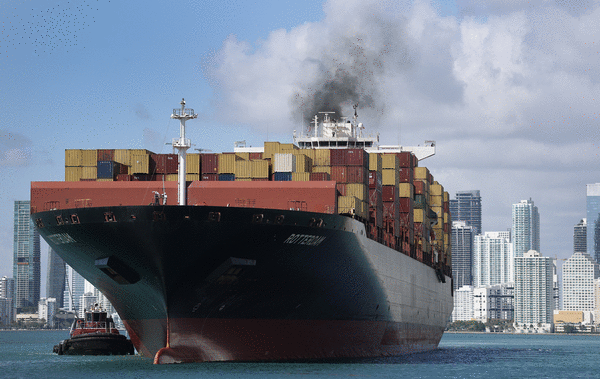
When the U.S. Supreme Court ruled that the administration’s tariffs were unlawful, it resolved a constitutional question. What it did not resolve is how to unwind the economic damage.
Gov. JB Pritzker has called for roughly $1,700 per Illinois household — about $8.7 billion total — arguing that families effectively paid an illegal tax through higher prices and deserve direct reimbursement.
It may be appealing math. But it is not how tariffs work — and it is not how refunds should work.
Tariffs are not directly paid by households. They are not collected at checkout counters. They are assessed at the border and paid up-front by the importer of record — often small businesses, manufacturers, retailers or logistics providers clearing goods through companies such as UPS, DHL or FedEx.
The importer of record is legally obligated to write the check before a single product can be sold. That matters. Because when the court declared those tariffs unlawful, the legal injury fell first on the entities that were compelled to pay them.
What happened after that payment varied widely.
Some businesses absorbed the tariffs, at least initially, cutting into margins to avoid sudden price hikes. Others passed along some or all of the cost. Some raised prices beyond the tariff itself because working capital costs rose — tariffs must be paid before goods are sold, tightening cash flow and often requiring short-term borrowing.
There is no single “pass-through” rate. One retailer may have absorbed most of the cost to preserve customer loyalty. Another may have increased prices and still lost sales volume. A small manufacturer might have postponed expansion plans or delayed equipment purchases to cover the unexpected expense.
Dividing total tariff collections by the number of Illinois households assumes a clean line from tariff to price tag to consumer wallet. Real life is far messier.
Consider a small Illinois importer that paid tariffs in September. To manage the sudden upfront expense, the company delayed hiring, reduced bonuses and scaled back holiday inventory. Even if it raised prices modestly, it likely lost some sales in the process. Growth slowed. Opportunities were missed.
How do you refund that?
How do you calculate the raise that was never given, the bonus that never materialized or the investment that was postponed? How do you account for customers who walked away because prices rose? You can’t.
And if refunds bypass the importer of record and instead go directly to households, what happens to the business that actually paid the tariff bill? It remains out the cash it fronted — sometimes hundreds of thousands or millions of dollars — while the state distributes checks based on broad economic estimates.
That is neither legally sound nor economically fair.
Tariff refunds should follow the legal payment trail. They should be returned to the importer of record — whether that is a small business directly or a customs broker or carrier clearing goods on its behalf. Those intermediaries can then reconcile accounts with their customers under the contracts that governed those transactions.
And then businesses should be trusted to decide what comes next.
Some may choose to pass refunds directly to customers. Others may offer promotions, sales or price rollbacks. Some may reinvest in hiring or restore delayed raises. Others may do nothing at all because their overall costs — including financing, fees and lost volume — exceeded what they were ever able to pass along. Each company’s experience was different. Each balance sheet tells a different story.
Even then, not every loss can be unwound. Businesses that cleared goods through major carriers often paid additional brokerage and processing fees. Increased borrowing costs and lost sales will not be fully recoverable. The economic ripple effects — slowed hiring, delayed raises, reduced investment — cannot be neatly itemized or refunded.
But the law does provide one clear principle: Money unlawfully collected should be returned to the party that was legally compelled to pay it.
Illinois is home to thousands of import-dependent small businesses operating on tight margins. For them, tariff refunds are not a windfall. They are working capital. They are payroll. They are inventory. They are the difference between expanding and retrenching.
This is not about favoring corporations over consumers. It is about respecting the legal structure of tariff collection and the economic reality that followed. If policymakers want to debate broader consumer relief or tax rebates, that is a separate discussion.
Tariff refunds are not a stimulus program. They are restitution.
Pritzker is right about one thing: Money that was unlawfully taken should be returned.
But the fair and lawful way to do that is straightforward — refund the tariffs to the businesses that paid them, trust them to respond according to their own circumstances, and allow existing contracts and market relationships to sort out the rest.
Anything else may make for clean headlines. It will not make things right.
____
Sara Albrecht is a Chicago resident and chair of the Liberty Justice Center, a nonprofit, nonpartisan public-interest law firm. She recently prevailed before the U.S. Supreme Court in Trump v. V.O.S. Selections, invalidating the so-called “Liberation Day” tariffs as unconstitutional.
___
©2026 Chicago Tribune. Visit at chicagotribune.com. Distributed by Tribune Content Agency, LLC.















































Comments