Noah Feldman: A judge's vulgar dissent is a loss for everyone
Published in Op Eds
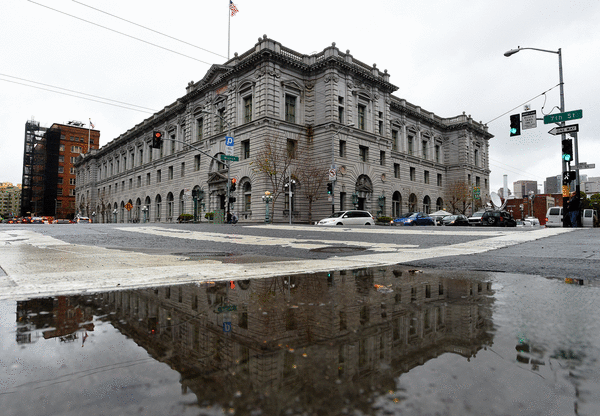
A recent opinion by a judge on the U.S. Court of Appeals for the 9th Circuit is a contender for the most vulgar piece of judicial writing in the 300-plus-year history of recorded judicial decisions in the English language.
The opinion in Olympus Spa v. Andretti — a dissent from the 9th Circuit’s decision not to rehear a case involving a potential conflict between transgender rights and free exercise rights — opens with this astonishing sentence: “This is a case about swinging d*cks.”
Except Judge Lawrence VanDyke, an appointee of President Donald Trump, didn’t use an asterisk.
VanDyke’s use of what 27 of his colleagues, in a separate opinion, called “vulgar barroom talk” isn’t merely a shocking departure from the norms of judicial language. Nor does it just simply “ignore ordinary principles of dignity and civility or demean the court,” as the other judges noted. It goes further: It denounces “woke regulators and complicit judges” for imposing their “Frankenstein social experiments on real women and young girls” — a tirade that reads as though it were lifted straight from a Trump anti-trans script.
VanDyke’s language undermines the very possibility of civil disagreement that is necessary to a constitutional democracy operating under the rule of law. It shows what can happen when Trumpian style, already toxic to democracy, infiltrates the courtroom.
At a moment when intense political polarization and social media have combined to make substantive conversations across differences so difficult as to seem almost impossible, courts have remained one of the last spaces where people can disagree intensely while still communicating civilly. The legal custom of zealous representation combined with mutual respect runs deep.
Shakespeare, who had his share of negative things to say about lawyers, nevertheless also had one character recommend, “Do as adversaries do in law, strive mightily, but eat and drink as friends.”
Breaking that social norm is hard to understand as anything other than a bid for attention by VanDyke — specifically, the attention of the president who appointed him and who might conceivably have the power to elevate him to the Supreme Court. The other judges hinted as much, stating that VanDyke’s “use of such coarse language and invective may make for publicity or entertainment value, but it has no place in a judicial opinion.”
And to be clear, what VanDyke wrote was wholly unnecessary to the legal issues raised by the case. Strictly speaking, he didn’t even use the term BSD accurately, in the sense in which it was used in Michael Lewis’s 1989 classic, Liar’s Poker. (“If he could make millions of dollars come out of those phones, he became that most revered of all species: a Big Swinging D*ck.”) For Lewis’s bond traders and salesmen, the phrase simply meant a rainmaker. VanDyke was instead (sort of) using the expression more literally and crudely.
The case in question arose from the state of Washington’s application of an anti-discrimination statute to require a Korean-owned spa that restricted access to “biological females” to permit access for a transgender woman. The owners of the spa, where clients are typically nude, went to court to request an exemption from the law on the basis of their Christian religious beliefs.
Whatever you might think of the policy wisdom of requiring the spa to comply with the anti-discrimination law, the constitutional issue is straightforward. Under Justice Antonin Scalia’s opinion in the 1990 case Employment Division v. Smith, there is no automatic religious exemption under the First Amendment from a law that is deemed neutral and generally applicable.
The Supreme Court has come close to overturning Smith several times, but for now, it’s still good law. Under current doctrine, the only way to obtain a free exercise exemption from a state law is if the law involves a system of individualized exemptions or otherwise discriminates on the basis of religion — for example, by treating non-religious conduct more favorably than religious conduct. The 9th Circuit panel that heard the case decided 2-1 against the spa owners. There was no convincing legal reason for the court as a whole to rehear the case.
VanDyke wasn’t on the original panel, but in the extremely unusual and outlying world of the 9th Circuit, it’s common for judges to write opinions dissenting from denials of rehearing. These unusual opinions, lightheartedly nicknamed “dissentals,” have the unfortunate effect of encouraging all kinds of controversy among judges. And in case you aren’t an aficionado of appellate bodies, the 9th Circuit is by far the largest appellate court in the U.S., with 29 active judges and more than 20 senior judges. (Senior-status judges don’t get to vote on rehearing but can join such opinions if they choose.)
It would be understandable to dismiss VanDyke’s opinion as just another manifestation of what sometimes seems like the 9th Circuit’s resemblance to a judicial clown car. Perhaps that was the view of the two judges who responded in one sentence: “Regarding the dissenting opinion of Judge VanDyke: We are better than this.”
But the truth is that VanDyke is channeling the president who appointed him: using particularly offensive language in a case involving a transgender woman, repudiating the principles of decorum and civility and treating the judiciary with contempt. Van Dyke ridiculed “my distressed colleagues” who, he wrote, “appear to have the fastidious sensibilities of a Victorian nun when it comes to mere unpleasant words in my opinion.”
He attempted to justify his words by accusing the judges who made the decision of using “slick legal arguments and deflection to studiously avoid eye contact with the actual and horrific consequences of their erroneous opinion. The ‘ordinary Americans’ affected by the majority’s opinion don’t have that luxury.”
The judges on the panel and their colleagues on the 9th Circuit weren’t using slick legal arguments. They were following the law. The fact that VanDyke doesn’t like the law — and that he’s not in a position to change it — shouldn’t be a basis for flouting the system itself. To do so is inconsistent with constitutional democracy. And if judges don’t stand up for constitutional democracy, no one will.
____
This column reflects the personal views of the author and does not necessarily reflect the opinion of the editorial board or Bloomberg LP and its owners.
Noah Feldman is a Bloomberg Opinion columnist. A professor of law at Harvard University, he is author, most recently, of “To Be a Jew Today: A New Guide to God, Israel, and the Jewish People."
©2026 Bloomberg L.P. Visit bloomberg.com/opinion. Distributed by Tribune Content Agency, LLC.

























Comments