Commentary: Being insured in America is not the same as having access to care
Published in Op Eds
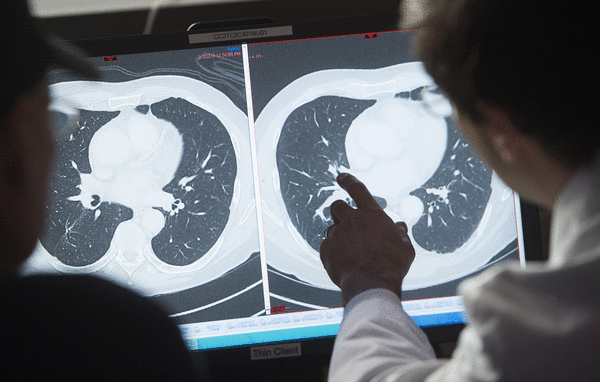
In April 2022, my mother-in-law, Karla, went for a routine physical therapy visit for carpal tunnel pain. The clinic was full and nearly turned her away. Only after she insisted that something felt wrong did a therapist send her to the emergency room.
A CT scan revealed a mass in her brain.
Karla was 50 years old. She was a first-generation American who immigrated from Honduras as a teenager, earned her bachelor’s degree and spent her career working in education, serving underserved children in Los Angeles. She was a devoted mother, a stabilizing force and someone who believed deeply in doing things the “right” way.
She had what many would consider decent insurance: an employer-sponsored health plan. She lived in California, home to some of the most advanced cancer centers in the world.
And yet, over eight months, we watched her decline, slowly, painfully, as the disease and its treatments took away her independence, her voice and finally her life. What I came to realize later was that this could have gone a very different way.
Her earliest symptoms were problems with coordination and loss of function in her right hand, signs that were initially dismissed as carpal tunnel syndrome. By the time imaging revealed the tumor, the initial misdiagnosis had already delayed her care. Surgery was performed quickly, not only to remove the mass, but to obtain tissue for diagnosis. In deciding whether to have that surgery, we were not informed that it would disqualify a patient from many clinical trials.
We were initially told the tumor was likely a meningioma, a far less aggressive diagnosis. That optimism lingered even as her tissue samples were sent to the National Institutes of Health because local pathology could not classify them. In the absence of good information, Karla was placed on a single treatment path: surgery, radiation and temozolomide for oral chemotherapy.
When the NIH reported that the tumor fell somewhere between glioblastoma and gliosarcoma, the treatment plan didn’t fundamentally change. When the tumor progressed, harsher chemotherapies followed at enormous cost to her quality of life. Karla lost the ability to walk and struggled with basic daily functions. Yet palliative care was never offered. We had to ask for it ourselves, only after her suffering had become impossible to ignore.
Clinical trials were never discussed. Other available treatment options were never clearly explained. A second opinion was never encouraged.
When we sought one ourselves, we found that because Karla’s tumor was located deep in her cerebellum, she was ineligible for the primary clinical trial at that site. No one had prepared us for how tumor location, something patients cannot control, could quietly close doors. No one helped us search beyond our region for other clinical trials. No one asked whether we could travel out of state. And like most families, we could not afford to uproot our lives chasing options that might not exist.
From the outside, it might appear that Karla had access to health care. From the inside, we could see that the systems denied more access than they provided.
Years later, when I was attending a meeting of the Society for Neuro-Oncology, a physician from another country remarked that in many parts of the world, patients with rare diseases do not have access to clinical trials at all. Americans, he suggested, should be grateful. You live here. You already made it.
I understand that frustration. Globally, the United States does have extraordinary scientific resources. But privilege in health care is not absolute or uniform. It is shaped by insurance coverage, geography, timing and a patient’s ability to navigate an unforgiving system while in crisis.
Karla’s experience is not unique.
In a recent nationwide survey of glioblastoma patients conducted by OurBrainBank, most respondents were diagnosed relatively quickly, within the first few months after symptoms began, underscoring a hard truth: Even when diagnosis happens quickly, access to meaningful options does not necessarily follow. Two-thirds of patients said they were never offered a clinical trial. More than half reported that a second opinion was never discussed. Nearly 9 in 10 said they were not adequately informed about tumor testing or whether tissue was being preserved for future treatment options. And more than 70% reported having no involvement with social workers or palliative or hospice care, even as their disease progressed.
These are not failures of science. They are failures of communication, navigation and equity.
When Karla’s doctors finally told us there was nothing left to do, the conversation was brief and lacked empathy. We were told she had about a month. She died roughly a week and a half later, unable to speak or eat, while my wife held her hand. No one had prepared us for how quickly the end would come.
Privilege did not save her.
Living in California and having insurance did not guarantee access to innovation, choice or dignity. It simply gave the illusion of it. Many of us don’t even get that illusion: Most Americans do not live near world-class cancer centers, and some 25 million do not have health insurance.
Disparity is not defined by borders. It is defined by experience.
And for families facing terminal illnesses, such as glioblastoma, time remains the most unequal resource of all.
____
David Robles is the lead researcher at OurBrainBank, a nonprofit formed by and for families with glioblastoma multiforme that aims to make the disease treatable.
©2026 Los Angeles Times. Visit at latimes.com. Distributed by Tribune Content Agency, LLC.































Comments