Commentary: Troubles down on the farm
Published in Op Eds
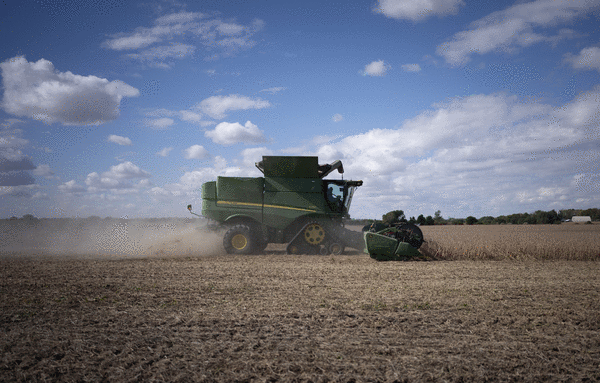
American farmers have become among the most productive in the world at growing grains. In doing so, to keep afloat, they have been depleting our rich soils, polluting water from Des Moines to the sprawling dead zone in the Gulf of Mexico, driving prices down, increasing farmer debt, and drawing heavily on taxpayer welfare.
Something is wrong with this picture.
A small-town boy from central Illinois, I think the world of my farmer friends. They are the salt of the earth, hard-working and proud of their capacity to produce bounteous crops. But they are in a box, and don’t know how to get out.
Big Ag equipment manufacturers, pesticide and herbicide chemical companies, seed enterprises and now drone operators drive productivity. These same global companies are of course also driving increased productivity in Brazil, Argentina, Ukraine. Rain forest trees are felled every day down under in large swaths to expand crop acreage, just as American farmers felled trees two centuries ago—and continue to fell trees along streams.
The only revenue tactic available to the farmer is to produce more, which simply drives down prices, and ratchets up taxpayer subsidies.
Midwest fence rows were plowed under years ago, as livestock were consolidated away from good crop ground. Farmers are now plowing into the roadside drainage ditches, to eke out more production. But supply is not the solution, it’s the problem.
The problems are getting worse. When I was a boy after World War II, the plowed farm fields on the edge of my rural town exposed big, soft chunks of rich black earth, held together by organic matter of plant residue, worms and microorganisms. The topsoil chunks were called clods; farmers and their boots were both called, dismissively, clodhoppers.
Today, according to research reported on by Verlyn Klinkenborg of the Yale School of the Environment, 24% to 46% of the Corn Belt topsoil has been lost in recent decades. The clods are gone as well, replaced with grainy, mealy, sometimes even powdery surface soil. We are squandering our patrimony.
Excess fertilizer in the form of nitrogen—a farmer doesn’t want to apply too little—runs off into streams, rivers and down to the Gulf, creating a dead zone the size of New Jersey, killing aquatic life. On the way to the gulf, excess chemicals threaten the water supplies of cities like Des Moines, Iowa, according to scientific assessments reported in 2025 by Iowa Public Radio.
So long as farmers produce an oversupply of basic commodities like corn, beans, cotton, sugar, prices will be depressed, and the federal government will continue to subsidize farmers, as it has since 1933. Farmers know they are in partnership with the federal government.
I took a look at recent commodity program payments to farmers in my state of Illinois, the number one producer of soybeans among the states and number two in corn. According to EWG, an environmental group that tracks this, over the 1995-2024 decade, the top 10 family-owned farms in Illinois each received from $6.5 million to $9.8 million in subsidy payments. Of course, most farmers received far less than that from the total subsidy payments of $21.6 billion for the period.
The least we can do is leverage federal payments to require better stewardship of our land and water. The dead zone in the Gulf is an embarrassment to American public policymaking.
In return for subsidies that are critical to farm profitability, farmers should be required to plant cover crops that rebuild nitrogen in the soil, and certify that their use of fertilizers and chemicals are fully absorbed on the farm, and not sent downstream.
Subsidies should be provided not just to basic commodities but also to higher value specialty crops like fruits and vegetables, which could diversify agriculture production.
Subsidy payments should be capped; the optics are terrible—paying a family farm up to $1 million a year to grow crops that are in oversupply. Most big family farmers have been able to grow their land holdings over the years, which is where the real wealth of agriculture resides. According to USDA, real farmland values per acre, adjusted for inflation, have increased almost six times since 1950, to $4,350 per acre, with good corn ground selling for as much as $15,000-18,000 per acre. Thus, a farmer owning 1,000 acres of good ground free-and-clear has a base net worth of $15-18 million.
Politics have been changing in ways that could affect agricultural policies going forward. Polarization has bunched Democrats in the cities, while Republicans dominate in rural, farm areas. Most farm states are deep Red, noncompetitive; Democrats need not care about them. If history is a guide, at some time in the future Dems will hold the White House and a majority in Congress. To provide political cover for the party’s desire to spend, its leaders may look for low-hanging fruit to cut from the tree: big farm subsidy payments.
Farmers may largely own the land for the moment, yet the good earth and water belong to all of us. Taxpayer subsidies for farmers should be applied to enrich rather than degrade our soil and water.
_____
ABOUT THE WRITER
Jim Nowlan grew up post-World War II in Toulon, Illinois, in the heart of the Corn Belt, and now lives in Princeton, Illinois. A former state legislator and campaign manager for U.S. Senate and presidential candidates, he has worked in senior roles for three unindicted Illinois governors. He is retired from the University of Illinois, where he taught American politics and authored books on the topic.
_____
©2026 Tribune Content Agency, LLC.





















































Comments