David M. Drucker: High gas prices will haunt the GOP even if the war ends soon
Published in Op Eds
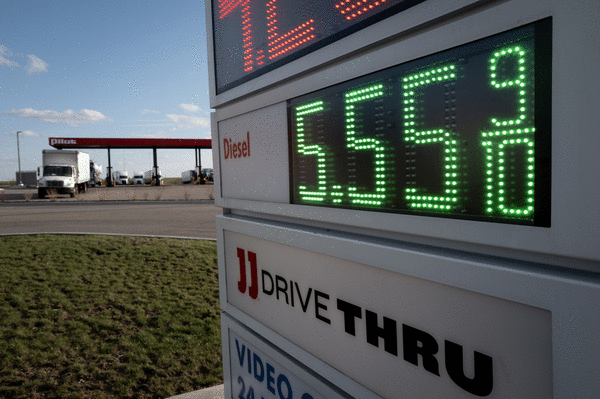
There’s still more political fallout for the GOP courtesy of the Iran war: Even if the conflict ends soon, voters could be grappling with pain at the gas pump deep into midterm election season, as Republicans struggle to defend razor-thin majorities in Congress.
The influence American presidents have on oil markets is often difficult to discern. But in the case of President Donald Trump, the impact of his decision to team up with Israel for ongoing military strikes on Iran has been plain to see. With the war and the resulting closure of the Strait of Hormuz heading into week six, crude oil is trading north of $100 per barrel. Americans, still beset by anxiety over the cost of living, are now paying more than $4 per gallon on average for gasoline, compared to roughly $3 per gallon before Operation Epic Fury started on Feb. 28.
That has erased a lone bright spot on affordability for the Trump administration, one rarely disputed even by Democrats. And when it comes to the cost of a barrel of oil, what is easily done is not easily undone, as Neale Mahoney, director of the Stanford Institute for Economic Policy Research, explained to me. “You have a ‘rockets-and-feathers’ phenomenon at the pump — something we’ve seen time again,” he said.
What does that mean?
When factors like war or other constraints that hamper supply cause oil prices to spike, the per-gallon cost of gasoline rises quickly, “like a rocket.” And when the pressures are removed from the equation, “Gas prices float down slowly, like a feather,” Mahoney said. In other words, even once Middle East oil producers get their facilities up and running at full capacity or the Strait of Hormuz is reopened to normal shipping traffic, “It will take time for prices to settle back to normal in the US,” he added.
But that’s not the only headache related to higher oil prices that Trump — and by extension, Republicans in Congress — are facing as they struggle to hang on to their majorities in the House of Representatives and Senate. The economic pain is spreading, impacting consumers across multiple sectors. Jet fuel costs have surged, driving airfares higher. Prices for diesel fuel and urea, a crude oil byproduct used to fertilize crops, are also climbing, taking some food prices with them.
Plus, extensive media coverage, which tends to occur once the average cost-per-gallon of gas eclipses $3.50, “will only stoke voters’ frustrations, according to Mahoney. “Because people are concerned about gas prices,” he said, “it raises inflation expectations — and the media pays attention to that.”
Case in point: Interest rates, which had dropped, are back on the rise, pushing up borrowing costs.
Based on historical trends and projections for the price of crude oil, Mahoney estimates that average pump prices could rise through June and then possibly relax over the summer — but at a snail’s pace. And even if prices begin to ease, the rate at which oil futures are trading suggest costs are likely to remain elevated. That means consumers could continue to pay more at the pump and face related higher costs for several months, potentially right up until midterm voting begins.
Trump’s political standing has already taken a hit since the Iran war began. His overall job approval rating was 43.5% then; it’s just under 41% now, according to the RealClearPolitics average of recent surveys. Voters rate him worse on his management of the economy, at 37.2%, and they’re even more dissatisfied with his handling of inflation, at 33.2%. Democrats lead the generic ballot, gauging which party voters would prefer control to Congress, by six percentage points.
If that’s not bad enough, Trump and congressional Republicans are in bigger trouble with independent voters, who are crucial to the outcome of midterm elections. Democrats hold a commanding 18-point generic ballot lead over the Republicans among independent voters, according to a fresh poll from CNN.
The president may truly believe that his policies have reduced the cost of living to acceptable levels. As he said in his speech from the White House last week: “We were a dead and crippled country after the [Biden] administration, and [I] made it the hottest country anywhere in the world by far, with no inflation.” But it’s abundantly clear that a majority of voters disagree with him, especially regarding that latter assertion.
Some of Trump’s Republican allies, however, do appear to understand the political minefield that the GOP could be forced to navigate for the next seven months.
“People are pocketbook voters,” Senate Majority Leader John Thune told NOTUS’ Al Weaver. The South Dakota Republican believes that’s likely to be the case with voters who are otherwise “inclined” to support the Iran war “from a national security standpoint.”
That’s the political challenge facing Republicans — and the political opportunity for Democrats — this fall, even if Trump were to have pulled the plug on the Iran war by the time you read this column.
____
This column reflects the personal views of the author and does not necessarily reflect the opinion of the editorial board or Bloomberg LP and its owners.
David M. Drucker is a columnist covering politics and policy. He is also a senior writer for The Dispatch and the author of "In Trump's Shadow: The Battle for 2024 and the Future of the GOP."
©2026 Bloomberg L.P. Visit bloomberg.com/opinion. Distributed by Tribune Content Agency, LLC.

















































Comments