Boeing's 737-derived E-7 Wedgetail caught in Congress-Pentagon spat
Published in Political News
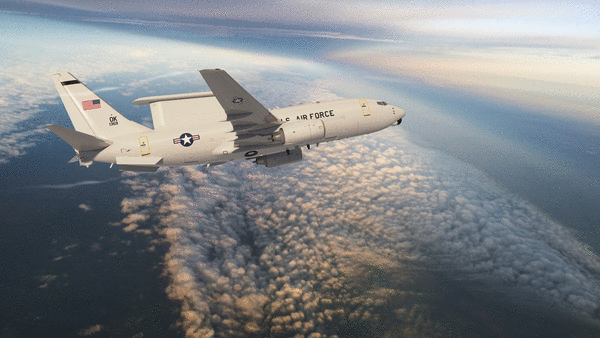
SEATTLE — Boeing’s E-7 Wedgetail is caught in a political tug-of-war.
The twin-engine airborne early warning and control aircraft is built on the Renton, Washington-made 737 NG airframe and then outfitted with radar antenna, sensors and other network connectivity equipment to turn it into a military plane.
As Boeing bills it, the Wedgetail can “scan the skies” and enable integration and communication with equipment on the ground and in the air.
It is already operating with the U.K., Australia, Korea and Turkey, and was set to replace the U.S. Air Force’s aging E-3 Sentry, another Boeing-built product. But in June, Defense Secretary Pete Hegseth canceled the contract for up to 26 Wedgetails, citing program delays and cost overruns. That prompted another cancellation by the U.S.'s European allies this month, leaving the program with few future customers.
Then came Congress.
In the November continuing resolution to reopen the government after a 43-day shutdown, Congress allocated about $400 million to keep the E-7 program going. The U.S. Air Force agreed to pay $2.6 billion for the first two E-7 aircraft in a deal finalized in 2024.
The bill included $200 million for research, development and prototyping activities, and continued roughly another $200 million in funding from the prior year, said Greg Williams, from the Project on Government Oversight, a watchdog group that tracks federal dollars.
That’s not an unusual path for defense programs, four analysts told The Seattle Times. Lawmakers can choose to allocate funds for a program even if the Defense Department says it no longer wants those machines.
It’s also not a guarantee of the future of the E-7. Just like the continuing resolution is a stopgap measure to reopen the government before negotiating a final budget, Congress will reconsider future funding for the E-7 when it attempts to pass a defense budget for 2026.
The E-7 is a low volume program for Boeing, with yearly production discussions in the single digits, versus its 737 MAX, which Boeing is gearing up to produce at a rate of 42 per month. But the U.S. canceling its contract could still impact the company, said the analysts, who split on what to expect for the program’s future.
Wayne Shaw, the director of aerospace and defense for consulting firm Frost & Sullivan, said he understood why Congress would keep the E-7 going, seeing the benefit in replacing the Boeing 707-based E-3 with a newer model. But, he continued, “since the DOD tried to kill it, I can’t see how it will survive.
William Alderman, founding partner of aerospace and defense financial firm Alderman & Co., thought the opposite. The continuing resolution may have only allocated funds for research and development, but to him, the funding vehicle doesn’t matter.
“There’s money to build airplanes, that’s the point,” Alderman said. “In the big picture, does this mean they’re going to make more Wedgetails? Yes.”
Even Steve Parker, the CEO of Boeing’s defense unit, isn’t sure what comes next.
“We’ll see what gets funded and what comes through and we’ll go from there,” he told reporters at the Dubai Airshow in November. “Certainly, we’re ready to go with the first two rapid prototype aircrafts.”
'Sitting ducks in the sky'
Boeing has already completed two E-7 prototypes for the Air Force. Those planes have moved through the entire Renton production line, a spokesperson confirmed, but it's not clear where they are now.
The planes were slated to move to the U.K. to be converted from the commercial airframe to the defense variant.
The U.S. Air Force placed its order for up to 26 E-7 Wedgetails in 2023 and finalized a $2.6 billion agreement with Boeing for the first two aircraft the following year. But Hegseth canceled that contract in June, citing delays and a cost increase of $588 million to $724 million per aircraft, according to defense trade publications.
Hegseth also wanted to switch the Defense Department’s focus from airborne early warning and control to space-based systems.
In other words, the Pentagon was saying the E-3 and soon-to-be E-7s are “sitting ducks in the sky,” said Todd Harrison, a military expert with the American Enterprise Institute, a conservative think tank. “They’re big, nonstealthy aircraft and they’re blasting out radar in all directions.”
The planes are meant to offer target tracking and command-and-control capabilities, to allow military forces to be "first to detect, first to engage," Boeing said in a news release announcing the Air Force's 2024 contract.
Congress seems to agree that the U.S. should move some military systems to space, and has allocated funds to do so, Harrison continued. But it also wants to “hedge its bets” by keeping the E-7 around, in case that new space technology takes a long time to develop.
“I think they’re both right,” Harrison said. “We can do this mission much better, much more effectively in space, and we should make this transition as fast as we can. But I’m not confident that the Space Force can pull it off (quickly.) So I think we may need to buy some E-7s in the interim.”
Boeing has a space division, but it doesn’t appear to be competing for the space-based defense systems that Hegseth envisions, Harrison said.
In Dubai, Boeing’s head of defense Parker said he believes the decision to cut the E-7 program was not about the budget. Hegseth has been “pretty candid” about his concerns with the airborne technology, he continued.
There's "consternation within the U.S. government about airborne versus space systems, Parker said. “Our view, Boeing’s view, is we should need both.”
With NATO's cancellation of the E-7 program this month, Boeing’s future market for the E-7 is even smaller, and its future profitability even more out of reach, said Shaw, from Frost & Sullivan.
“They need the E-7 to be built in volume so it's not as costly,” he said.
Sympathy in Congress
Shaw, who believes Hegseth’s June decision was the final blow to the E-7’s future in the U.S. Air Force, sees a scenario where Boeing has to keep the program on “life support.”
Because other countries already have it in their fleet, Boeing will have to keep up maintenance and spare parts for those planes, Shaw said, even if the E-7 never flies with the U.S. or other NATO countries.
Alderman saw a more optimistic future. He believes Hegseth’s cancellation was a warning message — “You really messed up this program, Boeing,” — while the $400 million in the continuing resolution is an “olive branch.”
“All it's doing is saying to Boeing, ‘You have a chance of salvaging yourself, you better show us the road to success,’ ” Alderman said.
Harrison didn’t believe the Defense Department meant to “punish Boeing.” It just had to make a budget call in his view. But Congress’ decision to fund the program in a relatively sparse, 31-page bill to hurriedly reopen the government does indicate something.
“The fact that Boeing got this inserted into that … continuing resolution is pretty impressive,” he said. “I think it’s an indicator that Boeing has got a lot of sympathetic ears in Congress on this issue.”
©2025 The Seattle Times. Visit seattletimes.com. Distributed by Tribune Content Agency, LLC.























































Comments