Trump's crosshairs on Somali immigrants stoke fear, anger among those in Twin Cities community
Published in Political News
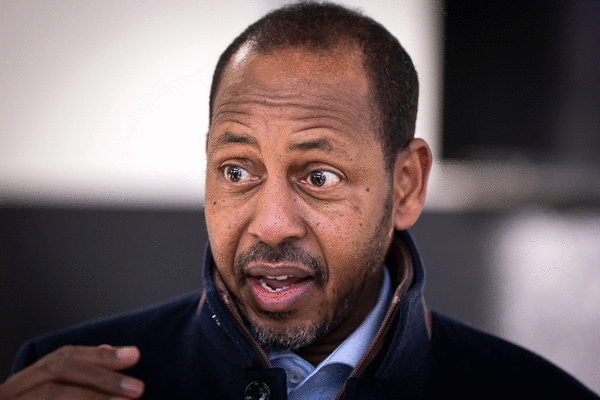
Reports that President Trump’s federal immigration authorities will ramp up enforcement in Minnesota with a focus on Somali immigrants has stirred widespread fear in the Twin Cities’ large community and raised concerns that political rhetoric may soon translate into sweeping action.
Inside Karmel Mall, the commercial and cultural center of Minneapolis’ Somali diaspora, the shift was unmistakable Tuesday. Foot traffic slowed. Shoppers cut their visits short. Conversations revolved around where ICE had been seen that morning or afternoon. The familiar weekday bustle felt eclipsed by caution.
“He’s destroying the fabric of this nation, not the Somali community,” said Rashid Mohamud, 48, who studied political science in Somalia and earned an MBA in Wales before immigrating to the United States to work as an accountant. “The Somali community is his scapegoat.”
He said the president’s framing distorts both Somali Americans and the country itself.
“America was built on multi-ethnicity, tolerance. The Founding Fathers and those after them were thinking logically and systematically, trying to maintain the rule of law.”
The president has also intensified his verbal attacks, describing Somali immigrants as “garbage,” claiming they “contribute nothing,” and suggesting they should be “sent back.” His comments, made during a cabinet meeting as ICE activity reportedly increases across Minneapolis and St. Paul, also targeted Rep. Ilhan Omar, a U.S. citizen born in Somalia.
The escalation comes on the heels of another significant move by the administration: ending Temporary Protected Status for Somali nationals, a change that strips humanitarian protections from hundreds of people who have lived legally in the United States for years. Many Somali Minnesotans say the TPS decision, coupled with stepped-up enforcement, signals that the president’s rhetoric is already shaping federal policy.
The timing dovetails with ongoing prosecutions in the $250 million Feeding Our Future scandal, in which nearly 80 people have been charged. Most defendants are Somali Minnesotans. Community leaders condemned the fraud early, stressing that a small group of conniving individuals carried it out. But many residents say the president is using the case to justify broad enforcement that casts suspicion over tens of thousands of lawful Somali residents, U.S. citizens, and mixed-status families.
At Zahra Café down the hall in Karmel Mall, owner Khadijo Warsame, 53, said her business slowed sharply after the president’s remarks. Several regulars told her they were afraid to be out in public while enforcement expands. Warsame, a single mother of three U.S.-born children who has lived in the United States for 27 years, said she supports prosecuting those who committed fraud but rejects being collectively targeted.
“We have good people,” she said. “It’s hard workers like me.”
She added that Somali Minnesotans contribute economically and pay taxes.
Warsame said many Somali immigrants cannot safely return to the country they fled.
“They don’t have places to go back to,” she said. “It’s a safety issue, economic issue. If you go to America and you go back (to) Somalia, you’re not safe.”
Extremist groups threaten people who return from the West, she said, because they view Western education and opportunity as subversive. She urged elected officials to intervene.
“I’m asking for him to change his mind about our community,” she said. “I ask the United States, Congress, government team, all of them: Do something for our immigrant Somalis, please, because they don’t have a place to go back.”
Sitting at a table near the entrance, Azizi Abdi, 49, a truck driver who immigrated as a teenager, said the Feeding Our Future scheme had already inflicted damage on the Somali community long before Trump invoked it.
“The people who are taking advantage have absolutely destroyed our community,” he said. “These few people took advantage of the system, yeah, and we all get blamed for it.”
He said most reporting has ignored Somali victims.
“They talk about the Somalis who did something,” he said, “but not the 90% who were denied services, grandmothers, vulnerable people.”
Abdi said he fears stepped-up ICE operations could sweep up lawful residents alongside undocumented immigrants.
“Anybody who doesn’t know that is gonna be a stupid guy,” he said. “He doesn’t care who’s (an) immigrant or not (an) immigrant. He just wants to get the numbers.”
Abdi said he has always believed in the rule of law.
“I absolutely love the law of this country. But there are some people who took advantage with a paper and pen.”
Across Karmel Mall, many people described recalibrating daily routines in response to reported ICE activity. Several feared lawful permanent residents and U.S. citizens could face mistaken scrutiny.
Warsame said the uncertainty now shadows daily life.
“I’m not scared of America,” she said. “But it’s uncomfortable for our dignity.”
She looked toward the subdued hallway outside her café.
“We’re great people, good people,” she said. “But now we are scared.”
_____
©2025 The Minnesota Star Tribune. Visit startribune.com. Distributed by Tribune Content Agency, LLC














Comments