Nvidia wins Trump's approval to sell H200 AI chips in China
Published in Political News
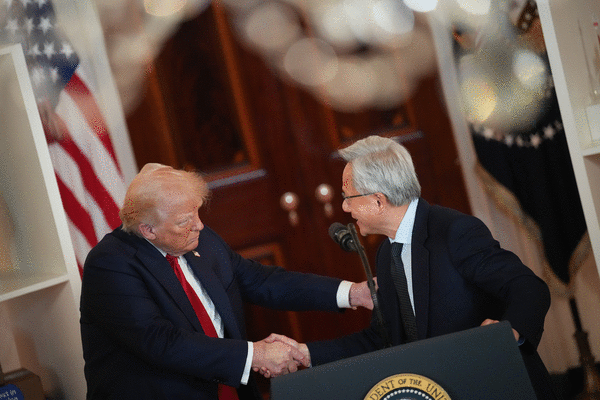
President Donald Trump granted Nvidia Corp. permission to ship its H200 artificial intelligence chip to China in exchange for a 25% surcharge, a move that lets the world’s most valuable company potentially regain billions of dollars in lost business from a key global market.
The decision was announced by Trump in a post on his Truth Social network, capping weeks of deliberations with advisers about whether to allow H200 exports to China. Trump said he informed Chinese President Xi Jinping about the move and that Xi had responded favorably. He added that shipments would only go to “approved customers,” and that chipmakers such as Intel Corp. and Advanced Micro Devices Inc. would also be eligible.
The move represents a victory for Nvidia in its push to get Trump and Congress to relax export controls that have kept the company from selling its AI chips to the world’s largest semiconductor arena. Chief Executive Officer Jensen Huang has forged a close relationship with Trump since the November 2024 election and has used those ties to make his case that restrictions only boost Chinese domestic champions like Huawei Technologies Co.
Trump’s decision provoked an immediate backlash from Democratic senators including Elizabeth Warren, who warned of a “colossal economic and national security failure” in providing Beijing the tools it needs to develop next-generation AI. The H200 is on paper at least a generation ahead of anything offered by Chinese designers from Huawei to Cambricon Technologies Corp. and Moore Threads Technology Co. The country at present also requires more chips than local firms can supply. Still, Beijing — in its quest to wean the nation off American technology — has in the past strongly discouraged Nvidia adoption particularly among state-affiliated corporations and agencies.
“We will protect National Security, create American Jobs, and keep America’s lead in AI,” Trump said in his post. “NVIDIA’s U.S. Customers are already moving forward with their incredible, highly advanced Blackwell chips, and soon, Rubin, neither of which are part of this deal,” referring to more advanced lines of Nvidia chips. Bloomberg reported last month that the administration was considering the H200 approvals.
Permission for H200 exports is seen as a compromise from Nvidia’s earlier push to sell its more advanced Blackwell-design chips to Chinese customers, a person familiar with the matter said prior to the announcement. Huang had met privately with Trump in Washington last week to discuss export controls, though neither the White House nor the company shared details on their conversation.
Payment to the American government would come as a 25% tariff when the chips are shipped from manufacturing sites in Taiwan to the U.S. for inspection by the Commerce Department’s Bureau of Industry and Security as part of a security review, according to a Commerce Department official. The chips would then be shipped to customers in China.
Nvidia hailed the decision, saying it will “help to support high-paying jobs and manufacturing in America. Offering H200 to approved commercial customers, vetted by the Department of Commerce, strikes a thoughtful balance that is great for America.”
Spokespeople for Intel, AMD and Commerce had no immediate comment. Chinese commerce ministry representatives didn’t immediately respond to a request for comment.
Nvidia and AMD shares both gained about 2% in late trading after Trump’s announcement. Intel, which isn’t expected to benefit from the changes in the near term, rose less than 1%.
Easing restrictions on the H200 and similar-grade chips risks giving an edge to Chinese companies like DeepSeek that compete with the U.S. in artificial intelligence, said Chris McGuire, a senior fellow for China and emerging technologies at the Council on Foreign Relations.
“This is very bad for the export of the full AI stack across the world. It actually undermines it,” said McGuire, who served in the White House National Security Council under President Joe Biden. “At a time when the Chinese are squeezing us as hard as they can over everything, why are we conceding?”
After meeting with Trump on Wednesday, Huang had expressed uncertainty about whether China would accept Nvidia’s H200 chips should the U.S. relax restrictions on sales of the processors.
“We don’t know. We have no clue,” Huang said, as he headed into a closed-door meeting with members of the Senate Banking Committee, which has jurisdiction over export controls. “We can’t degrade chips that we sell to China — they won’t accept that.”
In August, Nvidia won approval to sell its H20 chip to China while AMD was cleared for its MI308 processor — each designed to fall just below export restrictions. Under that arrangement, touted by Trump, the companies would have paid 15% of their China sales to the U.S. government. The payments failed to materialize because regulations were never enacted that would make them legal.
The H20 and H200 come from the same generation of Hopper processors, an aging lineup. Nvidia sells the more-advanced Blackwell generation in the U.S. and is preparing to shift to an even speedier family of chips called Rubin.
Still, the H200 represents a significant step up from the H20. According to Georgetown University’s Center for Security and Emerging Technology, the H200’s total processing performance is nearly 10 times the limit previously allowed for export to China.
Earlier exports to China of the H20 chips were ultimately stymied by authorities in Beijing, who told potential domestic customers to shun the American products and rely instead on processors made by Chinese companies. That effectively blocked Nvidia and AMD from China, the world’s biggest semiconductor market.
Trump floated in October, ahead of his summit with Xi, the possibility of offering a scaled-down version of Nvidia’s Blackwell architecture chip to China. That idea failed to come up in his meeting in South Korea with the Chinese leader. Members of Trump’s cabinet, including U.S. Trade Representative Jamieson Greer and Treasury Secretary Scott Bessent, subsequently said they were averse to selling a version of the Blackwell to China at the present moment.
Last month, Huang said that China represented a $50 billion market for his company, though for now Nvidia has excluded data center revenue from the Asian nation from its financial forecasts. “We would love the opportunity to be able to reengage the Chinese market,” he said in a Bloomberg Television interview.
Nvidia scored a related lobbying win in Congress last week, when lawmakers kept a provision out of must-pass defense legislation that would have limited the company’s ability to sell its advanced AI chips to China and other adversary nations. The so-called GAIN AI Act would have required chipmakers, including Nvidia and AMD, to give American customers first dibs on their powerful AI chips before selling in China and other arms-embargoed countries.
Easing the export restrictions marks a significant shift from policies imposed starting in 2022 to keep Beijing and its military from accessing the most powerful U.S. technologies. Such a move risks provoking sharp opposition from national-security hawks in Washington who have favored export controls as a way to keep adversaries like China from gaining ground in the AI race.
The H200, which began shipping to customers last year, is designed to both train and run AI models. The prospect of selling a higher-caliber processor to China bolstered arguments by lawmakers from both parties who have pressed unsuccessfully for the GAIN AI Act’s adoption.
Lawmakers are already working on another bipartisan measure known as the SAFE Act that would codify existing U.S. restrictions on exports of advanced semiconductors to the Chinese market.
(With assistance from Mackenzie Hawkins, Josh Wingrove, Skylar Woodhouse, Edwin Chan and Lucille Liu.)
©2025 Bloomberg L.P. Visit bloomberg.com. Distributed by Tribune Content Agency, LLC.
















































Comments