Supreme Court mixed on striking down party coordination rule
Published in Political News
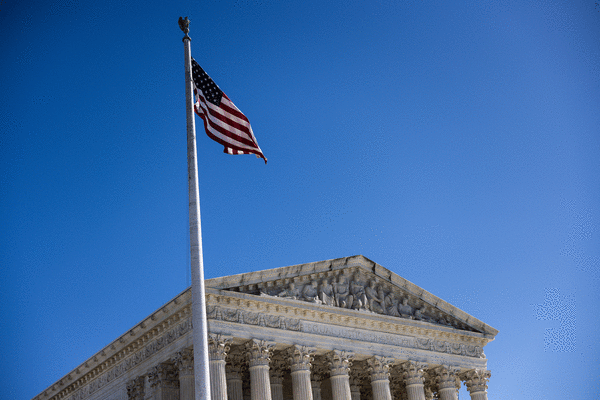
WASHINGTON — The Supreme Court gave a mixed reception during oral arguments Tuesday to an effort to overturn a limit on how much political parties can spend in coordination with federal candidates.
The National Republican Senatorial Committee, as well as Vice President JD Vance from when he was a senator, and former Rep. Steve Chabot, R-Ohio, brought the challenge to argue that the limit on party spending violated the Constitution.
Several of the court’s majority of Republican appointees questioned whether the rule violated the free-speech rights of parties and distorted American politics, but they also expressed some concerns about the future of campaign finance restrictions.
Chief Justice John G. Roberts Jr. questioned whether there was any difference between removing the coordination limit and allowing unlimited donations between candidates and committees.
“It seems to me that’s kind of a fiction, that, ‘Oh you know they’re just coordinating expenditures, they’re not making direct contributions,’” Roberts said. “I don’t know in substance what the difference is.”
The video player is currently playing an ad.
Noel Francisco, the attorney for the Republican challengers, responded that the difference is that party committees must attach their name to advertisements or other actions that support a political candidate.
Justice Brett M. Kavanaugh, one of the most active participants in Tuesday’s arguments, questioned both sides on the effect of the Supreme Court’s decisions around campaign finance restrictions.
“I am concerned, as you said, that the combination of campaign finance laws and this court’s decisions over the years have together reduced the power of political parties as compared to outside groups, with negative effects on our constitutional democracy,” Kavanaugh said.
At the same time Kavanaugh also noted that several outside groups have called other existing restrictions “toothless” to prevent the appearance of quid pro quo corruption. He also said the NRSC and other challengers could soon challenge some of the remaining campaign finance restrictions, such as prohibitions on earmarking party donations to candidates.
“So, to cite that as a prophylaxis, I’m not sure, five years from now, three years from now, you know, how that will look,” Kavanaugh said to Francisco.
Francisco responded that the existing campaign finance limits, including laws against bribery, could alleviate any concerns caused by removing the coordinated spending limit. Francisco also said he would not commit that his clients wouldn’t challenge other limitations.
The Trump administration, as well as the Republican challengers, argued the limit violated free-speech rights and allowed outside political groups an outsize role in American politics. Francisco argued that the Supreme Court’s recent decisions, including those invalidating other campaign finance limits, mean this one should fall too.
“The coordinated party spending limits are at war with this court’s recent First Amendment cases,” Francisco said.
Sarah M. Harris, arguing for the Trump administration, said the limits hurt the ability of parties to back candidates of their choice. “Limits on party expenditures unconstitutionally restrict core election speech,” Harris said.
Roman Martinez, an attorney appointed by the Supreme Court to defend a lower court decision that upheld the party spending restriction, said the same logic advanced by the challengers would also apply to individual donation limits to political parties and candidates in a future challenge.
“The reality is, they’re going to be coming back here asking you to overturn that, and that the logic that they’re asking you to embrace here is going to mean that that provision falls too,” Martinez said.
Martinez also argued the Supreme Court should not decide the issue at this time, since there is no way the limit would be enforced in the Trump administration. Martinez pointed out that the current administration will not likely bring a case against Vance.
“No one thinks President Trump is going to enforce this law and target his own vice president,” Martinez said.
Marc E. Elias, arguing on behalf of the Democratic National Committee, Democratic Senatorial Campaign Committee and Democratic Congressional Campaign Committee, said that abolishing the coordination limit would actually undermine the power of national and state parties.
Elias said that without the limit there would be increased pressure for parties to spend money on candidates in every close election, rather than broader party-building efforts.
“The practical effect of petitioners case would be to convert the political parties into mere paymasters to settle invoices from campaign vendors,” Elias said.
Justice Sonia Sotomayor said the current case builds on one from more than a decade ago, known as McCutcheon v. FEC, where the court’s conservative majority overturned aggregate donation limits to political committees. At one point, Sotomayor said that “every time we interfere with the congressional design, we make matters worse.”
“Our tinkering causes more harm than it does good,” Sotomayor said.
Sotomayor said that since the decision in McCutcheon, presidential campaigns have already set up joint fundraising committees allowing a single donor to give one check totaling hundreds of thousands of dollars in support of a presidential candidate — several orders of magnitude larger than the $3,500 limit in personal donations for an election.
“Once we take off coordinated expenditure limits, then what’s left? What’s left is nothing. No control whatsoever,” Sotomayor said.
The justices will likely issue a decision in the case by the conclusion of the term at the end of June.
The coordinated party expenditure limits challenged in the case started when Congress passed the Federal Election Campaign Act and amended it in 1974. Congress changed the law in 2014, increasing the amounts that could be spent, and allowing new expenditures like for nominating conventions, party headquarters and election court challenges.
The Federal Election Commission sets those limits each year depending on the state and the office of the candidate. The FEC caps the limit for most House races at $63,600, but in states with only one representative, committees can spend up to $127,200, according to the FEC. Senate race caps vary by state, from as low as $127,000 in Alaska up to $3.9 million in California.
The case is the National Republican Senatorial Committee, et al. v. Federal Election Commission, et al.
_____
©2025 CQ-Roll Call, Inc. Visit at rollcall.com. Distributed by Tribune Content Agency, LLC.



























Comments