With executive order, Trump moves to undo state AI laws
Published in Political News
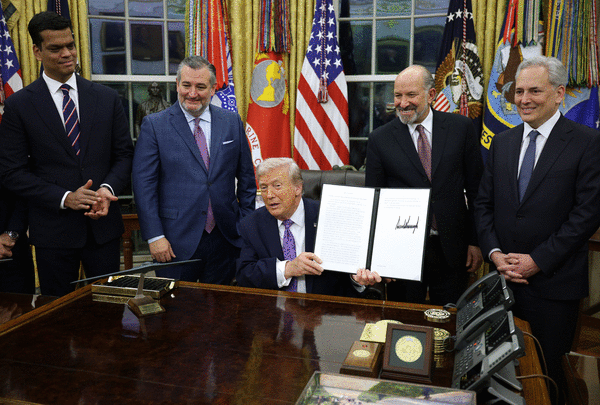
President Donald Trump signed an executive order Thursday evening that seeks to challenge state laws on artificial intelligence and withhold certain grant funds for states with AI laws the administration dislikes.
The effort could be a significant victory for major technology companies but is almost certain to be challenged in court.
“We must be unified,” Trump said at the signing, lauding the federal government as the single decision-maker on AI.
White House staff secretary Will Scharf described the order as “in keeping” with Trump’s commitment to the economy and “technological and military superiority.”
“This is an executive order that orders aspects of your administration to take decisive action to ensure that AI can operate within a single national framework in this country, as opposed to being subject to state level regulation that could potentially cripple the industry,” Scharf said.
David O. Sacks, the president’s special adviser for AI and crypto, has been “one of the key players and key authors behind this EO,” Scharf said, adding, that a national standard will allow the U.S. to “reap the benefits” of AI in terms of “economic growth, job development, national security and technological edge.”
Trump said AI could be “destroyed” by a patchwork of state laws in his Truth Social post previewing the order earlier this week.
“You can’t expect a company to get 50 Approvals every time they want to do something. THAT WILL NEVER WORK!” he wrote.
The AI industry has long pushed for a moratorium, also citing the difficulty of complying with different states’ laws.
Patrick Hedger, director of policy for industry group NetChoice, said in a statement that the group “applauds President Trump for ensuring America can lead the world in AI innovation with this executive order.”
“The federal government is the appropriate regulator to govern interstate commerce like AI tools, and we look forward to working with the White House and Congress to set nationwide standards and a clear rulebook for innovators,” Hedger said.
Legal task force
The order does not seek to impose a ban on state AI regulations, but instead establishes a Justice Department task force to challenge state laws, including on interstate commerce grounds, and withhold funding under the federal rural broadband grant program, based on states’ AI policies.
The order also does not establish a national framework on AI, as many lawmakers have called for as a condition on preempting state regulations.
However, it directs the Federal Communications Commission, in coordination with Sacks, to start proceedings to decide whether to adopt a reporting and disclosure standard for AI. It also directs the Federal Trade Commission, also in coordination with Sacks, to issue a policy statement to explain when the FTC’s prohibition on deceptive acts or practices affecting commerce preempts state AI laws that “require alterations to the truthful outputs of AI models.”
Finally, it directs Sacks and Michael Kratsios, the White House science and technology adviser, to prepare a legislative recommendation establishing a national framework for AI. The order specifies that the recommendation will not propose to preempt “otherwise lawful” state AI laws related to child safety, data center infrastructure other than “generally applicable permitting reforms,” and state government procurement and use of AI.
Congressional debate
The executive order comes after an effort to include a pause on state artificial intelligence laws didn’t make it into the compromise defense policy bill the House passed this week, despite a late push from the White House and Republican leadership.
Senate Commerce Chairman Ted Cruz, R-Texas, a leading advocate for a moratorium on state AI laws, on Tuesday posted on X to state his support for the president’s executive order plans, saying that those who disagreed “would cede ground to China.”
House Majority Leader Steve Scalise, R-La., also offered his support for the order on Wednesday and left the door open for Congress to “codify some of the things the President is trying to do.”
Democrats have generally opposed barring state AI laws.
Sen. Edward J. Markey, D-Mass., said in a statement Wednesday that Trump’s order would be “irresponsible” and “short-sighted,” calling it “an early Christmas present for his CEO billionaire buddies.”
At a Senate Judiciary subcommittee hearing Wednesday focused on music royalties, Sen. Adam B. Schiff, D-Calif., said that the federal government must not preempt the “important work” happening in states, including to protect copyright and the creators whose livelihoods depend on it.
“While the Congress and the federal government should certainly take the lead and craft the rules of the road for this revolutionary technology, in the absence of federal leadership, the states can and must exercise the power they have to protect their residents,” Schiff said.
Brad Carson, who heads Americans for Responsible Innovation, said in a statement said the order “directly attacks” state laws that have “vocal public support.”
“This EO is going to hit a brick wall in the courts,” Carson said. “The executive order relies on a flimsy and overly broad interpretation of the Constitution’s Interstate Commerce Clause cooked up by venture capitalists over the last six months.”
Experts have also questioned the federal government’s standing to sue states based on their AI laws.
____
(John T. Bennett, Jacob Fulton and Nina Heller contributed to this report.)
©2025 CQ-Roll Call, Inc., All Rights Reserved. Visit cqrollcall.com. Distributed by Tribune Content Agency, LLC.




























Comments