Supreme Court to hear oral arguments on transgender athlete bans
Published in Political News
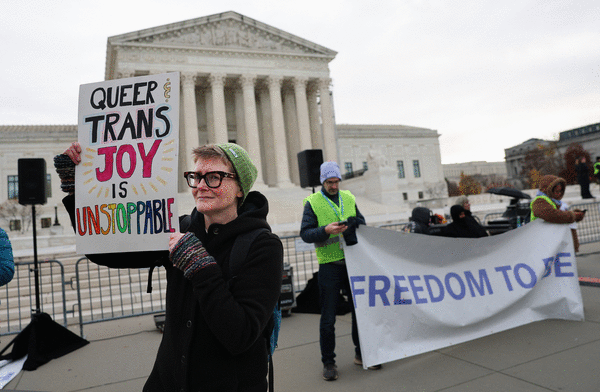
WASHINGTON — The Supreme Court is set to hear oral arguments Tuesday over the legality of state bans on transgender athletes participating in women and girls’ sports, in a pair of cases that could shape the legal landscape nationwide for similar bans and other transgender issues.
Two athletes challenged state laws in Idaho and West Virginia that ban transgender girls from participating in sports that match their gender identity. Lower courts ruled against the bans, and both the states and the Trump administration have asked the justices to allow the laws to stand.
The justices will weigh whether the state bans violate Title IX of the Civil Rights Act, which states no one should be discriminated against in education programs “on the basis of sex,” as well as whether the bans violate the Equal Protection clause of the 14th Amendment to the Constitution.
Specifically, the cases tee up the issue of whether sex discrimination includes gender identity, which experts say could have far-reaching implications beyond the more than two dozen states and territories that have such bans on the books.
Elana Redfield, the federal policy director at the Williams Institute at UCLA School of Law, said a Supreme Court decision about the meaning of the word “sex” also could affect efforts from states and the Trump administration to change federal passport policies, restrict bathroom access and more.
Redfield said that in recent years the current 6-3 conservative controlled court has ruled against transgender rights, and she is “maintaining quite a bit of realism about whether this is going to be in favor of transgender people.”
“Ultimately the court has indicated that they are leaning toward this biological sex interpretation of the meaning of the word ‘sex’ and not super inclined to rule in favor of transgender people,” Redfield said.
The brief for the West Virginia student, B.P.J., said that excluding her from sports violates Title IX because of her gender identity necessarily means “treating a student differently because they are transgender inherently entails differential treatment of a ‘person’ ‘on the basis of sex.’” A middle schooler, B.P.J. has received gender-affirming care to experience female puberty and wants to participate in non-contact track and field events.
The Idaho student had asked the justices not to consider her case, saying she had withdrawn from any attempts to play women’s sports and intended to drop the suit. The Idaho case includes only the constitutional issue, while the West Virginia case covers both the constitutional and civil rights law issues.
Josh Block, senior counsel at the ACLU’s LGBTQ+ & HIV Project and attorney for B.P.J., told reporters Thursday that the discrimination against his client was similar to discrimination in hiring that the Supreme Court has already said violates federal law.
At the same time, he noted prior decisions by the court let stand a state law that banned gender-affirming care for minors and allowed the Trump administration to implement a transgender military service ban and changes to passports for transgender people.
“Any objective person can look at that and say that’s not a very good sign,” Block said.
Backing bans
The states have defended their laws in briefs, arguing that Congress intended to allow divisions in sports based on sex assigned at birth. In its brief, West Virginia argued that its state law furthered the goal of federal civil rights law, which includes increasing participation in female sports.
Further, the state argued that Congress didn’t mean to include gender identity when it passed a law prohibiting discrimination “on the basis of sex.”
“Title IX’s text forbids sex discrimination—not sex distinctions,” the brief said, arguing that allowing transgender girls to participate in girls’ sports would undermine the distinction between boys’ and girls’ sports.
The Trump administration weighed in as well and will participate in support of the state bans. The administration argued in its court filings that siding with the lower court would undermine the administration’s efforts to ban transgender athletes from girls’ and women’s sports.
“Both Title IX and the Equal Protection Clause permit the traditional practice of sex-separated sports, which accounts for innate biological differences that make the two sexes not similarly situated for athletic competition,” the Trump administration argued.
About two dozen states have laws limiting the ability of transgender women to participate in women’s sports, while the Trump administration and congressional Republicans have sought to use federal funding to curtail policies that allow it.
Donald Trump campaigned on restricting participation of transgender girls in sports of their identified gender. Since taking office, Trump has sought to restrict transgender participation in scholastic sports, including both through executive orders and Department of Education enforcement efforts.
The NCAA and several higher education systems have reached agreements with the Trump administration to enforce the executive order. The administration has pursued numerous states that refused to ban transgender girls from girls’ sports, including by suing California over the issue.
The Republican-controlled House weighed in as well, arguing in a brief filed in the West Virginia case that siding with the transgender athletes could also block similar efforts at the national level. Siding with the athletes “could handicap Congress from legislating in the future to protect women’s and girls’ sports.”
That brief, along with others filed by congressional Republicans, argued that Congress never meant for the definition of “sex” in Title IX to cover gender identity.“
Quite simply, it strains credulity to think that when Congress and the Executive Branch acted in the 1970s to preserve certain single-sex activities and institutions in Title IX and its implementing regulations, they intended to mandate the consideration of gender identity rather than just permit the continued division of students by biological sex,” the brief said.
The House passed a bill last year that would prohibit the department from providing funds to programs that allow or support the participation of transgender women or girls in women’s or girls’ sports. A similar measure in the Senate did not clear a procedural hurdle last year on a 51-45 vote, falling short of the 60 votes needed to advance.
The basis of sex
Over the last five years the Supreme Court has taken multiple cases on gender identity and gender discrimination.
In a case in 2020 known as Bostock v. Clayton County, the Supreme Court held that firing an employee based on their sexual orientation or gender identity “necessarily and intentionally discriminates against that individual in part because of sex,” citing similar language in Title VII of the Civil Rights Act.
Last term, the justices ruled in favor of a Tennessee law banning gender-affirming medical care for minors wishing to transition. The majority stated that the ban differentiated on medical diagnoses, not sex.
Chief Justice John G. Roberts Jr. wrote in that case that there are “fierce scientific and policy debates” about gender-affirming care that would likely be best left to elected branches of government to decide.
In November, the justices allowed the Trump administration to continue a policy blocking passport applicants from changing the sex on their passport or having an “X” instead of a gender marker. In an unsigned order, the court’s majority wrote that the policy did not violate the Constitution.
Chris Erchull, a senior staff attorney at GLAD Law, said how the justices decide the case, such as whether they decide the case based on federal law or reach deeper to the Constitution, could affect other discrimination protections.
A ruling that treated transgender Americans differently in “sex-separated” contexts like sports could impact access to bathrooms and other spaces outside of education, Erchull said. Deciding the definition of “sex,” as the states have asked, could ripple through anti-discrimination law more broadly.
“We hope other people are watching carefully too because it could have very broad implications of how the court will handle discrimination on the basis of sex,” Erchull said.
The cases are Bradley Little, in his official capacity as Governor of the State of Idaho, et al. v. Lindsay Hecox, et al. and West Virginia, et al. v. B.P.J.
©2026 CQ-Roll Call, Inc., All Rights Reserved. Visit cqrollcall.com. Distributed by Tribune Content Agency, LLC.















































Comments