Supreme Court sounds ready to rule against Hawaii gun law
Published in Political News
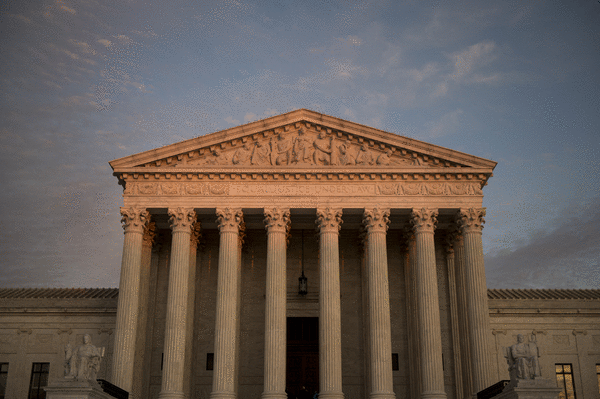
WASHINGTON — The Supreme Court appeared ready during oral arguments Tuesday to rule against a Hawaii law that bars gun possession on private property without the property owner’s consent, as most justices expressed concern the law violated the Second Amendment.
The state passed the law in the wake of a 2022 decision by the Supreme Court in New York State Rifle & Pistol Association Inc. v. Bruen, which expanded the right to possess guns outside the home. Gun owners in Hawaii challenged the state law, with backing from the Trump administration.
Most members of the court’s conservative majority expressed skepticism about the law. Chief Justice John G. Roberts Jr. said Hawaii’s law treated the Second Amendment as a “disfavored right” and compared it to a state law that prohibited solicitation on private property.
“One of the motivating concerns, and you could see it in our decisions under the Second Amendment, is that it was treated as a disfavored right,” Roberts said.
The Bruen decision established a new “history and tradition” test for gun control laws, requiring historical examples to uphold a law. The U.S. Court of Appeals for the 9th Circuit upheld Hawaii’s law, citing a colonial-era law from New Jersey and an 1865 law from Louisiana banning gun possession on private property without consent of the owners.
But Justice Brett M. Kavanaugh said there was a lack of historical laws supporting the Hawaii rule.
“Why are we making it complicated?” Kavanaugh said during an exchange with Trump administration attorney Sarah M. Harris. “Here there is no sufficient history supporting the regulation, end of case.”
Justices Neil M. Gorsuch and Samel A. Alito Jr. objected to Hawaii relying on the 1865 law, part of the “Black Codes” meant to disenfranchise newly freed former slaves. Alito called it the “height of irony” to cite a law meant to disarm freed slaves and make them vulnerable to the Ku Klux Klan in support of the modern Hawaii law.
Alan A. Beck, arguing on behalf of the challengers, said the law was meant to infringe on the rights of gun owners and closed off more than 90% of publicly available lands in Hawaii from gun owners, when combined with other aspects of state law.
“There was a clear body of evidence here that this was done to undermine Bruen and undermine the Second Amendment right,” Beck said.
Neal Katyal, arguing on behalf of Hawaii, said that states going back to the founding have flipped the “default rule” of consent for property owners. “No one has ever said you have a right to the implied consent of a private property owner,” Katyal said.
The court’s democratic appointees tried to compare the law to state regulation of property owners’ consent and trespassing law. Justice Ketanji Brown Jackson pointed out that property owners nationwide can always object to someone entering their property with a gun, and Hawaii law flipped the presumption to require affirmative consent.
“What I’m suggesting is that the Second Amendment right is not being implicated when the property owner’s right is implicated,” Jackson said during an exchange with Harris.
Harris said that framing the law as addressing property rights did not allow the state to avoid the fact that its law impacted the gun rights of law-abiding Americans.
“When states are trying to redefine property concepts, that doesn’t get them out of constitutional scrutiny,” Harris said.
The justices will likely issue a decision in the case by the conclusion of the term at the end of June.
The case is Jason Wolford, et al. v. Anne E. Lopez, attorney general of Hawaii.
©2026 CQ-Roll Call, Inc., All Rights Reserved. Visit cqrollcall.com. Distributed by Tribune Content Agency, LLC.


















































Comments